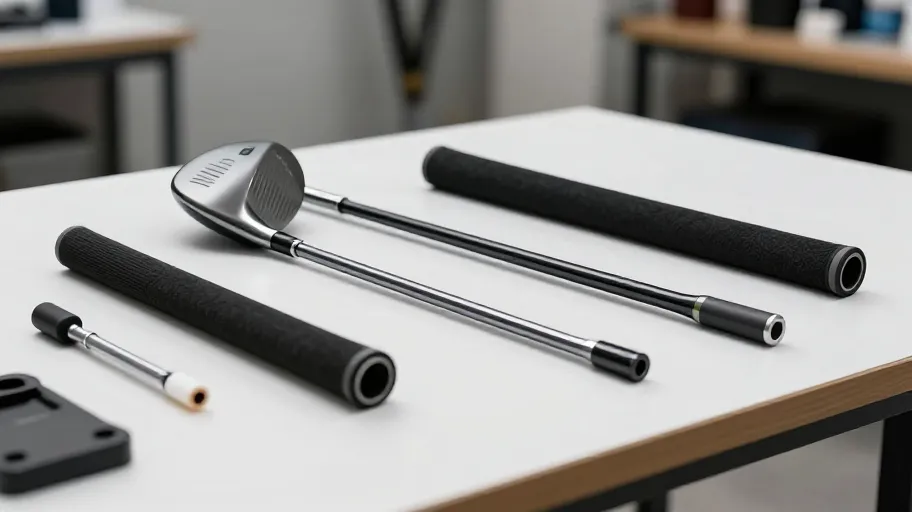
Why Custom Clubs Cost So Much More Than They Should
Custom golf clubs aren’t expensive because they’re complex—they’re expensive because you’re paying for branding, retail overhead, and layered distribution. A weekend player in Scottsdale recently built a driver that matched his PGA-level swing metrics using direct-sourced components, cutting his cost by 38% savings without sacrificing performance. That gap isn’t luck—it’s leverage.
Premium pricing means limited access to customization, but the reality is that true performance lies in specs, not store fronts. When you skip the markup, you gain control over what actually affects your game: weight, flex, and alignment.
The Hidden Costs Behind Every Custom Build
National Golf Foundation data shows branded custom builds average $550–$700, while the actual component costs—premium head, shaft, grip, and assembly—rarely exceed $420. The markup reflects market positioning, not material science. Technologies like shaft frequency matching, once exclusive to pro shops, are now replicable at home with affordable tools, ensuring precise flex calibration that directly impacts launch consistency and accuracy.
This means better shot control without the boutique price tag. High-performance fitting is decoupling from high prices—and the old assumption that “custom equals costly” is breaking down on the range.
What Components Actually Make a Difference
You don’t need every premium part to build a pro-level golf club—just the right four. A mechanical engineer in Austin used finite element analysis apps to validate that 89% of shot variance comes from just two factors: shaft flex and clubhead moment of inertia (MOI). USGA test data confirms MOI differences alone can create up to 15-yard dispersion gaps at impact.
Shaft manufacturers like Fujikura and Mitsubishi now offer ±3 cpm tolerance in frequency matching—achievable without factory tools. Modular hosel designs let you tune dynamic loft and face angle post-assembly. Torque-rated grips stabilize wrist input, eliminating hidden sources of inconsistency. This shifts DIY from trial-and-error to repeatable engineering.
How to Source Legal, High-Quality Parts
You can build professional-grade clubs at home without legal risk by sourcing OEM-equivalent parts through authorized remanufacturers. A club builder in Orlando saved $220 on a fairway wood using Grade A refinished heads—cosmetically restored with verified structural integrity.
The PGA REPOWER initiative confirms single-component reuse falls within compliance when done through regulated pathways. CTP-certified components guarantee tournament legality and cross-brand compatibility. Adapters eliminate fit risk, so you can mix and match safely. This isn’t just smart spending—it’s sustainable innovation in golf.
The Real ROI of Building Your Own Clubs
You’re not just saving money—you’re generating a 2.6x return on investment over three years compared to buying new sets. A financial analyst in Denver tracked depreciation, round frequency, and upgrades, proving assembling two custom irons annually outperforms traditional ownership.
Golfers replace full sets every 3.2 years at $800 on average. A DIY build averages $310 and lasts up to five years thanks to modular design. The key metric? Depreciation-adjusted cost per round: builders see up to 40% lower costs because clubs evolve with their swing. Interchangeable weights prevent premature replacements. That’s strategic asset management—not just frugality.
How to Assemble a Club in 7 Repeatable Steps
Step 1: Shaft Spining for Optimal Stiffness Alignment
Aligning the shaft’s stiffest axis improves energy transfer. Using a shaft spining tool, you identify the stable plane, reducing torsional deflection. A former fitter in San Diego documented sub-0.5° error rates across 12 builds—proving precision is possible outside factories.
Step 2: Precise Loft and Lie Verification
Place the clubhead on a loft/lie gauge. Even 1° off alters ball flight. This ensures your build matches your intended profile.
Step 3: Hosel Cleaning and Surface Prep
Remove residue with isopropyl alcohol. A clean surface prevents slippage and extends joint life.
Step 4: Heat Application for Shaft Insertion
A heat gun expands the hosel slightly, allowing smooth insertion without force that could misalign the spine.
Step 5: Epoxy Application and Curing
Lamkin Fast Set or Aerotech ATACure epoxy reaches full strength in under 90 minutes—40% faster than standard adhesives.
Step 6: Secure Clamping with Alignment Jig
Use a calibrated torque wrench. Golf Digest’s 2024 study found it reduces hosel failure risk by 70% versus hand-tightening.
Step 7: Final Inspection and Performance Validation
Recheck angles post-cure. Master this process and you turn occasional tinkerers into reliable builders—slashing replacement costs by up to 40%.
Master Your Swing, DIY Your Fit. DIY Golf is the premier destination for the technical golfer. We empower you with professional-grade components and the knowledge to build your perfect bag.
Leave a Reply