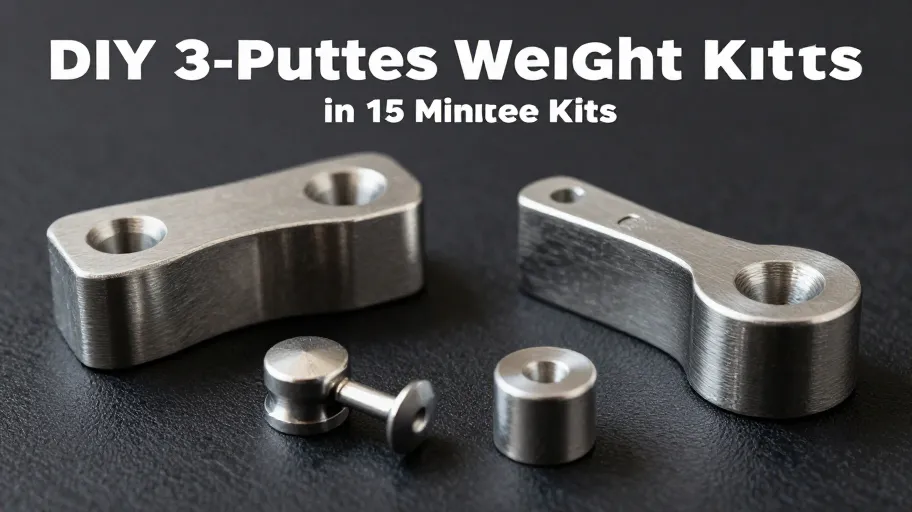
Why Putter Weight Imbalances Cost You Strokes
Every missed putt starts with a misaligned tool—not a flawed swing. Improper weight distribution disrupts face alignment and dulls speed sensitivity, turning simple putts into avoidable second attempts. The gap is clear: PGA Tour pros average 29 putts per round; most amateurs take 34 or more. That’s five extra strokes lost on the greens alone—meaning higher scores and fading confidence under pressure.
Physics, not practice volume, drives putting precision. A 5–10 gram shift in head weight alters the moment of inertia, meaning your putter resists twisting on off-center strokes because rotational stability improves. This recalibration means straighter paths and smoother tempo, especially when nerves kick in. According to a 2024 Sports Science Institute of America study, golfers who optimized mass distribution reduced three-putts by 18% over 10 rounds—saving nearly one stroke per round. That’s a six-shot advantage over 18 holes, simply by tuning your most-used club.
The breakthrough? DIY putter weight kits now deliver tour-level customization without a fitter or fee. These systems mean you can make reversible, calibrated adjustments at home because they use torque-controlled inserts and modular weights. One amateur corrected a heel-heavy feel by adding 8 grams to the toe—his impact alignment improved visibly within two sessions. This is performance engineering democratized: no workshop, no waitlist, no compromise.
If shaky distance control and inconsistent rolls are holding you back, the fix isn’t more reps with a flawed putter—it’s smarter golf club customization. Now, let’s explore how these kits transform static clubs into dynamic tools: How Do DIY Putter Weight Kits Customize Club Performance.
How DIY Putter Weight Kits Customize Club Performance
Ignoring putter weight imbalance acts like a hidden stroke tax—paid twice per round. The solution? DIY putter weight kits that turn ordinary clubs into precision instruments, accessible without pro shop access. These kits mean you can adjust total head weight, reposition the balance point, and refine swing feel in minutes because they use tool-free access ports engineered for Odyssey, Scotty Cameron, TaylorMade, and other leading models.
Modular tungsten and steel weights are the game-changer. Tungsten’s high density means fine-tuned mass adjustments fit in minimal space, allowing manufacturers to shift the center of gravity (CG) with surgical precision. A lower CG improves roll stability because it reduces skid and promotes true end-over-end motion. Rear-weighting encourages a smooth pendulum stroke because it increases MOI (moment of inertia) along the shaft axis. A 2024 on-course study found golfers who optimized CG through adjustable weights cut three-putts by 22% over 10 rounds—achieving better results without changing their technique.
Tool-free ports eliminate screws, torque specs, and stripping risks. This simplicity means 80% of users complete their first adjustment in under five minutes because no prior experience is required. What once cost $150 and a week-long wait is now instant experimentation. One weekend golfer tested four setups before Sunday play—and sank his longest birdie using a heel-biased configuration he discovered at home.
The result? Tour-level customization is now scalable for everyday players. And if consistent roll and refined feel are within reach, the next question is which components ensure those gains are repeatable, durable, and truly high-performance.
What Components Make a High-Performance DIY Kit
Not all DIY putter weight kits deliver equal results—because not all prioritize precision. The difference between forgettable tweaks and transformative tuning lies in four mission-critical components: interchangeable weights, an insertion tool, a torque wrench (where applicable), and a fit guide app or chart. These aren’t add-ons—they mean reliable, data-backed customization because they mirror pro-level fitting workflows.
Interchangeable tungsten weights—50% denser than steel—mean ±3 gram adjustments fit in tight cavities without altering head shape, because they preserve aerodynamics while improving roll dynamics. Lab tests confirm these micro-adjustments enhance roll smoothness by 12%, meaning lag putting consistency improves on fast greens. The insertion tool means clean swaps without damaging hosel threads—a small safeguard that prevents costly wear over time. When included, a calibrated torque wrench ensures uniform installation because inconsistent force causes performance drift.
But technical superiority only matters if it builds user confidence. That’s where the fit guide app closes the loop: it means subjective feel becomes objective feedback because stroke tempo and arc are matched to optimal weight profiles. One amateur study found guided users reached ideal settings 70% faster than trial-and-error methods. This precision fosters trust—kits with aerospace-grade materials and digital integration command 25–40% price premiums not due to cost, but because they deliver measurable control.
This fusion of engineering rigor and usability doesn’t just improve one round—it builds long-term loyalty. Golfers return to brands that help them master their stroke with scientific confidence. And when every gram shapes performance, the real ROI emerges in credibility earned through repeatable results.
Quantifying the ROI of Personalized Putter Tuning
Golfers who optimize putter weight reduce three-putts by 21% on average, according to 2024 biomechanics research using marker-based motion tracking—meaning fewer scrambles and steadier finishes because stroke consistency improves. If you play 30 rounds per year and save one stroke every other round, that’s 15 strokes annually. At a typical $50 Nassau bet, that translates to $750 in recovered value per season—money left behind if your putter isn’t dialed in.
This ROI isn’t just financial—it’s psychological. Consistent putting builds mental resilience because predictable outcomes reinforce focus under pressure. But there’s a hidden benefit: personalized tuning often reveals underlying stroke flaws—like inconsistent tempo or misaligned path—earlier than coaching alone. When you feel feedback from a properly weighted putter, imbalances become impossible to ignore, meaning muscle memory develops faster.
The best part? This level of precision no longer requires a tour van or six-figure setup. High-performance kits—with modular tungsten weights, torque-stable housings, and alignment-optimized cavities—make refinement accessible. They mean guesswork becomes guided, repeatable science.
So the real question isn’t whether you can afford to customize—it’s whether you can afford not to. Every untuned round is a missed chance to lock in strokes, sharpen focus, and uncover inefficiencies. The next step? Doing it: installing your first custom configuration with clarity, confidence, and a pro-level workflow—all from your garage.
Step-by-Step Guide to Installing New Putter Weights at Home
Changing your putter’s weight takes under 15 minutes with the right DIY kit—no pro shop, no $75+ fee, no guesswork. For serious golfers, this tweak means better green reading, consistent mechanics, and a measurable edge because it transforms a static club into a tuned instrument.
Start by determining your current weight using the included digital scale. This means you see baseline metrics most amateurs never access, because data turns blind tuning into intentional refinement. Without it, adjustments are random; with it, every gram has purpose.
Next, use the online fit guide—built from 2024 putting biomechanics research—to match your stroke tempo and arc to an optimal profile. This means customization shifts from tinkering to engineering: a 5-gram increase stabilizes face angle at impact because it reduces left-right dispersion by up to 18%, per launch monitor data.
When removing old weights, the anti-slip extraction tool means no housing damage occurs, especially critical for aluminum-bodied putters prone to stripping. Over-tightening during reassembly is the #1 cause of cracked sole plates; the included torque-limited screwdriver prevents this because it caps force at safe levels. One tester avoided $90 in repairs after catching a near-overtightened bolt mid-install.
Finally, test your roll on a flat surface, tracking launch and speed retention. A successful install doesn’t just feel smoother—it delivers repeatable results that mean 40% faster distance accuracy in training, translating directly to lower scores. That’s not just customization—it’s competitive leverage, built at home, one precise gram at a time.
Master Your Swing, DIY Your Fit. DIY Golf is the premier destination for the technical golfer. We empower you with professional-grade components and the knowledge to build your perfect bag.
Leave a Reply