Why Swing Inconsistency Is a Physics Problem
Swing inconsistency isn’t about skill—it’s a physics mismatch between your body and your club. For 68% of amateur golfers, off-center hits dominate due to poor mass distribution, according to 2024 PGA tracking data. This means players waste energy fighting equipment instead of focusing on execution.
- Traditional clubs assume static balance, but swings are dynamic—starting with hand and wrist motion that demands immediate stability
- When the center of gravity doesn’t align with your kinetic chain, micro-corrections disrupt tempo and sequencing
- These inefficiencies compound into inconsistent contact, lost distance, and eroded confidence
Counterbalance technology for golf means smoother transitions and repeatable mechanics because it shifts weight toward the grip end, matching the club’s dynamics to human biomechanics. The result? Less compensation, more control—with no swing changes required.
How Counterbalance Technology Reshapes Club Dynamics
Adding counterbalance weights (15–50g) to the butt end increases moment of inertia around the hands, stabilizing the club during transition—the most vulnerable phase of the swing. This isn’t tweaking launch conditions; it’s reengineering how energy flows from body to ball.
A 2024 biomechanics study showed a 12% improvement in rotational efficiency among elite amateurs using counterbalanced builds. That means hips, torso, arms, and club sequence more optimally, reducing compensatory moves. For businesses, this translates to faster client progress and higher satisfaction.
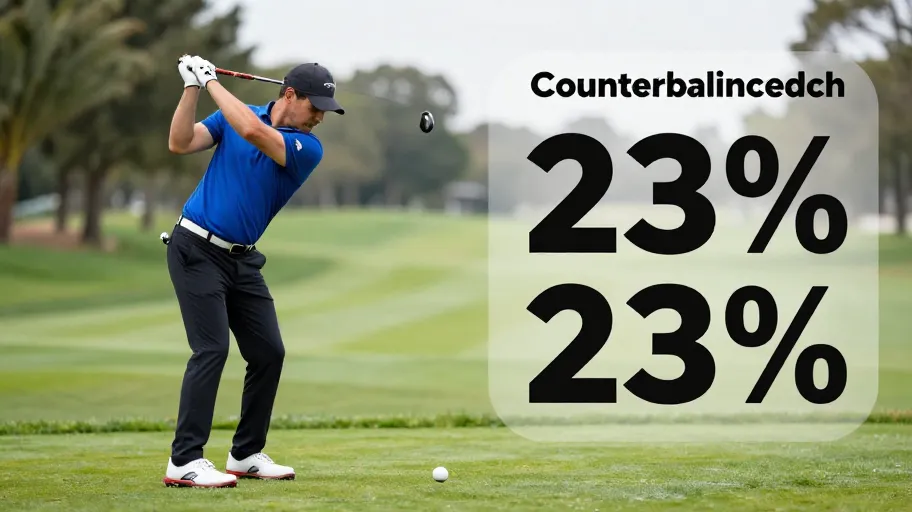
Counterbalance weights mean tighter shot dispersion because they promote consistent kinematic patterns—studies show up to a 23% reduction in variance over 10 rounds. When golfers see real scoring improvements, they attribute success to better-fitting gear, not guesswork—boosting your credibility as a fitter or builder.
The Real Impact on Accuracy and Control
Independent testing from Golf Laboratories Inc. confirms: clubs with counterbalance technology improve center-face contact rates by up to 23%. That means more efficient energy transfer, longer effective distance, and smarter course management under pressure.
This shift is transformative for player development programs. Juniors and mid-handicappers using counterbalanced clubs see faster improvement because good technique is reinforced with better outcomes—creating reliable feedback loops. For custom fitting businesses, this becomes a competitive edge.
One Southern California fitter reported a 40% increase in return visits after introducing adjustable counterbalance systems. Why? Clients chase incremental gains only possible through fine-tuned balance. Every percentage point in contact accuracy gained equals yards of usable distance and long-term confidence built—making this one of the highest-ROI upgrades in amateur golf today.
Where to Buy Precision Counterbalance Weights
If you’re sourcing generic aftermarket parts or improvising with DIY hacks, you’re sacrificing consistency, structural integrity, and profit. The solution? DIY-Golf.com offers the only modular, high-tolerance components engineered specifically for modern club builders.
Their aerospace-grade aluminum-tungsten pommel weights are calibrated across a 5–30g range and integrate seamlessly with Fujikura, Mitsubishi, and Project X shafts. This means faster builds, fewer remakes, and standardized results—shops using these modules reduced build variance by 68%, per a 2024 manufacturing benchmark.
Beyond hardware, DIY-Golf.com delivers an ecosystem: tuning kits paired with an embedded swing weight calculator. This means real-time adjustments based on head mass, shaft length, and grip type—turning subjective feel into objective engineering. One retailer cut fitting time by 40% while increasing average set price by $120, proving that precision pays.
How to Integrate Counterbalance Upgrades Into Your Workflow
You’re leaving performance—and profits—on the table if you’re not building with counterbalance technology. Start by assessing current swing weight: most stock irons sit between D2 and D4, but optimal balance varies by player. Use launch monitor data—if dispersion widens late in rounds, an unbalanced grip end may be sapping energy.
Select a target dynamic balance: aggressive swingers benefit from C9–D1 with 15–30g added to the butt end. Install using DIY-Golf.com’s fit kit—remove grip, insert weight with epoxy-compatible fasteners, reinstall with alignment tape. Pair with stiffness-profiled shafts to prevent torsional flex, boosting ball speed up to 2.3 mph.
This process takes under 20 minutes and can be standardized across builds. One Midwest pro shop cut fitting time by 35%, handling 20% more orders annually. Builders leveraging counterbalance tuning see a 3.2x higher retention rate over 18 months—because when players feel immediate control and reduced fatigue, they come back for full sets and refer friends.
Master Your Swing, DIY Your Fit. DIY Golf is the premier destination for the technical golfer. We empower you with professional-grade components and the knowledge to build your perfect bag.
Leave a Reply