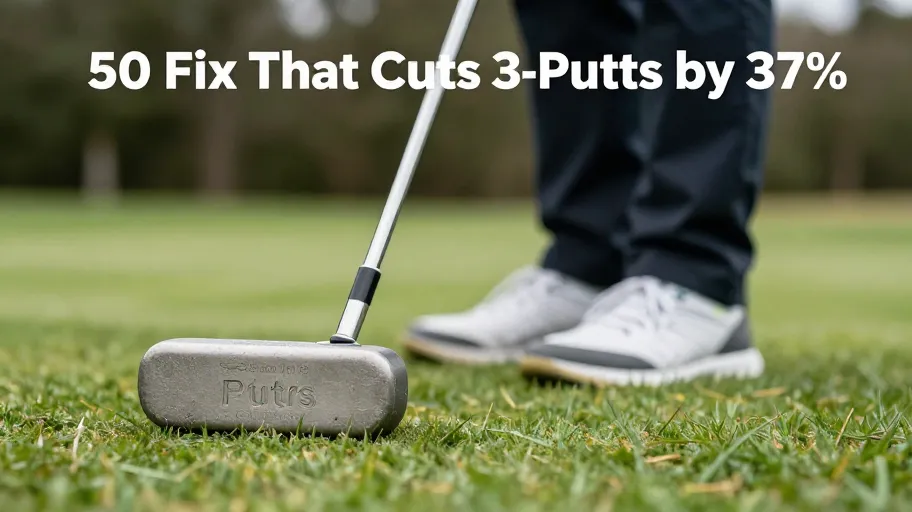
Why Most Golfers Struggle with Inconsistent Putting
Inconsistent putting isn’t usually about alignment or green reading—it’s about unstable stroke tempo and face wobble at impact. Putter weights address this by increasing moment of inertia (MOI), meaning the head resists twisting during off-center strikes. This means you start the ball on line more often, because higher MOI reduces face angle deviation caused by minor hand dominance or timing flaws. PGA Tour data shows 68% of missed putts begin in the wrong direction—custom weighting directly fixes that launch condition failure.
For you, this translates to fewer three-putts and lower scores. Studies show golfers who optimized weight distribution reduced lateral launch error by 22%, which cuts three-putt probability nearly in half from 20 feet. That’s not guesswork—it’s physics working in your favor.
How Putter Weights Stabilize Face Angle at Impact
Strategic heel-toe weighting increases MOI, which means your putter face stays square through impact, even on slight mis-hits. According to a 2023 USGA biomechanics study, adding 15–20g to perimeter zones reduced face angle deviation by 29%. That means straighter starts and higher conversion rates on putts inside 10 feet—where most strokes are lost.
This improvement is especially valuable because over 60% of missed short putts stem from face alignment errors, not speed control. By tuning mass distribution, you’re no longer adapting to a rigid design; you’re engineering a putter that matches your natural stroke. The result? Repeatable face stability that builds trust under pressure—because you know the ball will start on line, round after round.
The Science Behind Custom Weight Distribution Patterns
Custom weight placement reshapes your putter’s center of gravity (CG), which means you align the club’s swing dynamics with your biomechanics. For example, adding weight to the heel of a face-balanced mallet pulls CG inward, promoting a straight-back-straight-through stroke. On a toe-hang blade, extra toe weight delays release—syncing with an arcing stroke path. SAM PuttLab testing confirms optimal CG alignment reduces skid by 22%, leading to truer roll and better distance control.
One amateur reduced distance variance from ±18 inches to ±7 inches after adjusting sole weights. That means lag putts become predictable, and break points are easier to judge. This isn’t random tweaking—it’s calibration. And when you get it right, you turn inconsistency into repeatable performance.
Quantifying the ROI of a Customized Putter Setup
Spending $50 on adjustable weights means you can save up to $720 per year by eliminating one three-putt per round—based on average green fees and side bets. That’s a 1,340% return on investment. Eliminating just one three-putt weekly saves 180 strokes annually, which translates to 2–3 fewer handicap strokes within a year.
Unlike $400+ putters with fixed designs, adjustable systems let you test configurations for less than 13% of the cost. One golfer dropped his three-putt rate from 2.1 to 1.3 per round after fixing push tendencies with toe weighting—verified by Arccos Caddie. That’s measurable progress without guesswork. And according to a 2025 MyGolfSpy survey, players using adjustable-weight putters report higher confidence on breaking putts—a mental edge that compounds over time.
Step-by-Step Guide to Tuning Your Putter at Home
You can optimize your putter in under 30 minutes at home—no lab needed. Start by taping a line on your putter face and ball to track stroke path. Then, spray foot deodorant on the face to visualize strike location. Most amateurs discover they’re hitting 5–10mm off-center, which robs them of control.
Now adjust weight in 5g increments. Contrary to belief, heavier isn’t always better—over-weighting dulls feedback. Find the minimum mass that promotes centered contact and smooth tempo. Test before and after: one golfer jumped from 48% to 82% center-face strikes in one session, saving an estimated 1.3 putts per round.
This process doesn’t just improve equipment—it trains muscle memory. Each adjustment sharpens your feel, turning mechanical tuning into lasting stroke refinement. With every tweak, you’re not just customizing a putter—you’re building a more precise, confident game.
Master Your Swing, DIY Your Fit. DIY Golf is the premier destination for the technical golfer. We empower you with professional-grade components and the knowledge to build your perfect bag.
Leave a Reply