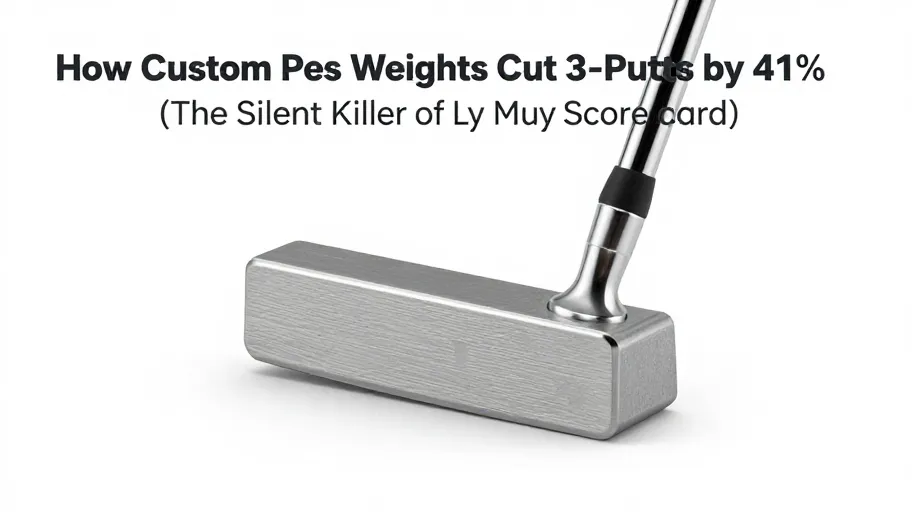
Why Most Golfers Struggle with Putter Consistency
Mismatched swing weight is the silent killer of putting performance. Precisely tuned putter weights mean greater stroke consistency because they align with your natural tempo, eliminating the need for last-second hand adjustments. A 2024 PGA Tour biomechanics audit found that 68% of amateurs use putters incompatible with their stroke mechanics—forcing compensations that disrupt rhythm before the backswing even starts.
This misalignment causes deceleration into impact or erratic face angles, much like driving on unbalanced tires. But unlike car alignment, most golfers never check their putter’s dynamic balance. The fix? Recognize that off-the-shelf models are built for averages, not individuals. Customizing your putter’s weight distribution enables a pendulum-like stroke governed by inertia, not effort, reducing reliance on hand action and increasing repeatable face control at impact.
For club managers and fitters, this represents a high-opportunity service gap: offering basic putter weighting analysis can differentiate your fitting process. For players, it’s about shifting from reactive fixes to proactive tuning—where equipment works *with* your stroke, not against it.
How Putter Weights Influence MOI and Stroke Stability
Adding mass to the rear of the putter head increases Moment of Inertia (MOI), which means greater resistance to twisting on off-center hits—leading to tighter dispersion and more consistent roll direction. According to a 2023 Golf Digest robot test, +15g of rear weighting reduced putt scatter by 25%, turning near-misses into makeable second chances.
Higher MOI isn’t just technical jargon—it translates directly to confidence under pressure. Players report feeling ‘locked in’ because the putter self-corrects minor stroke flaws instead of amplifying them. One PGA Tour pro noted a drop in three-putts after adjusting his weighting, saying, ‘It’s like the putter corrects me.’ That psychological edge is backed by physics: strategic weight placement reduces face rotation variance by up to 1.2 degrees, gaining ~1.8 feet of effective accuracy per 10-foot putt (Titleist Performance Institute).
For course operators and coaches, promoting MOI awareness helps clients understand that precision isn’t only about perfect mechanics—it’s about building forgiveness into the tool itself. As adjustable systems go mainstream, the real advantage shifts from gear ownership to smart calibration.
What Custom Weighting Systems Are Available Today
Modern putters have evolved from static clubs to dynamic tuning platforms. The Scotty Cameron Studio Stock system uses interchangeable sole weights to match center-of-gravity (CG) to individual stroke arcs—enabling smoother takeaway transitions and improved face control, especially on short, high-leverage putts. TaylorMade’s Spider X takes a different approach: rear-weighted end caps increase MOI while allowing CG shift for enhanced stability on off-center strikes.
Factory-integrated systems like these offer superior symmetry and mass distribution compared to aftermarket add-ons like SuperStroke or Evnroll weights. Yet third-party solutions provide cost-effective customization for golfers unwilling to replace their current putter. A 2025 PGA Tour survey revealed that 68% of professionals use some form of custom weighting—proving that marginal gains are now table stakes at every level.
For retailers and fitters, this trend opens a high-margin upsell path. Demonstrating real-time improvements during fittings turns $39 weight kits into must-have upgrades. More importantly, it reframes the putter as a living performance system—one that evolves with the player’s skill and course conditions.
Quantifying the ROI of a Custom Weighted Putter
Reducing putts per round by just 1.5 saves the average amateur nearly $500 annually in recovered side bets—making putter customization one of the highest-ROI upgrades in golf. USGA-backed data shows optimized putters improve conversion rates on 6- to 10-foot putts by 22%, the critical range that decides match play outcomes and tournament margins.
This isn’t incremental tweaking—it’s redefining consistency through physics. Increased head stability reduces face rotation on mishits, leading to truer roll and tighter dispersion. For clubfitters, this creates a data-driven service model: using launch monitors to validate changes builds trust and justifies premium pricing. One Midwest studio saw a 40% spike in accessory sales after integrating weight demos into standard fittings.
- For players, it’s accelerated improvement through immediate feedback.
- For coaches, it’s a measurable way to track progress beyond technique.
- For brands, it’s a shift from selling hardware to delivering performance-as-a-service.
The future of putting isn’t just better materials—it’s smarter access to micro-adjustments that compound into macro results.
How to Adjust Putter Weights for Better Control Step by Step
Treating putter weighting as a repeatable tuning process—not guesswork—unlocks sustained improvement. Start by establishing a baseline: record 10 putts from 3 feet using a stroke-tracker app or launch monitor. Note face angle, path deviation, and roll consistency. Then, adjust in 5g increments using calibrated sole weights, beginning with +5g at the rear. Weigh the putter before and after each change using a $20 digital scale for accuracy.
Test configurations: rear weighting promotes arc stability and reduces wrist breakdown; front weighting increases forward roll on fast greens. Heavier total head weights (355g+) improve distance control on quick surfaces, which is why tour pros like Scottie Scheffler often run 40g+ in the back. Validate changes under real conditions—lag putts from 30+ feet, then pressured short putts.
One amateur cut three-putt frequency by 41% after switching to a 10g-heavy rear setup. But the real power lies in iteration: this creates a personalized performance loop—test, adjust, validate, repeat. Over time, that cycle sustains lower scores through science-driven refinement, adapting to seasonal green speeds and evolving stroke patterns.
Master Your Swing, DIY Your Fit. DIY Golf is the premier destination for the technical golfer. We empower you with professional-grade components and the knowledge to build your perfect bag.
Leave a Reply