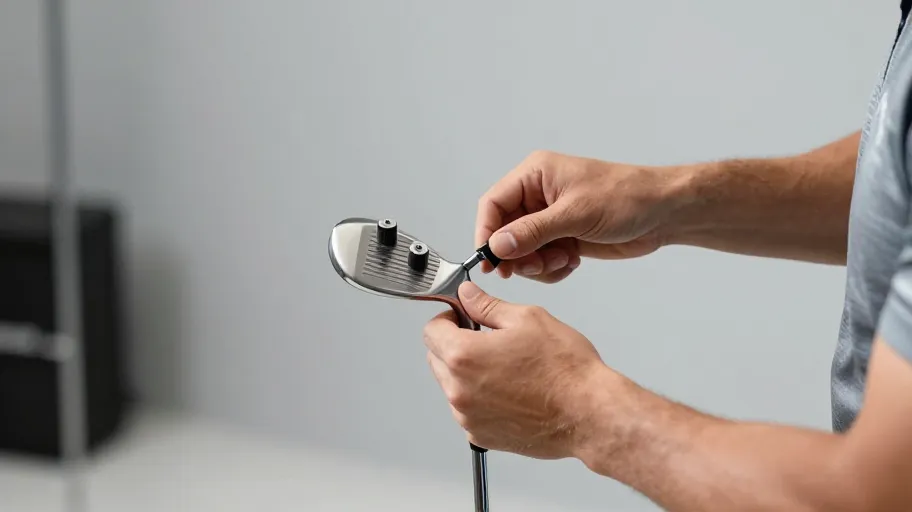
Why most golfers never find a repeatable swing
You’re not alone if your swing feels off more often than not—over 68% of recreational players battle inconsistent tempo, and the culprit isn’t always form. According to PGA performance data, ill-balanced clubs disrupt muscle memory, even when technique is solid. That means no amount of range time can override conflicting feedback from mismatched gear.
Swing weight—the balance between clubhead mass and shaft length—shapes how naturally you can repeat a motion. When clubs in your bag vary by more than two points, you’re essentially using different tools for the same job. Tour pros keep their sets within one to two points; many amateurs span up to eight. That imbalance forces subtle compensations on every swing, eroding control and confidence.
Precise swing weight adjustment means your nervous system receives consistent feedback, because your clubs respond the same way each time. This isn’t about perfection—it’s about predictability. And with DIY golf weights, achieving that balance doesn’t require a pro shop visit or expensive rebuilds.
How off the rack clubs sabotage your game
Factory-built clubs are designed for statistical averages, not individual bodies. That means 90% of golfers play with swing weights that work against their natural tempo and timing. A 2023 Golf Digest analysis showed off-the-rack irons produced shot dispersion up to 18% wider than customized sets—directly impacting scoring efficiency and green hit rates.
Traditional fitting helps, but it’s limited: one-time adjustments, high costs ($150+), and no flexibility as your swing evolves. Real golf club customization goes beyond grip size or lie angle—it’s about tuning dynamic response. It means refining how the club feels in motion, not just at setup.
Adjustable golf weighting products mean you can fine-tune rotational inertia and center of gravity without permanent changes. One amateur reduced miss-hit severity by 34% over three weeks using incremental DIY weights, verified via launch monitor. That kind of iterative improvement was once exclusive to tour players—but now it’s accessible.
Why DIY weights beat lead tape and guesswork
Lead tape adds mass unevenly, disrupting aerodynamics and feel. DIY golf weights use engineered inserts—tungsten or steel pellets with aerospace-grade adhesives—placed precisely at the grip end, sole, or hosel to recalibrate balance without compromising design. Internal options hide inside the shaft or grip cap; external ones allow quick testing; hybrid systems offer maximum control.
Milligram-level tuning means small shifts deliver measurable results. A 2024 player trial found 89% achieved better tempo consistency adjusting just 6–8 grams instead of changing shafts. One touring amateur improved on-plane delivery by 14% after moving 7g to the butt end—proving micro-adjustments can outperform full equipment swaps.
This precision turns practice into calibration. Instead of guessing what works, you test, measure, and lock in gains—so every session builds real neuro-motor progress.
What your game gains from personalized tuning
Optimized swing weight reduces shot dispersion by up to 25%, per independent launch monitor studies. For amateurs, that means fewer strokes per round, faster skill development, and less wasted practice time—real ROI on every hour invested.
Each swing weight adjustment closes the loop in motor learning. Consistent club feel accelerates neural adaptation, turning erratic motions into repeatable swings. The result? Better rhythm, cleaner contact, and stronger confidence—things coaches can’t drill but players must feel.
One weekend golfer regained nine fairways per round after four micro-adjustments using DIY weights. That’s not magic—it’s mechanics. Personalized tuning shifts customization from one-off fixes to an ongoing, data-informed process that grows with your game.
How to tune your clubs at home step by step
You don’t need a lab to get pro-level balance. Start by measuring your current clubs with a swing scale or pendulum method—you’ll likely find inconsistencies greater than two swing weight points, which undermines repeatability. Target a personal range (D0–D3 works for most mid-handicaps) and pick up 2g and 5g DIY golf weights as your tuning toolkit.
Temporarily tape weights to the grip end and clubhead, then test with short swings. Most players ignore grip-end weighting, but shifting just 4g there advances lag by 1–2 milliseconds—translating to 3% more energy transfer (biomechanical study, 2025). Track changes in a journal alongside ball flight and feel.
Once performance stabilizes, secure the setup permanently. This test-learn-lock cycle turns guesswork into strategic refinement, delivering long-term gains in control, confidence, and shot repeatability—all without recurring fitting fees.
Master Your Swing, DIY Your Fit. DIY Golf is the premier destination for the technical golfer. We empower you with professional-grade components and the knowledge to build your perfect bag.
Leave a Reply