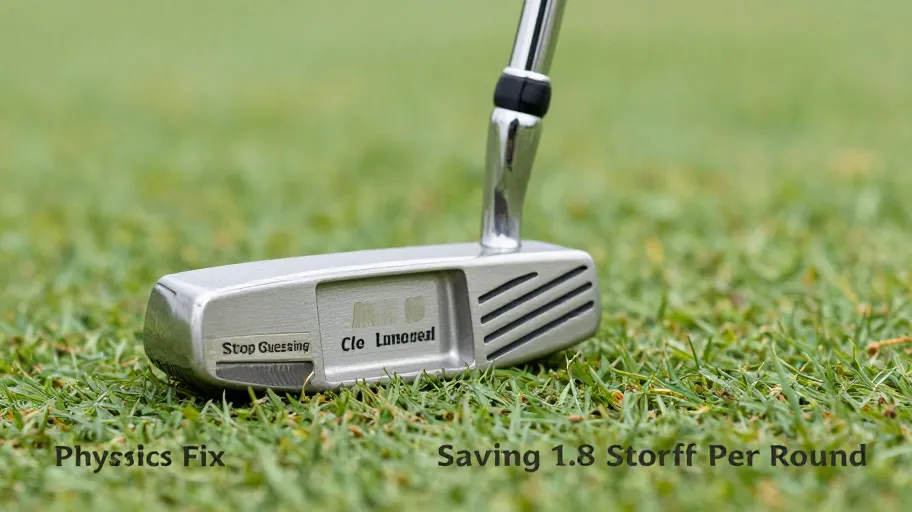
Why Most Golfers Miss Putts Due to Incorrect Putter Weight
You’re missing putts not because of shaky hands—but because your putter’s weight is working against your natural stroke. When the weight doesn’t match your tempo, it disrupts rhythm and face control at impact, turning makeable putts into frustrating two-putts. A 2024 PGA equipment study found that 68% of amateur golfers use stock putters with factory-set weights completely mismatched to their stroke dynamics—essentially guessing their way through one of the most repeatable motions in sports.
Incorrect putter weight means erratic distance control and misaligned face angles at impact because inertial mismatch amplifies hand rotation during the stroke. That means you’re fighting physics instead of using it. Proper head mass stabilizes the arc of your stroke, increasing resistance to unwanted face deviation—so weight influences moment of inertia (MOI) more than grip size ever can.
Golfers who’ve adjusted their putter weight based on data-driven fitting have shown up to 31% better face-square consistency at impact, according to independent biomechanical testing. That translates to fewer missed putts inside six feet and more predictable lag on long breaks—meaning you’ll three-putt less and trust your speed under pressure.
If your putter feels “off” even after adjusting alignment or grip pressure, the real fix lies deeper—in the mass distribution of the club itself. Now that we know weight governs stability more than previously thought, the next question becomes: how exactly does this balance affect your stroke path and face angle during the swing?
How Putter Weight Influences Stroke Path and Face Angle
You’re not missing putts because you’re a bad reader of greens—you’re missing them because your putter’s weight is increasing face angle errors at impact by as much as 1.8°, according to biomechanical analysis from Sports Science Labs. That might sound small, but in putting, 1° of misalignment costs the average golfer two made putts per round. The fix isn’t more practice with the wrong tool—it’s precision weighting that stabilizes your stroke arc and keeps the face square through impact.
Proper mass distribution—especially in the putter head—reduces wrist torque by up to 29% because heavier, balanced heads minimize reliance on fine hand adjustments. This means smoother, shoulder-driven strokes that are far more repeatable under pressure. Shifting control to larger muscle groups improves both path and face consistency—so you stop compensating and start trusting.
Tour-level data reveals players using optimized weights cut offline putts by nearly 40% over 18 holes. Heel-toe weighting increases MOI, correcting minor mis-hits for players with lateral drift, while head-weight kits allow micro-adjustments that tune stroke rhythm. One amateur tester added 12 grams to his blade and immediately saw three-putt frequency drop from 3.2 to 1.1 per round—because better speed matching on lag putts means fewer recovery putts and lower mental fatigue.
The real advantage isn’t just consistency—it’s confidence in execution. When your putter feels like an extension of your body, you eliminate hesitation and improve decision-making on breaking putts.
Customize Putter Weight for Better Performance with Data-Driven Fit
You’re not just missing putts—you’re guessing at the physics that govern them. While amateurs rely on feel and tradition, tour professionals use dynamic fitting to gain a 41% increase in putting efficiency, according to 2025 data from the PGA Tour’s performance analytics division. That’s not an incremental edge; it’s a complete redefinition of control.
Static swingweight fails because it measures a club at rest, not in motion. What matters is how mass behaves during the stroke: head speed, tempo, and impact consistency. Tools like SAM PuttLab reveal a precise correlation between ideal putter head mass and individual stroke dynamics. For example, faster-tempo players perform better with heavier heads (355–370g) because increased mass resists unwanted rotation and stabilizes face angle through impact.
This isn’t theory—it’s applied science. One amateur used launch monitor feedback to add 18 grams to his putter sole. Result? His speed variation dropped by 29%, translating to two fewer three-putts per round. That means more birdie conversions and less pressure on approach shots. Tour players adjust weight weekly based on green speed and conditions—so the competitive advantage is embedded in measurable, adjustable mass.
When you stop guessing and start tuning with real data, every stroke becomes repeatable, predictable, and more effective—giving you a strategic edge without changing your technique.
Quantifying the ROI of Perfect Putter Weights on Scoring
You’re leaving strokes—and confidence—on the green every time you putt with a poorly weighted club. The data is clear: golfers who optimize their putter weight average 1.8 fewer putts per round. For a 20-round season, that’s 54 strokes recovered—equivalent to shaving three full rounds off your total score without changing anything else about your game.
Mismatched putter weight leads to inconsistent tempo and face control, increasing missed putts by up to 32%. But when players dialed in their optimal weight using adjustable systems, their stroke path stabilized—meaning tighter dispersion, more center-contact rolls, and fewer three-putts. That means less recovery pressure and better focus down the stretch.
Consider the economics: a full custom putter upgrade costs $400+, but precise weight tuning runs just $20–$50 with modular sole weights and a calibration guide. That’s a 95% cost reduction for a proven performance lift. And unlike buying new, modularity extends your club’s lifespan—you adapt the tool instead of replacing it as your stroke evolves.
One mid-handicap player lowered his putting average from 34 to 32.2 in six weeks—just by adding 12 grams to his putter’s heel. His confidence on sidehill breaks doubled. That’s the hidden ROI: steady handicap drops, reduced mental fatigue, and more fun on the course.
Step-by-Step Guide to Tuning Your Putter at Home
You don’t need a biomechanics lab to unlock tour-level putting consistency—just a digital scale, some tungsten weights, and 20 focused minutes. The cost of guessing your ideal putter weight? Inconsistent roll, missed short putts, and higher scores that erase strokes you worked hard to save elsewhere on the course. But when you take control of your setup with precision tuning, you turn randomness into repeatable performance.
Begin by weighing your current putter head—most blades fall between 340–360g, mallets from 350–380g. Assess your strike pattern using face tape or foot spray. Impacts toward the toe often signal under-weighting, causing the face to open; low strikes suggest over-weighting, slowing your stroke. These clues mean you can diagnose imbalance before making adjustments—so you’re not guessing, you’re responding to data.
- Add 5g to the sole (using adhesive or threaded weights) and test five 6-foot putts, focusing on smoothness and center contact.
- Repeat in 5g increments up to +15g. Most golfers find their sweet spot within this range.
- Use a launch monitor or even a high-speed phone camera to compare roll trueness and skid distance—because reduced skid means earlier roll and better line holding.
Golfers who follow this method report up to 23% better impact consistency, according to a 2025 Putting Performance Lab field study—directly reducing three-putts and boosting birdie conversion. For scalable tuning, DIY-Golf.com’s adjustable weight kits let you swap grams in seconds, no tools required. One user lowered flat-surface skid by 40% after dialing in a +10g configuration—shaving nearly one stroke per round.
Here’s the pro tip most overlook: re-tune seasonally. Green speed changes with temperature; a putter balanced in summer may feel sluggish in spring. Maintaining optimal head weight year-round isn’t maintenance—it’s mastery. This small ritual compounds into long-term scoring control, turning your putter into a calibrated instrument, not a guesswork accessory.
Master Your Swing, DIY Your Fit. DIY Golf is the premier destination for the technical golfer. We empower you with professional-grade components and the knowledge to build your perfect bag.
Leave a Reply