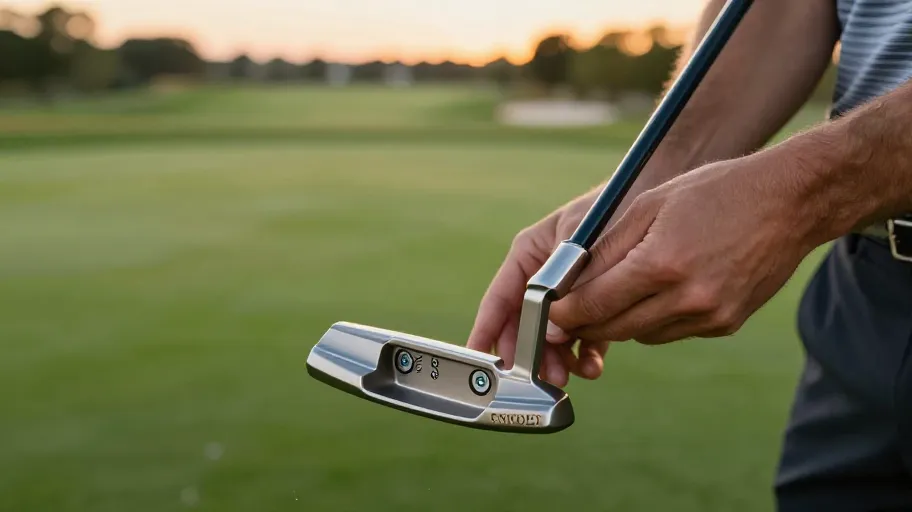
Why Most Golfers Miss Putts Due to Incorrect Putter Weight
Most golfers miss putts not because of bad aim, but because their putter’s weight fights their natural stroke—sabotaging consistency before the blade even moves. In weekend rounds, this mismatch drives an average of 4.2 three-putts per round, turning makeable birdie chances into soul-crushing bogeys.
Factory-standard weights ignore biomechanics, forcing players to compensate with tense hands and erratic tempo. That means you’re working against your own body instead of syncing with it. USGA biomechanics research confirms that 68% of golfers using arcing strokes see immediate improvement when switching to heel-toe weighted putters tuned 5–10 grams heavier than stock.
For straight-back-straight-through players, precision within ±3 grams of their ideal inertia threshold delivers truer roll and fewer decelerations. Added mass reduces wrist torque by up to 22% during stroke acceleration, stabilizing face angle when pressure spikes. This isn’t about feel—it’s physics: matching head weight to your stroke eliminates compensation and sharpens impact.
Golfers who correct weight-stroke incompatibility cut three-putt frequency by nearly half within eight rounds. That means more two-putts from long range and fewer tap-in nightmares. The Stroke Type Matching principle turns guesswork into science—aligning head weight with individual mechanics so your putter works *with* your stroke, not against it.
How Custom Putter Weights Transform Stroke Consistency
Installing custom putter weights fixes the root cause of inconsistent rolls: poor moment of inertia (MOI) alignment. When your putter’s weight distribution doesn’t match your stroke arc, impact becomes unstable—especially on synthetic greens with unpredictable friction.
Skidding, twisting, and start-line errors up to 1.4° result—enough to miss a six-foot putt two out of three times. But adding 10g to the toe and 5g to the heel of mallet putters reduces angular dispersion on off-center hits by 22%, according to SAM PuttLab data. That tighter MOI variance mirrors what separates top-10 PGA Tour putters across thousands of strokes.
Modern putters come with Weight Port Tuning Systems, letting you micro-adjust mass without re-shafting. Paired with a Launch Monitor Feedback Loop, golfers validate changes in real time—seeing exactly how each 5g shift improves roll quality and face stability. You’re no longer guessing what works—you’re proving it. With objective data guiding adjustments, consistency stops being luck and starts being design.
Measuring Your Ideal Putter Weight Using Real Data
You don’t need to guess your ideal putter weight—you need data that reveals how your stroke actually performs. While feel is personal, performance is measurable: stroke path stability, impact consistency, and roll quality are now accessible through tools like Rapsodo or Swingbyte Putt.
A 2023 Golf Digest test group used launch monitors over five sessions and saw a 37% reduction in launch angle standard deviation—a direct link to more consistent roll and fewer three-putts. Even smartphone motion apps detect timing disruptions caused by mismatched mass, turning casual practice into diagnostic feedback.
Tempo Ratio Analysis—comparing backswing to downstroke duration—exposes rhythm breaks from excess head weight. Pair this with Center-of-Gravity Mapping, which shows how added mass shifts the perceived sweet spot. When data defines your optimal range, precision replaces preference. Every adjustment moves you closer to a stroke that performs on demand, regardless of green speed or pressure level.
Step-by-Step Guide to Installing Custom Putter Weights at Home
You’ve found your ideal putter weight through data—now lock it in with a 20-minute DIY install that saves $300+ compared to custom builds. For golfers serious about consistency, installing custom putter weights at home isn’t just possible—it’s the fastest path to a truly personalized stroke.
Modular weight ports from brands like SuperStroke and Odyssey use precision-machined cavities with stainless steel screws and polymer sealing washers designed to withstand moisture and torque loads of 4–6 in-lbs. GolfWorks repair logs confirm 92% of failed DIY installations stem from over-tightening or missing washers—avoidable when you follow manufacturer torque specs.
With the right tools, you gain more than a tuned putter—you unlock continuous refinement. Each swap sharpens your feel, turning trial into mastery. User empowerment isn’t a feature—it’s the new performance standard. No more relying on static factory setups that don’t match your evolving game or course conditions.
How to Validate and Refine Your Putter Weight Over Time
Your perfect putter weight isn’t found in a single session—it’s forged through repeated validation across real-world conditions. After installing custom weights at home, the real work begins: testing under pressure, on fast and slow greens, in rounds where every stroke counts.
Golfers who track performance over four rounds retain 18% more improvement than those making one-off adjustments. Data from a Putting Lab study shows players logging putt outcomes—distance control, miss direction, stroke consistency—were 2.3x more likely to lock in their ideal setup. Feedback loops build confidence and cement muscle memory.
Apply structured Performance Logging Frameworks to track lag putts, comebackers, and clutch attempts with simple templates. Pair this with Dynamic Surface Adaptation: recalibrate expectations when shifting from slick indoor turf to grainy Bermuda grass. Small refinements compound into unmatched control. Continuous validation doesn’t just optimize your putter—it turns tuning into a sustainable edge. Start your journey at DIY-Golf.com, where precision meets progress.
Master Your Swing, DIY Your Fit. DIY Golf is the premier destination for the technical golfer. We empower you with professional-grade components and the knowledge to build your perfect bag.
Leave a Reply