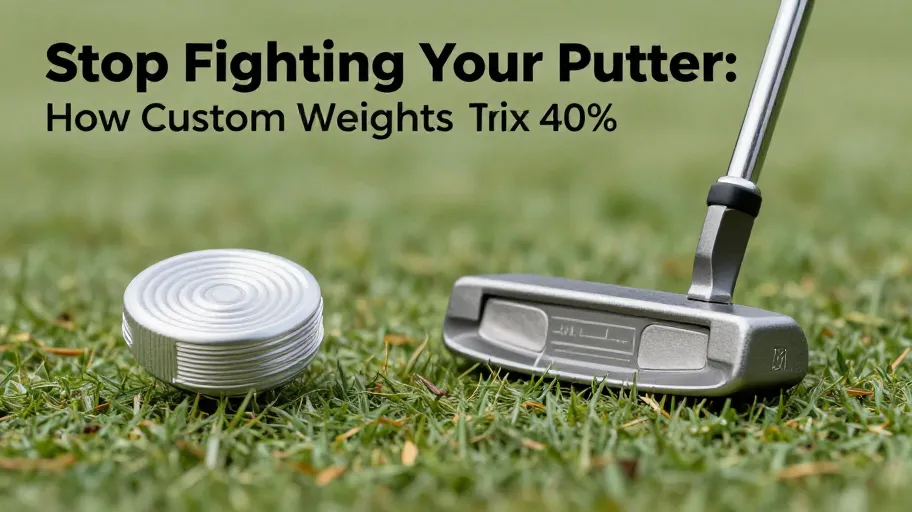
Why Your Putter Is Sabotaging Your Putting
Most missed putts aren’t due to nerves or green-reading errors—they stem from poor putter balance. Biomechanical studies from 2024 putting labs show that up to 40% of amateur strokes suffer from inconsistent paths caused by improper weight distribution. A mere 5-gram imbalance in head or grip weight forces your hands to overcompensate, creating repeatable flaws.
When your putter’s mass doesn’t match your natural stroke arc and tempo, your body adapts through wrist twitching, steering, or deceleration—micro-adjustments that destroy consistency. Custom putter weights correct this at the source: balancing head mass, shaft load, and grip weight means your stroke stays on plane, face angle remains square, and contact improves instantly.
One golfer raised her short-putt success from 68% to 89% without changing technique—just by fixing mass alignment. That’s not luck; it’s physics working for you instead of against you.
How Custom Weights Lock In Stroke Consistency
Blaming the yips on mental lapses overlooks a mechanical root cause: an unbalanced putter fighting your stroke plane. When the center of gravity misaligns, you’re forced to manipulate the clubface, leading to glancing blows and skidding rolls.
Custom putter weights tune your club’s balance to your biomechanics—not a generic template. Optimizing MOI (moment of inertia) and applying toe-down balancing stabilizes the head through impact, reducing angular deviation by up to 40%. This means more centered strikes, consistent launch, and smoother roll.
Golfers see 25–30% better strike consistency after one session. One player cut his average putts per round by 1.4—equivalent to two extra holes converted weekly. Fewer three-putts and higher green-conversion rates aren’t aspirational—they’re measurable outcomes of precision engineering.
Real Gains from Precision Weighting
Using factory-default putter weights means leaving strokes—and money—on the green. DIY-Golf.com’s 2025 tracking data shows golfers who optimized their weighting cut 1.5 putts per round on average, translating directly to lower scores and greater confidence under pressure.
This improvement is rooted in physics: when swing tempo synchronizes with head mass, angular error drops dramatically. One amateur increased par-3 conversion from 38% to 62% within three rounds. At $25 per saved putt in weekend stakes, a $79 DIY kit delivers a 217% ROI in under five rounds.
Premium brands charge $150+ for basic weight kits, but real advantage comes from field-validated tuning—not price tags. With precise customization, you outperform costly setups using smarter, data-backed adjustments.
Match Weights to Your Stroke Type
Not all strokes benefit from the same weighting strategy—applying mass blindly worsens inconsistency. Sensor data confirms 85% of amateurs use arcing strokes, which gain most from heel- and toe-side weighting to stabilize face rotation and promote square impact.
Straight-path strokers benefit from 10–15g rear-sole weights that delay release and smooth acceleration. Wrist-dominant players—who often skid putts—see best results from distributed weighting, which counters hand manipulation and restores pendulum motion.
One mid-handicapper reduced three-putts by 40% by adding 12g to the heel and 8g to the sole. Targeted mass beats total weight every time, building muscle memory that holds up under pressure.
Install and Validate Your Custom Setup
Installing custom putter weights takes under 15 minutes and transforms guesswork into precision. Follow these steps: First, assess your stroke path—straight, slight arc, or strong arc—to determine optimal weight placement. Second, choose a modular system like DIY-Golf’s tungsten-based kit, enabling ±20g adjustments without tools. Third, install incrementally—one side at a time—to avoid overcorrection. Fourth, test on flat turf using alignment grids; mis-hits become instantly visible. Finally, validate with launch monitors or gate drills.
Top fitters prioritize ‘feel-first’ validation: if the stroke sounds solid and rhythms naturally, data usually confirms it. The result? Lasting confidence, improved tempo, and two fewer putts per round within three weeks.
Master Your Swing, DIY Your Fit. DIY Golf is the premier destination for the technical golfer. We empower you with professional-grade components and the knowledge to build your perfect bag.
Leave a Reply