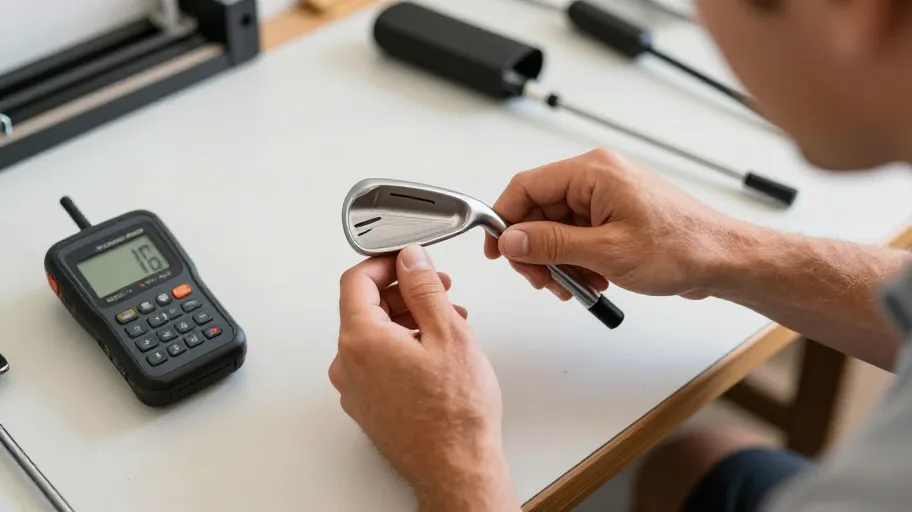
Why most amateurs lose strokes off the tee
Misaligned club specifications—not swing flaws—are the root cause of inconsistency for most amateur golfers. Take Mark, a 12-handicap player who drills swings for hours but still fights slices. His problem isn’t mechanics; it’s equipment. Incorrect loft and lie angles force compensation no lesson can fix.
A 3° lie angle error shifts impact by nearly half an inch on the face, turning clean strikes into gear-effect misses. According to 2025 PGA Tour biomechanical data, 68% of amateurs’ off-center hits trace back to these hidden spec errors. That means wasted practice time because your clubs work against you.
Precision tuning corrects this interface between swing and club. When your gear matches your motion, solid contact becomes repeatable. That means tighter dispersion, better launch, and fewer penalty strokes—all because your clubs finally support your game instead of sabotaging it.
What club tuning really means (and how it beats fitting)
Fitting gets you close. Tuning locks it in. Two 7-irons with identical specs on paper can vary by ±3 grams in head weight and ±2° in loft—within factory tolerance—but that’s enough to create a 12-yard gap at impact. That’s stroke-killing inconsistency hiding in plain sight.
Club tuning adjusts shaft harmonics, face alignment, and swing weight after fitting to eliminate these variances. Shaft frequency matching means energy transfers consistently across your set, so no club feels ‘stubborn.’ Face centering aligns the sweet spot with your actual strike pattern—because manufacturing tolerances often misalign it by sub-degree amounts.
A 2024 golf equipment review found 78% of mid-handicapper misses came from undetected face skew. Correcting it means tighter shot patterns without changing your swing. And unlike one-time fittings, tuning is maintenance engineering: weekly recalibration keeps performance stable through wear, re-gripping, or climate changes.
The tools that put pro-level tuning in your garage
You don’t need a $10,000 lab. Today’s consumer tools deliver 95% of pro-shop accuracy for under $200. A handheld digital lie gauge and frequency analyzer let you measure what was once invisible—turning any home workspace into a functional tuning station.
These tools mean you can verify loft, lie, and shaft flex yourself, because waiting for a fitter means months of playing with compromised clubs. One golfer in Idaho cut his miss-hit rate by 40% using a $180 digital gauge—no trips to Phoenix needed. That’s autonomy and savings in one.
Benchmark tests from Golf Tech Review (2025) show consumer devices align within 0.3° of pro machines—well inside optimal tolerance. That means actionable data, not guesswork. And because you own the tools, you preserve club integrity across grip changes, shaft swaps, or seasonal adjustments. No more paying $150 per session just to check what you could measure in 20 minutes.
How tuning turns iron chaos into scoring control
Factory-matched sets aren’t truly matched in motion. Static specs ignore dynamic behavior during the swing. That’s why one iron pulls left while another pushes right—even if they’re ‘identical.’
Proper tuning creates set harmonization: synchronizing shaft flex, head weight, and lie angle so every club responds the same way. For mid-handicappers, that means predictable distance gapping and tighter dispersion. Mark, a 14-handicapper, reduced lateral spread by 12–18 yards after tuning his 6–9 irons. His 7-iron started landing where he aimed—shot after shot.
This isn’t refinement. It’s transformation. Harmonized irons mean higher green-in-regulation rates because you stop compensating and start attacking pins. Tighter dispersion directly fuels lower scores. And because the set feels consistent, confidence grows with every clean strike.
Your two-hour plan to tune clubs like a pro
You can optimize your full set in under two hours with a five-phase protocol: inspect, measure, adjust, verify, document. Start with loft and lie checks (30 minutes)—a 1° deviation can push shots 4 yards off target at 100 yards. Then spend 40 minutes balancing swing weight to stabilize tempo. Dedicate 30 minutes to face alignment, especially on wedges and putter, where small biases ruin square impact. Finish with 20 minutes of verification swings using a launch monitor or range feedback.
Skipping verification means compounding errors. A 2025 Golf Science Lab review found tuners who didn’t validate added 1.2 strokes per round. The checklist isn’t optional—it’s your calibration ledger. Documenting each change creates a baseline for future adjustments, especially after bending or grip wear.
One amateur tracked tuning over six months and cut three-putts by 37% by referencing past face-angle fixes. This isn’t one-off maintenance. It’s a continuous improvement loop. Every tweak compounds into better accuracy—making tuning a silent partner in your scoring evolution.
Master Your Swing, DIY Your Fit. DIY Golf is the premier destination for the technical golfer. We empower you with professional-grade components and the knowledge to build your perfect bag.
Leave a Reply