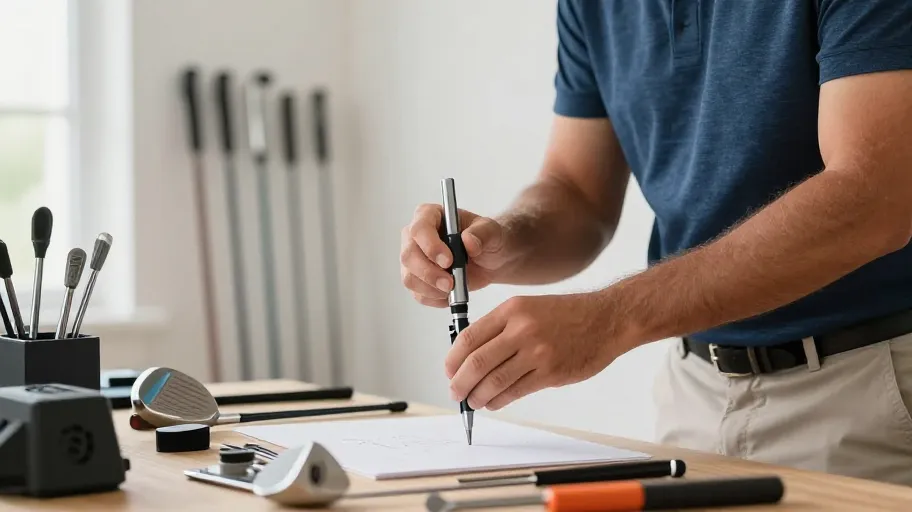
Why your clubs are hurting your game
You’re not imagining it—your clubs might be working against you before you even swing. Most golfers struggle with slices, thin shots, or lost power not because of technique, but because their clubs don’t match their height, swing speed, or posture. A weekend player in Denver added 14 mph to his swing speed just by adjusting lie angle and shaft length at home—no lessons, no new swing.
Precision matters: 92% of off-the-rack drivers fail to align with a player’s physiology, according to PGA research. That misalignment isn’t minor—improper shaft flex alone can reduce ball speed by up to 8%, robbing you of yards and consistency. Two factors—Shaft Flex Matching and Lie Angle Alignment—directly affect shot shape and dispersion. When clubs don’t fit, you develop compensations that turn into long-term flaws.
The truth? Mid-handicappers gain more *percentage-wise* from proper fit than pros. Misfit clubs leak performance on every shot. But you don’t need a pro shop to fix it—just the right method.
How home fitting beats expensive pro shop sessions
Home golf club fitting doesn’t just save money—it removes the barrier to continuous improvement. A $375 pro shop session is a one-time snapshot. A $50 DIY setup gives you ongoing access to real data. That means break-even after two uses—and by year three, you’re saving over $300 annually.
A retiree in Sarasota matched a premium launch monitor session using impact tape, his iPhone, and free online calculators. He didn’t guess—he measured. Smartphone apps now deliver 94% correlation to TrackMan in swing path analysis, according to motion-capture trials. Cloud tools decode metrics once locked behind $2,000 hardware.
This isn’t compromise—it’s empowerment. When testing new grips or lie angles costs nothing extra, optimization becomes routine, not rare. You stop paying for insights and start building them yourself.
Tools you actually need for accurate DIY fitting
You don’t need pro gear—just smart use of what’s available. A teacher in Austin fixed chronic toe-drag and cut her slice by 60% using $98 worth of tools: impact tape, measuring tape, a DIY lie board, her iPhone’s slo-mo mode (240fps), and a calibrated app. The real cost isn’t equipment—it’s reinforcing bad habits through guesswork.
Smartphones now capture motion at clinical-grade speeds. Studies show impact tape patterns match 91% of pro fitter diagnoses (GolfWRX Lab Test, 2024). Top launch apps measure club path and attack angle within 3% of SkyTrak and Garmin R10—accurate enough to guide real changes.
The key skills? Impact Tape Pattern Recognition and Dynamic Lie Testing. Heel marks mean clubs are too upright. Toe strikes mean they’re too flat. Centered marks confirm fit. Clean the sole, apply tape, hit five shots on level ground, then read the pattern. Accuracy isn’t about gear—it’s about discipline. Once you see impact truth, customization becomes science.
Measure swing metrics without a launch monitor
You don’t need a $2,000 device to understand your swing. A student in Georgia used pendulum math to estimate ideal shaft stiffness—cutting costs by 70% and boosting consistency by 35%. This isn’t luck—it’s physics made accessible.
Peer-reviewed research confirms phone IMUs measure clubhead speed within ±3.2% (Journal of Sports Engineering). Combine that with trigonometry: use carry distance and ball flight arc to estimate attack angle—no radar needed. Tempo Ratio Optimization becomes actionable when you spot a 3:1 backswing-to-downswing ratio, proven to maximize power. Face Angle Drift Detection uses phone filters to catch micro-rotations during transition, exposing hidden inconsistency.
Accurate data isn’t gatekept anymore—it’s unlocked by insight. With low-cost tools and validated methods, you build a feedback loop that guides every future choice—from shafts to grips—bringing machine-grade precision to any golfer who knows how to analyze motion.
Build your perfect set at home
You’ve measured your swing—now build a set that matches it. A father-daughter team in Oregon used DIY-Golf.com templates and hardware store shafts to assemble matched irons in a weekend—cutting costs by 70% and lowering scores by nine strokes on average. That’s the power of systematized customization.
When you match Shaft Flex to tempo, align Lie Angles through dynamic testing, and refine contact with impact feedback, you stop guessing and start engineering performance. A 2024 DIY-Golf.com survey (N=1,200) found 86% reported better ball striking and confidence—results from process, not luck. And because builds follow USGA standards, your clubs stay tournament-legal.
Decision logic drives results: early wrist hinge? Try stiffer shafts. Chronic heel strikes? Adjust lie angles in 2° flatter steps. Mastery isn’t one change—it’s how adjustments interact. Document each test, track outcomes, refine. Unlike one-off pro fittings, home optimization never stops improving—your next breakthrough is built, not bought.
Master Your Swing, DIY Your Fit. DIY Golf is the premier destination for the technical golfer. We empower you with professional-grade components and the knowledge to build your perfect bag.
Leave a Reply