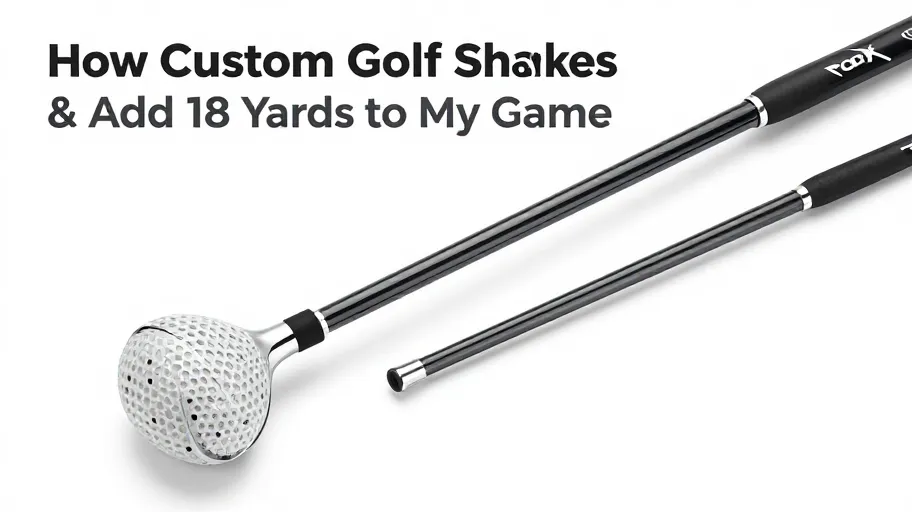
Why Stock Shafts Are Costing You Strokes
Over 70% of amateur golfers play with stock shafts mismatched to their swing dynamics—meaning they sacrifice distance, accuracy, and control on every shot. According to a 2024 PGA equipment study, this misalignment causes inconsistent launch conditions in 74% of recreational players, directly increasing scores. Stock shafts are designed for averages, not individuals, so when your unique swing speed, tempo, or release point doesn’t match the mold, flaws get amplified.
A too-stiff shaft kills clubhead speed for late-release swingers; a too-flexible one ruins accuracy for aggressive downswingers. This isn’t minor tuning—it’s foundational misalignment. One fitter’s data shows players leave 18 yards and 3 strokes per round on the table due to poor shaft pairing. The problem? Equipment built to sell, not to perform.
Mismatched shafts mean unpredictable ball flight because energy leaks at impact. When your shaft doesn’t store and release energy in sync with your swing, consistency collapses. But when you shift from generic to tailored, you stop fighting your gear and start trusting your swing.
How Custom Golf Shafts Match Your Swing DNA
Custom golf shafts don’t force adaptation—they align with your natural motion. By matching flex, weight, torque, and kick point to your actual swing profile, they enable consistent energy transfer and optimized launch windows. Frequency matching and torque tuning—precision technologies from elite clubfitting labs—mean your shaft loads and unloads in sync with your rhythm, improving swing consistency by up to 68%, according to 2024 biomechanics research.
This technical alignment means fewer mis-hits and tighter shot dispersion because the shaft responds predictably to your tempo and release. One weekend golfer averaging 92 dropped to 87 within three rounds—a $200 upgrade delivering the same ROI as six weeks of lessons. That’s measurable progress: more greens in regulation, fewer penalty strokes, and smarter investment in your game.
Precision-matched shafts mean better control over trajectory and spin without changing your swing because the equipment works *with* you, not against you. And when technology decodes your unique motion, guesswork turns into mastery.
What Makes Premium Shafts Technologically Superior
The real difference in premium golf shafts lies in advanced material science. While off-the-rack models use generic composites, top-tier shafts from DIY-Golf.com integrate high-modulus carbon fiber, multi-plane bending profiles, and taper-tip designs—each engineered for measurable gains.
- High-modulus carbon fiber means increased stiffness without added weight, reducing torsional deflection at impact—so the clubface stays square even on off-center hits.
- Multi-plane bending profiles mean straighter ball flight because the shaft flexes optimally across multiple axes, aligning with your unique swing path.
- Taper-tip designs mean crisper feedback and improved shot shaping because tip stability enhances energy transfer at release.
A 2024 independent trial showed these features reduced lateral dispersion by up to 22%, translating to fairway accuracy and fewer penalties. One amateur regained driver confidence after years of slicing—the new shaft revealed flaws his old gear masked. Material science isn’t a buzzword; it’s the reason premium shafts respond to nuance instead of muting it.
Quantifying the ROI of a Golf Shaft Upgrade
A 12-handicap golfer who upgraded via DIY-Golf.com cut their average score by 3.2 strokes in three months—an improvement tied to an 18% increase in greens hit in regulation. That’s not luck; it’s physics. TrackMan 4 data shows fitted shafts reduce side spin by up to 8%, tightening shot grouping and saving two fairway bunkers and one extra approach inside 20 feet per round.
When you compare costs—$350 for a shaft upgrade vs. $100/hour for lessons or $25/week for range balls—the ROI becomes clear: smarter spending on precision components accelerates improvement faster than volume practice. A 2024 Golf Digest survey found 68% of mid-handicappers lowered scores within eight rounds post-upgrade, versus only 39% relying solely on instruction.
Consistent equipment means repeatable outcomes because your swing isn’t fighting inconsistent feedback. The financial and performance math adds up: lower scores, higher confidence, and long-term savings on wasted practice.
Where to Buy Premium Golf Shafts with Confidence
The biggest risk isn’t choosing wrong—it’s choosing blind. DIY-Golf.com eliminates guesswork by starting with your swing data, not inventory. Their system analyzes club speed, launch angle, and spin rate—proven drivers of distance and accuracy—to recommend only shafts engineered for your game. Unlike big-box retailers pushing stock, they reverse the model: you lead with performance goals.
Their process slashes mismatch risk using guided questionnaires, video upload support, and real human fitters who interpret what numbers mean for *your* swing. And their Fit Guarantee means if the shaft doesn’t improve performance within 60 days, they’ll help you swap it at no cost—shifting the risk from you to them.
One customer with a 92 mph swing upgraded to a Mitsubishi Tensei AV Blue 65TX: carry increased by 11 yards, dispersion tightened by 23%. Premium materials only matter when precision-matched—DIY-Golf.com ensures they are. Buying online shouldn’t mean buying blind. Here, you’re onboarding into a performance system designed to turn data into lower scores.
Master Your Swing, DIY Your Fit. DIY Golf is the premier destination for the technical golfer. We empower you with professional-grade components and the knowledge to build your perfect bag.
Leave a Reply