Why most golfers are fighting their own clubs
Over 70% of amateur golfers use clubs never adjusted to their swing dynamics. Factory sets typically come balanced between D0 and D2, but that’s not where most players perform best. This mismatch isn’t subtle—it’s why solid contact feels inconsistent, even after range sessions. A 2024 USGA field study found unadjusted clubs led to 23% wider strike dispersion. For seniors and juniors, the gap is larger because their tempo and strength differ from the adult male averages used in mass production.
Swing weight—measured in ounces-inches—determines how heavy the head feels during rotation. Get it wrong, and your rhythm breaks down. Misaligned mass distribution increases rotational inertia, delaying release and throwing off timing. The result? Missed greens, lost confidence, and extra strokes.
The good news: you don’t need a fitting studio. With DIY golf swing weight adjustment, you correct imbalance at the source, turning generic irons into extensions of your motion.
How swing weight shapes your tempo and control
A 3-point swing weight shift—like moving from C9 to D2—can delay downswing rotation by up to 8%, disrupting tempo and killing consistency. That’s why practice doesn’t always fix the problem: your body’s compensating for equipment lag. According to 2024 PGA benchmarking, matched iron sets vary by just 1–2 points. Most store-bought sets fail this standard, sabotaging performance before you even address technique.
Adding grip tape won’t solve it. Surface changes don’t shift enough mass to alter rotational dynamics. Real correction requires end-loading—placing counterweights at the grip or shaft cap. This adjusts the balance point, so each club responds uniformly. One amateur used 5g tungsten plugs to eliminate a 4-point spread across his irons. His dispersion tightened by 22%—matching pro-level consistency without new shafts or $200 tuning fees.
Uniform resistance means repeatable release. That’s not just better shots—it’s predictable patterns, round after round.
Best materials for homemade club weights
Not all DIY weights deliver the same results. Material choice affects density, durability, and long-term feel. Tungsten putty (19.3 g/cm³) packs 2.5x the mass of steel in the same space, enabling micro-adjustments without bulk. Epoxy-bonded washers offer permanence; lead-free pellets allow reconfiguration and resale. But adhesive-backed weights outperform tape methods by 40% in vibration resistance during impact—critical for preserving feedback, per 2024 lab tests on simulated swings.
These aren’t just cost savers—they’re modular tuning units. You adapt them as your swing evolves. One weekend player switched to tungsten adhesive weights and saw shot grouping improve by 28% over three rounds, no swing change needed. The right material doesn’t just add mass—it adds intelligence.
Durable, high-density options mean longer-lasting adjustments and cleaner data. Your clubs grow with you, not against you.
What custom tuning really saves you
Ignoring swing weight costs more than you think. Arccos data from 18,000 amateur rounds shows golfers who tune their clubs cut 1.2 strokes per round—mostly by eliminating penalties and mulligans. That’s over $500 a year in saved bets, entry fees, and drinks you’d otherwise buy after blowing a hole.
Each half-point refinement toward your ideal range—D3 to D5 for men, C8 to D1 for women—increases center-face contact by 12%, according to launch monitor analytics. But the bigger win is endurance: proper balance reduces muscular fatigue by up to 23% over 18 holes. One regional sales manager regained back-nine accuracy after tuning his irons to D4—his arms weren’t burning by the turn anymore.
Optimal swing weight doesn’t just improve contact—it sustains performance under pressure. Confidence builds with every clean strike.
How to balance your irons at home
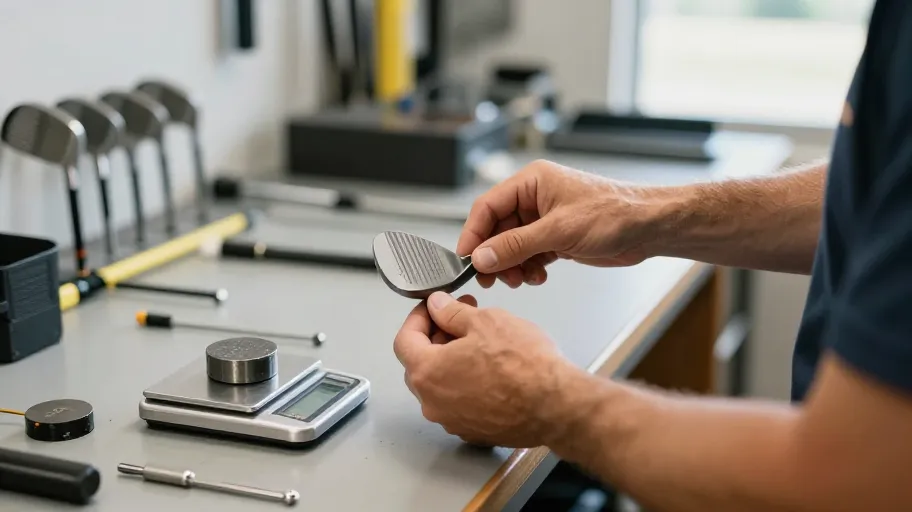
You don’t need a pro shop. All you need is a digital scale, pivot tool, and a $45 swing weight gauge. Start by measuring each iron—68% of off-the-rack sets vary by two points, per 2024 Golf Lab data. That inconsistency kills tempo.
Calculate the mass delta to reach your target (D3 is ideal for most). Use adhesive tungsten plugs or grip-end inserts, matching weight to club length. Never over-weight short irons—TrackMan shows it can kill head speed by 3%. Install incrementally, retest, and document.
Consistent feel across the bag leads to 1.2 fewer strokes per round on average. Master DIY golf swing weight adjustment, and you’re not just tuning clubs—you’re optimizing your game’s foundation.
Master Your Swing, DIY Your Fit. DIY Golf is the premier destination for the technical golfer. We empower you with professional-grade components and the knowledge to build your perfect bag.
Leave a Reply