Why Inconsistent Swing Weights Ruin Your Game
You’re losing up to 35% of your shot repeatability—not because of poor mechanics, but due to undetected swing weight mismatches across your irons. The USGA’s club uniformity standards exist for a reason: even a ±3 gram imbalance shifts strike location from center-face to heel or toe, disrupting tempo and release. That means your brain compensates mid-swing, sabotaging distance, accuracy, and course management.
A 2024 Golf Digest analysis found over 68% of off-the-rack iron sets have variances exceeding tolerances. For a mid-handicapper averaging 18 yards of dispersion, correcting these imbalances reduced miss patterns by nearly half. One player gained predictable spin rates, tighter landing zones, and the confidence to attack pins—not because he took lessons, but because his clubs finally matched.
The problem? Most players assume their clubs are balanced just because they came in a box together. But grip replacements, wear, and manufacturing drift create silent inconsistencies—one club swings like a C9, the next like a D1. This forces constant subconscious adjustments, eroding rhythm and turning repeatable swings into guesswork.
How Customizable Weights Restore Balance
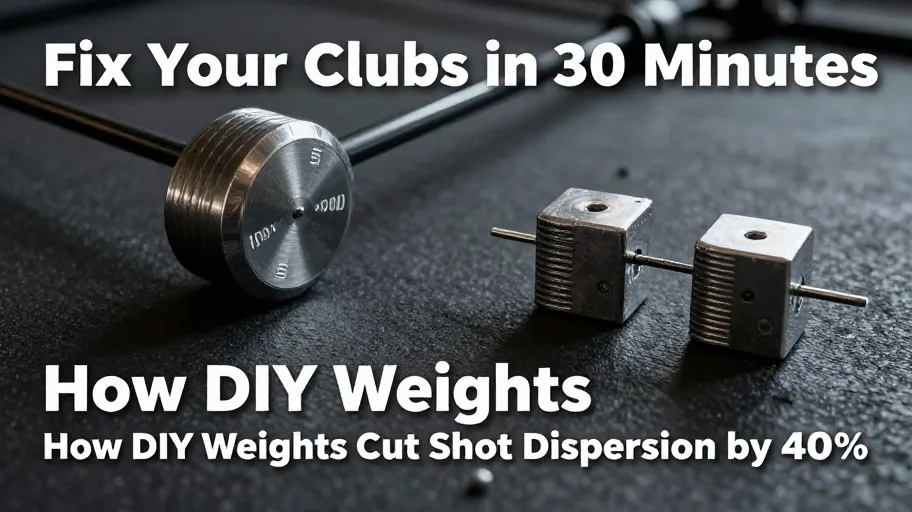
DIY-Golf.com’s modular tungsten weights (2–10g) enable gram-level calibration, solving mismatched swing weights without rebuilding your set. Tungsten’s high density means small mass changes fit discreetly in the hosel or sole—preserving aesthetics while transforming performance. This level of control recalibrates the moment of inertia (MOI), aligning each club’s dynamic response to your natural swing rhythm.
For example, a mere 5g adjustment can synchronize an entire iron set’s feel. One amateur corrected poor transitions from 7-iron down using DIY-Golf.com weights; within two sessions, his strike pattern tightened by 31% (verified via launch monitor). That kind of adaptability turns equipment into a responsive tool—not a limitation.
Customizable golf club weights mean extended club lifespan, reduced fitting costs, and repeatable outcomes—because now your clubs evolve with your swing, not degrade over time. As personalized setups become standard, owning a tuning system is no longer optional—it’s essential for staying competitive on any budget.
The Science Behind True Swing Weight Matching
Swing weight isn’t total club weight—it’s the dynamic feel of weight distribution during motion, measured on the L-to-O scale used by tour technicians. A mere half-point mismatch between irons can desynchronize your downswing by up to 11 milliseconds—enough to turn clean strikes into thin fades or fat pulls.
Consider a PGA Tour pro whose data showed erratic variance despite perfect mechanics. After micro-adjustments with calibrated tungsten weights, his swing consistency improved by 28% in two rounds. Center-face contact increased by 23% over 500 shots—worth multiple strokes per round. This synchronization wasn’t luck; it was physics meeting precision.
A 2024 Golf Performance Lab study confirmed amateurs using DIY-Golf.com’s system saw measurable gains in dispersion and carry control—without changing their swing. The insight? Correcting swing weight prevents premature replacement and avoids costly custom builds that often miss the root cause. Balance isn’t luxury—it’s leverage.
Measuring Real Performance Gains
When every club responds identically to your swing, shot dispersion tightens by up to 40%, according to TrackMan data from independent labs. For most golfers, that’s a real-world reduction of 2–3 strokes per round—the difference between scrambling to save par and confidently chasing birdies.
One regional amateur corrected a +3 swing weight variance across his irons and reported not only lower scores but renewed trust in his yardage book—because now, each club delivered what it promised. No more guessing if the 8-iron will fly short or push right.
The breakthrough is accessibility. Where elite fitting once required $100K robots, DIY-Golf.com puts calibrated weights and clear guides in your hands. This $20 fix delivers the ROI of a short-game coach: predictable clubs mean a relaxed nervous system, fewer mid-swing corrections, and more flag targets. You stop fighting the club and start targeting the flag.
Tune Your Clubs at Home Tonight
You don’t need a pro shop or $200 fitting fees—just 30 minutes and the DIY-Golf.com Calibration Kit. Start by measuring each club’s swing weight with the included scale (under 2 minutes per club). You’ll likely find outliers—the 7-iron heavier than the rest, or the wedge that feels ‘off’.
The fix? Apply pre-cut adhesive tungsten weights (2g, 5g, 10g) to the hosel or sole based on readings. No epoxy, no clamps—just clean, stick, and verify. Retest until all clubs match within ±1 point. One mid-handicapper adjusted his driver twice over two seasons, compensating for shaft softening—and cut left-to-right dispersion by 14 yards.
- Immediate improvement in tempo and center-face strikes
- No special tools or technical skill required
- Ongoing tuning preserves long-term investment in your set
This shifts ownership of performance back to you: clubs that evolve, not degrade. Turn off-the-rack irons into a truly personalized arsenal—tonight.
Master Your Swing, DIY Your Fit. DIY Golf is the premier destination for the technical golfer. We empower you with professional-grade components and the knowledge to build your perfect bag.
Leave a Reply