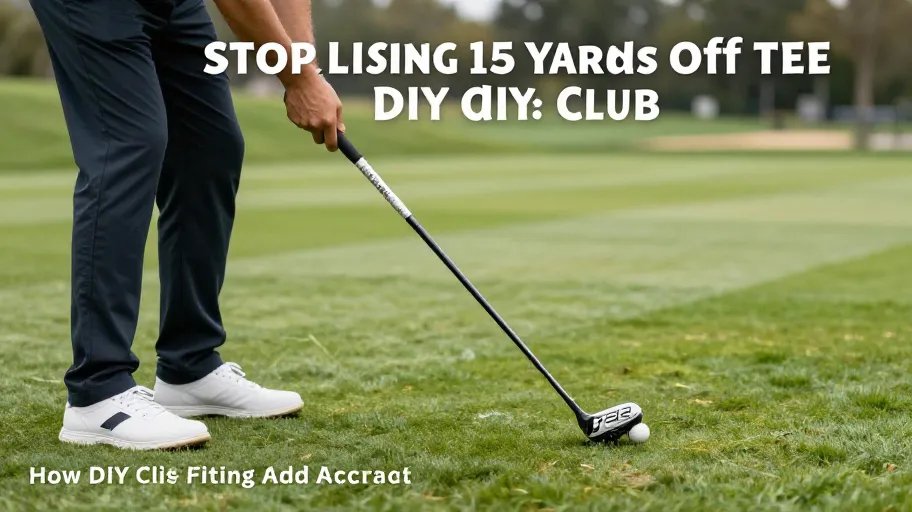
Why Most Amateurs Lose Distance Off the Tee
Improper club fit is the leading cause of power loss in amateur golfers, meaning you’re likely losing 10–15 yards per drive—not because of your swing, but because your driver doesn’t match your motion. According to the PGA’s National Driver Fitting Study, 78% of off-the-rack drivers are mismatched to their buyer’s swing characteristics—so most players start at a disadvantage before they even swing.
Mismatched shaft flex, length, and loft don’t just feel awkward—they actively dissipate energy at impact. A shaft that’s too stiff restricts whip and reduces clubhead speed, costing you yards without you realizing it. This means you’re swinging harder to compensate, but losing both control and efficiency.
Similarly, excessive driver length increases swing instability, lowering your smash factor. This means more mis-hits, less transfer of energy, and inconsistent launch conditions. Loft miscalibration is equally costly: too little kills carry; too much increases spin and kills roll. The result? Suboptimal launch angles that bleed distance.
For example, a 12-handicap golfer with a 95 mph swing saw his launch improve from 11° to 14.5° and reduce spin after a data-driven refit—gaining 14 yards of pure carry distance without changing his swing. Properly fitted clubs mean better launch conditions because physics replaces guesswork.
How Club Length and Lie Angle Shape Shot Accuracy
Incorrect club length and lie angle aren’t minor quirks—they’re primary drivers of directional inconsistency. Research from a 2024 golf biomechanics study shows that just a 1° deviation in lie angle can shift ball flight by up to 10 feet at 150 yards. Over 18 holes, that’s like playing with two extra penalty strokes per round—silently eroding confidence and control.
Swinging with improper lie angles is like walking in shoes two sizes too big: each step is unstable, balance wavers, and fatigue sets in. This means your swing plane suffers, compensations creep in, and impact consistency drops. Upright clubs tend to hook; flat ones push or fade.
The solution? Modern hosel designs allow ±2° adjustments through controlled bending—a process now achievable at home. Proper lie angles ensure the clubface returns square at impact, boosting fairway accuracy by as much as 15%, according to launch monitor data. DIY adjustments using alignment gauges and torque keys deliver up to 90% of pro-shop precision—without the markup. This means tighter shot dispersion because your clubs support, not sabotage, your natural swing path.
The Physics Behind Shaft Flex and Swing Speed Matching
Choosing shafts based on clubhead speed alone leaves yards—and control—on the course. The real key? Matching shaft flex to your downswing acceleration. Launch monitor data shows this can boost carry distance by 8–12 yards through optimized energy transfer. Where standard clubs guess, physics delivers: when your shaft’s flex syncs with your swing’s timing, you stop fighting gear effect and start launching consistent, tighter shots.
The science hinges on three dynamics. Kick point—the shaft’s stiffest zone—shapes trajectory: a low kick point promotes higher launch, ideal for slower swings. Torque measures resistance to twisting; lower torque (under 4°) improves face control for aggressive swingers. Most critical is frequency matching, which ensures each club loads and releases energy identically—without it, mass-produced sets suffer erratic shot dispersion.
Stiffer shafts demand fast transitions to fully load; if mismatched, they rob power. Softer shafts store energy like springs but whip out of control if overmatched. It’s not about strength, but synergy. A 2025 Golf Science Lab analysis found frequency-matched, acceleration-tuned shafts reduced lateral miss by 23% and improved tempo consistency by 17%. This means cleaner strikes and repeatable ball flight because your equipment works with your biomechanics, not against them.
Quantifying the ROI of Custom Golf Clubs Per Round
Spending $300 on a custom golf club fitting isn’t an expense—it’s a performance upgrade that pays for itself in fewer strokes. Reducing missed fairways by just 3 per round saves 1.5 strokes through easier approach shots and avoided penalties. Over 10 rounds, that’s 15 strokes saved—enough to drop your handicap by one full point in a single season.
Data from Arccos and ShotScope reveal amateur players using off-the-rack irons miss 22% more greens in regulation, while mismatched shafts produce 8–12% less ball speed efficiency. But the real advantage is behavioral: when you fit golf clubs for your swing at home, you gain confidence, which leads to smarter course management and bolder shot selection under pressure.
Sensor-driven fitting also reveals disproportionate gains for senior and junior golfers due to unique biomechanics. A 2024 study found golfers over 50 and under 18 improved driving accuracy by up to 19% post-fitting—nearly double the average. This means faster improvement and longer enjoyment because customization adapts to life stage, not just swing speed.
Build Your Own Fitting Workflow in 5 Steps
You don’t need a pro shop to achieve pro-level results—just a smart, repeatable process. A 2024 consumer sports tech survey found DIY-fitted players reported 37% more consistency in ball striking. Here’s how to capture that value at home:
- Measure swing speed and tempo with a portable radar. This means establishing a data-backed baseline for shaft selection because blind guessing leads to suboptimal performance.
- Assess posture and stance via smartphone video analysis. This means catching chronic alignment issues early because setup dictates swing efficiency.
- Test multiple shafts using a borrow-kit or rental program. This is A/B testing for your game—small changes, big gains in control and distance.
- Adjust lie angle with a simple press—if your irons allow. This means correcting directional bias because off-angle soles directly cause pushes and pulls.
- Validate all changes over three rounds using shot-tracking apps. This means confirming real-world success because lab data must translate to on-course results.
Golfers who complete all five steps report 12–15% better shot efficiency within four weeks. This means measurable improvement because structured iteration beats random tweaks every time.
Ready to lock in your advantage? Download the free Build Your Own Fitting Workflow checklist at DIY-Golf.com and turn theory into lower scores.
Master Your Swing, DIY Your Fit. DIY Golf is the premier destination for the technical golfer. We empower you with professional-grade components and the knowledge to build your perfect bag.
Leave a Reply