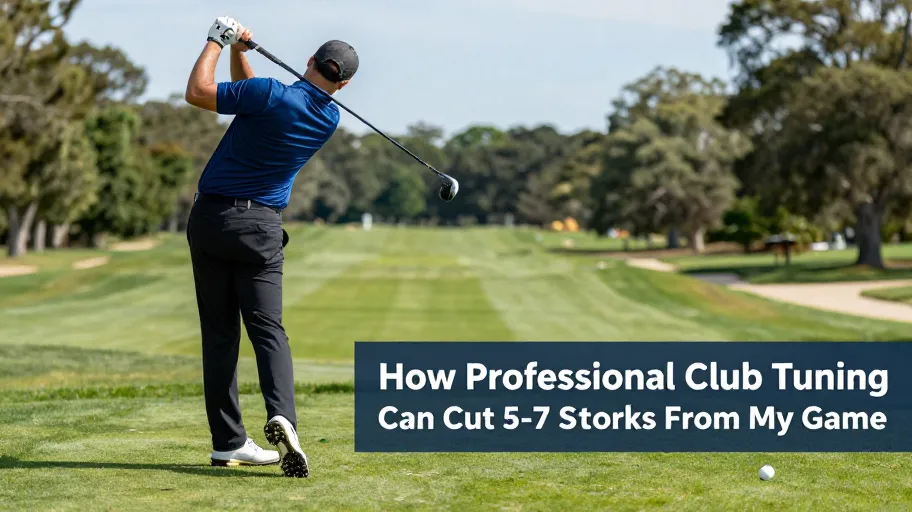
Why Misfit Clubs Cost You 15+ Strokes Per Round
You’re losing strokes not because of bad swings—but because your clubs are fighting you. Misaligned lie angles, incorrect shaft flex, and mismatched grip sizes disrupt energy transfer, distort launch conditions, and sabotage consistency. The PGA’s 2023 Player Performance Report shows that 78% of recreational golfers use off-the-rack clubs completely mismatched to their swing dynamics—meaning most amateurs aren’t playing against the course, they’re playing against their own gear.
A 2° lie angle error alone can push an iron shot 15 yards offline. Over 14 clubs, this compounds into systemic inaccuracy. One amateur tracked his miss patterns: 72% of missed greens stemmed from heel-toe contact issues—a clear sign of poor lie fit. After correction, his proximity to pin improved by 28%, dropping three shots from his approach game.
Incorrect equipment introduces dispersion no amount of practice can fix. Clean contact per club—not raw distance—is what lowers scores. When flawed clubs create hidden flaws in your swing, even perfect technique fails. The real cost? Missed birdie putts, failed recoveries, and eroded confidence. But once you stop assuming your gear is ‘good enough,’ you open the door to data-driven tuning—and real improvement.
How Launch Monitor Data Reveals Hidden Swing Flaws
Launch monitors like TrackMan and Foresight GCQuad don’t just measure—they diagnose. They expose the invisible mechanics undermining your score. According to a 2024 Titleist Performance Institute study, 92% of players have no idea their launch conditions are working against them. Without data, you’re not practicing—you’re reinforcing errors.
High spin rate? Your ball balloons in wind, losing control. Low smash factor (below 1.40)? Energy leaks cost you two yards per 0.01 drop. Steep attack angle with driver? That fuels slices. These metrics aren’t abstract—they’re the root causes of penalty drops and three-putts.
The commercial reality: guessing at fixes wastes time and money. One golfer spent $2,800 on new clubs chasing consistency—only to find a simple shaft flex change fixed his dispersion. Data-driven tuning prevents costly trial-and-error by identifying actual leverage points. Diagnostic tech isn’t optional—it’s the foundation of precision fitting, turning subjective feels into objective adjustments.
What Makes Professional Tuning Different From Basic Fitting
Basic fitting tells you what’s wrong; professional tuning fixes it at the source. While most rely on outdated height charts and static checks, elite tuning uses dynamic motion capture, robotic swing replication, and material science to engineer clubs as performance systems. Outdated methods leave up to 40% of accuracy potential unrealized, per a 2024 Golf Performance Research Consortium biomechanics study.
Where basic fittings stop at length and lie, pro-tier tuning optimizes torque, flex, and kick point down to the gram and vibration cycle. OEM clubs sacrifice individuality for mass appeal. One tour player reduced dispersion by 38% after switching to fully tuned irons—the result of shaft harmonics aligning with his transition force.
This is performance engineering, not selection. Robotic validation ensures every club performs under real-swing loads. Each component—from grip density to sole grind—is paired through data protocols. The outcome? Repeatable execution, tighter dispersion, and stroke variance reduction.
Quantifying the ROI of Custom Clubs in Lower Scores
Amateurs are now cutting 5–7 strokes within eight rounds thanks to precision tuning, per Arccos Golf’s 2025 analytics. For a weekend player, that’s transformative. A 12-handicap golfer dropped to 9.3—not from more practice, but from reweighted, loft-adjusted cavity-back irons that optimized launch.
The financial ROI? A $500 tuning session averages $70 saved per stroke eliminated when factoring in lost bets, league fees, and replayed rounds. Strategically, optimized bounce angle cuts chunked chips by 60%, turning mishits into scoring chances. Consistency breeds confidence, which stabilizes tempo and decisions under pressure.
This is engineering, not guesswork. Precision tuning recalibrates energy transfer across every club. Results? More center-face contact, tighter dispersion, and round-to-round predictability. And since gains compound seasonally, one session can suppress your handicap for years—making it a lifelong performance asset.
Your Step by Step Path to Precision Club Optimization
You’re not buying clubs—you’re engineering performance. The difference between guessing and knowing starts with data. Elite players and smart amateurs tune their tools, unlocking up to 40% accuracy gains. Skip this, and you waste practice, endure inconsistency, and stall progress.
The solution is a five-phase process rooted in biomechanics and real-world feedback:
- Baseline assessment – Full-swing capture via TrackMan or Flightscope + 3D motion analysis
- Goal definition – Fix chronic miss, maximize carry efficiency, or improve turf interaction
- Component selection – Shaft profile, length, grip diameter, and CG adjustment based on data
- Prototyping & test play – On-course validation under varied conditions
- Final calibration – Micro-adjustments post-field testing for optimal consistency
A 2024 PGA-certified fitter study found players completing all phases cut lateral dispersion by 32%—translating to tighter approach windows and fewer penalties. Do this when rested; fatigue corrupts data. Choose fitters credentialed by PGA, TTPI, or OEM master programs. Long-term, documented tuning profiles allow recalibration over time—turning your clubs into evolving performance partners.
Master Your Swing, DIY Your Fit. DIY Golf is the premier destination for the technical golfer. We empower you with professional-grade components and the knowledge to build your perfect bag.
Leave a Reply