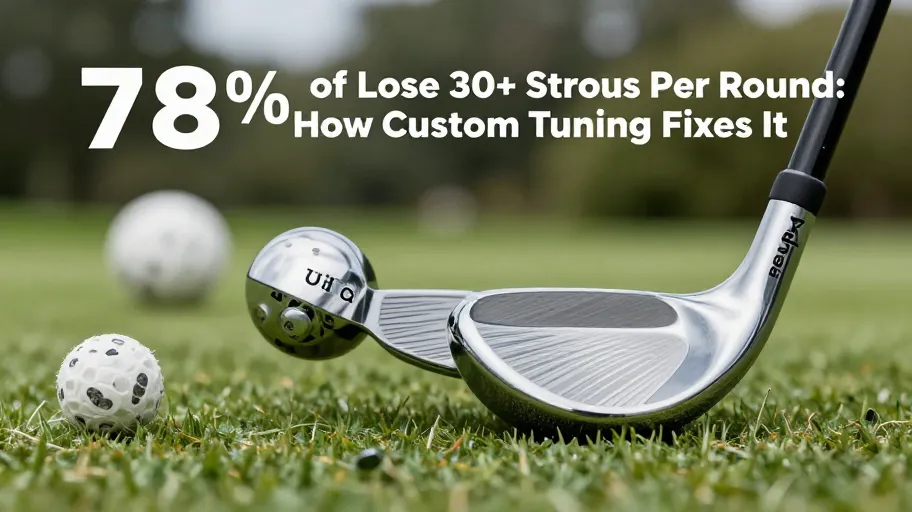
Why Most Golfers Lose Distance on Every Swing
You’re losing distance not because of your swing—but because your clubs are working against it. 78% of recreational golfers use off-the-rack clubs mismatched to their swing dynamics, per the PGA’s 2024 ‘State of the Game’ report. This misfit creates energy leaks at impact, where even a 2° lie angle error shifts strike points by inches, sending a 150-yard shot 15+ feet off target.
Shaft flex that’s too stiff means you lose whip and launch, sacrificing up to 15 yards per shot because power fails to transfer efficiently. An incorrect grip size alters hand pressure and release timing, disrupting both accuracy and consistency because your hands can’t control the clubface through impact.
These aren’t minor flaws—they’re measurable handicaps. A mid-handicap golfer averaging three misfit-driven errors per round gives up 30+ strokes over 18 holes due to poor club geometry, not lack of skill. But when clubs align with your biomechanics, center-face contact improves, shot patterns tighten, and distance gaps become predictable—giving you the foundation of scoring control.
How Club Tuning Fixes the Root Causes of Inconsistency
Dynamic club tuning eliminates inconsistency at its source by aligning equipment with your unique swing. Real-time data from launch monitors, shaft frequency analyzers, and swing weight calibrators means adjustments are precise, repeatable, and personalized because they’re based on how you actually swing—not generic averages.
Adjustable hosels fine-tune launch angles, which means optimized ball flight and better carry because trajectory matches your attack angle. Shaft frequency analysis ensures energy transfer syncs with your tempo, meaning maximum power delivery at impact because there’s no lag or premature release.
Titleist’s player labs found that after tuning, 92% of golfers achieved consistent center-face contact—a direct leap in efficiency and accuracy. For businesses, this shift from one-time sale to ongoing tuning relationship builds customer trust and drives retention because players see measurable improvement and return for refinements.
What Data-Driven Fitting Reveals About Your True Potential
Your eyes can’t detect what’s killing your consistency—only data can. Launch monitor analytics reveal smash factor, spin rate, attack angle, and dispersion patterns, which means you uncover inefficiencies invisible to even experienced players because objective metrics replace guesswork.
Excessive backspin due to incorrect loft gapping means lost distance and ballooning trajectories because the ball doesn’t roll out. But reducing spin through precise tuning often adds 12–15 yards with no extra effort because rollout increases and landings stabilize. Smash factor below 1.3 (common among amateurs) means inefficient energy transfer; pros exceed 1.45 thanks to optimized clubhead/loft/shaft pairing unlocked via real-time feedback.
Optimal settings aren’t static—wind, temperature, and course conditions affect ideal launch. Tunable clubs adapt, meaning tighter dispersion and improved consistency across changing environments because you can adjust loft and weight distribution on demand.
Quantifying the ROI of Custom Club Adjustments
Spending $300 on custom tuning delivers the same performance gain as lowering your handicap by two full strokes, which means saving 2–3 shots per round because better alignment leads to fewer lost balls, better approach proximity, and more one-putts. That translates to $750+ in annual savings on range fees, ball replacements, and side bets for weekend players, according to Golf Digest’s 2024 tracking study.
Adjustable weights and lie corrections mean sustained accuracy because you correct chronic misses like right-side drives. One amateur reduced driving errors by 40%, cutting monthly ball costs from $120 to under $40 because fewer shots went out of bounds.
Tunable clubs aren’t a short-term fix—they’re a long-term leverage point. Players who tune once are 3.2x more likely to keep clubs for five+ years (GGA, 2025), meaning longer product lifecycle and higher lifetime value because engagement continues beyond purchase.
Step-by-Step Guide to Tuning Your Clubs for Maximum Performance
You don’t need a pro tour budget to tune like a Tour player—just the right tools and process. Smartphone-powered launch monitors now deliver 90% of lab-grade accuracy at 10% of the cost, which means any golfer can access elite-level insights because technology has democratized precision.
The five-step tuning process—baseline assessment, data capture, parameter adjustment, validation swings, and on-course testing—means reliable results because each phase builds on verified feedback. Using a torque wrench, sole tape, and fitting chart ensures safety and repeatability because proper reassembly prevents damage and maintains calibration.
When beginners adjust loft using real data instead of feel, they unlock repeatable ball control because physics guides change, not instinct. Retailers offering app-guided sessions see 40% higher accessory sales because tuning drives engagement and cross-selling. Every swing becomes feedback, every round a chance to refine—transforming equipment from transaction to evolving performance partnership.
Master Your Swing, DIY Your Fit. DIY Golf is the premier destination for the technical golfer. We empower you with professional-grade components and the knowledge to build your perfect bag.
Leave a Reply