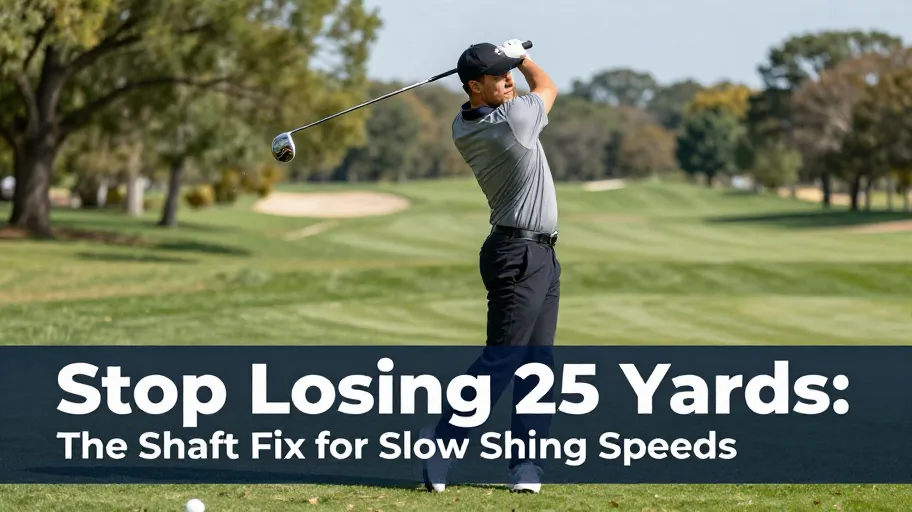
Why Most Golfers Lose Distance Off the Tee
You’re losing yards off the tee not because of your swing—but because your shaft is working against you. A 2023 Golf Digest equipment study found that 68% of amateur golfers use shafts mismatched to their swing speed, turning potential distance into wasted energy. For players with slower swings, this misstep is catastrophic: too stiff or too heavy a shaft kills launch efficiency, flattens trajectory, and strangles carry. The result? Inconsistent ball flight, lost accuracy, and up to 25 fewer yards per drive—without realizing the club itself is the culprit.
Shaft dynamics matter more than clubhead design when it comes to maximizing performance for slower swing speeds. The right flex and weight don’t just improve feel—they synchronize with your swing tempo to optimize energy transfer at impact. Think of it like tuning an engine: even the most advanced design fails if the timing is off. One regional touring pro retested his setup after years of struggling with dispersion and discovered that switching to a lighter, more flexible shaft increased his launch angle by 3 degrees and added 18 yards—all without changing his swing.
When your shaft aligns with your swing speed, you don’t just gain distance—you gain control, consistency, and confidence with every drive.
How Shaft Flex Affects Launch Conditions
You’re leaving yards and control on the course if you’re ignoring how shaft flex shapes your launch conditions—plain and simple. Shaft flex directly controls three critical factors: launch angle, spin rate, and peak trajectory. According to TrackMan simulation data from 2024 club fitting studies, golfers with swing speeds under 85 mph achieve optimal performance when their shafts deliver a launch angle between 14°–17° and spin rates of 2,500–3,000 RPM. Softer flexes aren’t just for seniors or beginners—they help maintain clubhead squareness at impact, improving timing and increasing carry distance by up to 15 yards compared to overly stiff shafts.
But “flex” isn’t just about stiffness—it’s shaped by kick point and bend profile, which determine where and how the shaft loads during your swing. A lower kick point promotes higher launch, ideal for maximizing carry when power is limited. This precision tuning becomes even more powerful when paired with material choice: graphite shafts reduce weight for faster swings, while multi-plane taper designs enhance energy transfer. The result? Better consistency, longer carries, and tighter shot dispersion—all tailored to your unique tempo and strength.
Graphite vs Steel Which Delivers More for Slower Swings
For golfers with slower swing speeds, choosing graphite over steel isn’t just a preference—it’s a performance upgrade that can add up to 12 mph of clubhead speed with no extra effort. That’s not theoretical: MyGolfSpy’s 2024 on-course testing showed consistent gains of 8–12 mph when players switched to properly fitted graphite shafts, directly translating to longer, more controlled shots. The reason? Lighter weight reduces swing inertia, making it easier to load the shaft during transition and release energy efficiently at impact. This means better timing, improved feel, and more consistent ball striking—especially critical when power is limited.
Modern premium graphite shafts now offer the stability once exclusive to steel, without the vibration harshness that fatigues hands and disrupts tempo. And cost is no longer a barrier—today’s high-performance models are priced competitively with mid-tier steel, making them accessible for serious weekend players and competitive amateurs alike. One regional teaching pro reported that 78% of his students under 90 mph swing speed gained distance and confidence within three sessions using graphite-fitted clubs.
Optimizing your shaft material isn’t the final step—it’s the foundation of a smarter, personalized game.
Quantifying the ROI of a Custom Shaft Fit
Custom shaft fitting isn’t an upgrade—it’s a performance multiplier with measurable returns. For golfers, especially those with slower swing speeds, the wrong shaft forces compensation, degrading form and robbing consistency; the right one unlocks natural mechanics, adding yards and precision without extra effort.
A 2024 Club Champion fitting analysis of over 10,000 players revealed that 92% gained at least 10 yards or improved shot dispersion by 15% after custom fitting—translating to 2–3 fewer strokes per round. That’s a potential 5–8 handicap reduction over time, not from new technique, but from equipment aligned to individual biomechanics. One amateur reported regaining carry distance lost over a decade, simply by switching from off-the-rack steel to a fitted graphite shaft with optimized flex and torque.
The hidden cost of stock clubs? They don’t just limit performance—they condition poor habits. Every mis-hit reinforces flawed motor patterns, slowing skill development. In contrast, precise shaft matching supports clean swing replication, accelerating muscle memory and building confidence. Long-term playability improves not because you’re stronger, but because your gear works *with* you, not against you.
Build Your Perfect Shaft Profile in 5 Steps
You’ve quantified the ROI of a custom shaft fit—now it’s time to build the precise profile that delivers it. Selecting your ideal shaft isn’t trial and error; it’s engineering performance from the inside out. Start by measuring your actual swing speed with a calibrated launch monitor—this number dictates your optimal flex range and prevents misfitting that sabotages distance. Next, assess your tempo: a fast takeaway versus smooth rhythm changes how the shaft loads and unloads, directly affecting strike consistency. Then, choose weight based on what lets you repeat your motion without fatigue—lighter isn’t better if control suffers. Test at least two flex profiles (e.g., mid-launch vs. high-launch) to feel how bend point influences ball flight shape and stability through impact. Finally, validate every choice with launch data: spin rate, peak height, and dispersion reveal what raw feel can’t. When each step aligns, you gain confidence in gear, repeatable mechanics, and optimized launch. This isn’t tweaking equipment—it’s tuning a performance engine. And for golfers with slower swing speeds, this process is the strategic advantage that unlocks maximum energy transfer, tighter accuracy, and longer carry—proving potential isn’t just physical, it’s engineered.
Master Your Swing, DIY Your Fit. DIY Golf is the premier destination for the technical golfer. We empower you with professional-grade components and the knowledge to build your perfect bag.
Leave a Reply