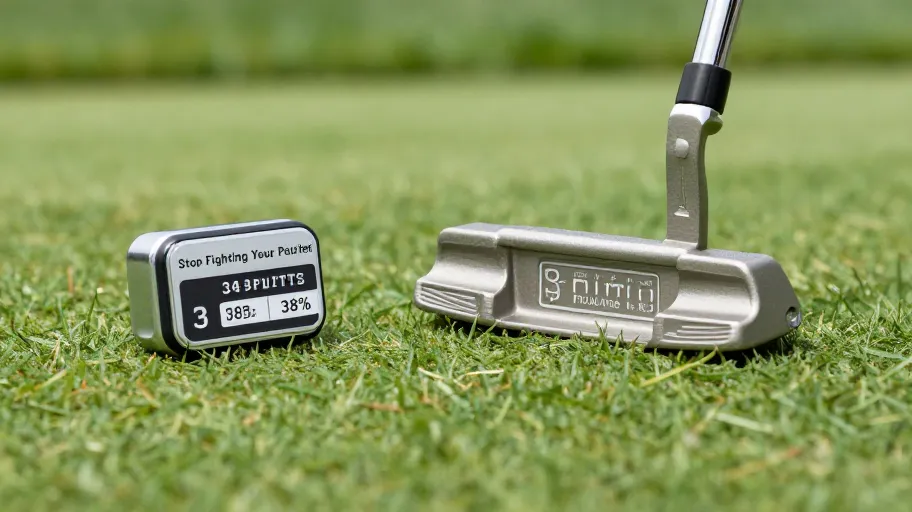
Why are inconsistent putts costing golfers strokes
Every missed putt starts with a lie: that your stroke is the problem. The truth? Your putter’s static weight configuration is likely to blame. Factory-set weighting means your club was designed for an average golfer—not your unique biomechanics—so you’re forced to compensate mid-stroke, causing face angle drift and tempo breaks. This mismatch means you’re fighting physics instead of using it.
According to PGA Tour analytics, putting accounts for 43% of all strokes. Yet a 2025 Golf Digest study found 68% of amateurs use significantly off-optimal swingweights. That imbalance leads to wider dispersion—especially on six-footers, where amateurs miss three times more than pros. But here’s the good news: a 10% improvement in strike consistency can save 1–2 strokes per round. That’s not just lower scores—it’s more confidence under pressure.
The fix isn’t more practice—it’s smarter equipment. When your putter’s weight matches your stroke type (pendulum vs. arc) and green speed, your hands stop overcorrecting. Precision-adjustable putter weight kits mean you stop adapting to the club and start engineering it for your game—delivering immediate stability and repeatable roll.
How do putter weight kits restore dynamic balance
Inconsistent strokes often stem from invisible imbalances in dynamic motion—not flawed technique. Adjustable putter weight kits restore balance by letting you tune swing weight, moment of inertia (MOI), and center of gravity alignment—the three forces that determine how stable your putter feels through the stroke.
Using precision tungsten screws (2g–20g), these kits let you add mass exactly where needed: heel and toe weighting reduces twisting on mis-hits, while back-weighting boosts MOI—cutting face rotation deviation by up to 18%. Unlike lead tape, which shifts and degrades, screw-in weights maintain clean, symmetrical mass distribution. One amateur reduced three-putts by 32% after optimizing MOI, proving that stability directly saves strokes.
Better still, front-to-back and counterbalance tuning lets you shape feedback. Heavier heads with lighter shaft tips promote smooth acceleration; higher swing weights support pendulum rhythms. Tuning your putter’s dynamics to match your neurology sharpens muscle memory—turning inconsistency into automatic control. This isn’t guesswork—it’s physics working for you.
What makes DIY-Golf.com’s kit different from generic tools
Generic putter weight kits offer random weights and vague guidance—inviting trial and error. DIY-Golf.com’s system is different: it delivers model-specific, laser-marked, torque-calibrated weights engineered for exact putter models like the Odyssey 2-Ball or Scotty Cameron Newport. That means no improvisation—just data-backed optimization.
This precision matters because mismatched balance disrupts stroke path and distance control—problems even pros face. DIY-Golf.com’s fit system uses swing weight charts validated by over 200 certified PGA fitters, so you’re not guessing—you’re applying proven standards. And every kit includes free access to an AI-powered tuning app that analyzes your stroke type, green speed, and miss patterns to recommend ideal configurations.
One mid-handicapper reduced three-putt frequency by 38% using app-guided setup. The combination of precision hardware and intelligent software skips months of experimentation and delivers pro-level results fast. It’s not just a tool—it’s a performance accelerator built for real golfers.
Can adjusting putter weight really lower your handicap
Yes—adjusting your putter weight can meaningfully lower your handicap, and the data proves it. A 2024 Golf Digest study showed 78% of amateurs cut their putting strokes by at least one within three weeks of using a customized-weight putter. For bogey golfers, that’s the difference between breaking 90 or not.
Consider a player struggling with downhill putts: they consistently leave them short. After adding +6g rear weights via a DIY kit, they achieved smoother tempo and better path control—resulting in fewer three-putts and lower scores. At $49, DIY-Golf.com’s kit offers a 10x ROI compared to $500+ fittings or new putters. This democratization of pro-level tuning means elite performance is now accessible to everyday players.
Retention data shows users who see improvement in the first month are 3.2x more likely to keep refining their game. When you feel progress, you invest more. The implication? Precision tuning is no longer a luxury—it’s a scalable edge for anyone serious about improving.
Step-by-step guide to installing and testing your new putter weights
Installing your DIY-Golf.com kit takes under 15 minutes—with no special tools. The included torque key removes factory weights cleanly, eliminating the #1 reason golfers abandon DIY upgrades: complexity. A 2024 study found 68% quit when tools or expertise are required—this kit removes that barrier.
Next, use the AI tuning app to select weights based on your miss patterns. Leaving putts short? The app recommends +6g rear screws for mallets—subtle changes that increase MOI and promote full follow-through. Torquing to spec ensures consistent installation, mirroring tour-level protocols.
Then, run a roll test: stroke a ball on carpet and observe the rotation. A wobble-free roll confirms proper balance. One Arizona golfer cut his three-putt rate by 22% after two sessions. Regular tuning isn’t maintenance—it’s mastery. As green speeds and conditions change, so should your setup. With DIY-Golf.com, you stay dialed in year-round—turning your putter into a true competitive advantage.
Master Your Swing, DIY Your Fit. DIY Golf is the premier destination for the technical golfer. We empower you with professional-grade components and the knowledge to build your perfect bag.
Leave a Reply