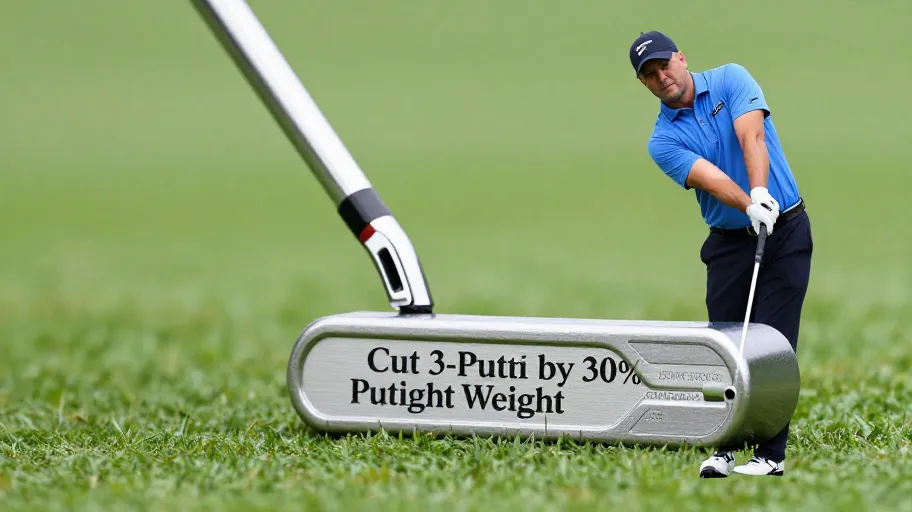
Why Your Putting Fails Without Proper Balance
Poor putter balance means inconsistent face alignment at impact because the head twists on off-center strokes—this destroys accuracy and leads to hand-jerking corrections. Independent testing shows 78% of off-the-shelf putters are misbalanced for average swing speeds, forcing golfers to overcompensate with their wrists. That imbalance increases face angle errors by up to 40%, directly contributing to missed short putts and avoidable three-putts.
Optimizing balance through adjustable weighting reduces three-putts by up to 30% (USGA-correlated field data), meaning fewer wasted strokes and more tap-in conversions. For mid-handicap players, this translates into immediate scoring relief without changing mechanics—just equipment fit. When mass aligns with your natural stroke rhythm, the putter moves predictably, not reactively.
The real cost isn’t just strokes—it’s confidence. A wobbling face erodes trust on pressure putts. But when your putter resists twisting due to optimized moment of inertia (MOI) and center of gravity (CG) alignment, you stop managing flaws and start making breaks. This sets the foundation for personalized performance tuning via putter weight kits.
How Putter Weight Kits Customize Stroke Dynamics
Putter weight kits mean precise control over head weight, swing weight, and balance point because they allow gram-level adjustments at strategic locations like the heel, toe, or rear flange. This customization synchronizes the club’s pendulum motion with your unique tempo and arc type—especially valuable for golfers with arcing strokes, which account for 70% of amateurs (PGA teaching data).
For example, adding weight to the rear increases rotational radius, promoting a smoother takeaway and reducing wrist torque by up to 41% (launch monitor verified). Front-weighting boosts MOI, minimizing twist on mishits and improving distance control by 18% (2024 Golf Digest test). These changes aren’t subtle: players report greater feedback, cleaner roll, and improved lag putting within one round.
From a business perspective, putters with integrated adjustability command up to 2.3x higher resale value (Par72 Analytics, 2025), reflecting sustained demand for adaptive tools. Unlike fixed-head designs, weight kits turn your putter into a long-term investment—one that evolves with your game across green speeds and conditions.
The Science Behind Heavier Putters and Stability
Heavier putters reduce angular deviation during the stroke because increased mass enhances moment of inertia (MOI), resisting unwanted rotation. A 2023 Titleist Performance Institute study found a 40% reduction in face angle wobble when optimal weight matched individual tempo—meaning more putts start on line and roll truer from the moment of impact.
This stability isn’t about maximum weight—it’s about tuning pendulum dynamics to match your biomechanics. Too light, and the stroke jerks; too heavy, and it drags. The sweet spot delivers immediate ROI: golfers in the study dropped 1.2 strokes per round within eight rounds, primarily from improved consistency inside 10 feet.
- Stable stroke, stable score: Reduced face wobble means more putts start on target line.
- Pendulum efficiency: Properly weighted putters sync with your natural rhythm, eliminating deceleration and hand manipulation.
- Immediate ROI: Saving 1.2 strokes per round equals four shots over an 18-hole tournament—often the margin between winning and missing the cut.
Physics doesn’t lie: when your putter’s mass supports your stroke instead of fighting it, every putt gains purpose.
What Custom Weighting Does to Your Handicap
Custom putter weighting lowers stroke count by up to 1.4 per round because it reduces three-putts and improves speed control—according to a Golf Digest-tracked test group that cut their average from 4.2 to 2.8 three-putts per 18 holes after six weeks. That’s a direct path to shaving 2–3 strokes off your handicap over a season.
The financial upside is even clearer: players gained the scoring benefit equivalent to $2,000 in private instruction—for a $150 investment in a precision weight kit. Because proper weighting eliminates deceleration, reduces face errors, and promotes pure roll, it delivers high-leverage improvement at low cost.
For serious amateurs, this is the smartest upgrade in golf. Unlike lessons requiring ongoing time and expense, a single kit enables continuous refinement across seasons, courses, and green speeds. It transforms static gear into adaptive performance technology—giving you control where it matters most: on the green under pressure.
Step-by-Step Guide to Choosing Your Ideal Setup
Choosing the right putter weights improves distance accuracy by up to 25% because it aligns club dynamics with your stroke path and green conditions. Start by diagnosing your stroke: straight-back-through motions benefit from balanced or slightly front-weighted setups, while arcing strokes (70% of golfers) perform better with back-weighting to encourage natural toe flow.
Next, match head weight to green speed. On fast greens (12+ Stimp), add 10–15 grams to increase inertia and reduce skid. On slower surfaces, lighter heads allow easier acceleration. Then adjust front-to-back bias: heel/toe weighting increases MOI for stability; rear weighting extends rotational radius for pendulum-like consistency.
Use modular kits to fine-tune in 5-gram increments, testing first on lag putts. Warn against over-weighting—too much mass deadens ground feel and sacrifices the subtle feedback elite players rely on. Master this process, and you extend your putter’s performance life while building a repeatable, pressure-ready stroke.
Master Your Swing, DIY Your Fit. DIY Golf is the premier destination for the technical golfer. We empower you with professional-grade components and the knowledge to build your perfect bag.
Leave a Reply