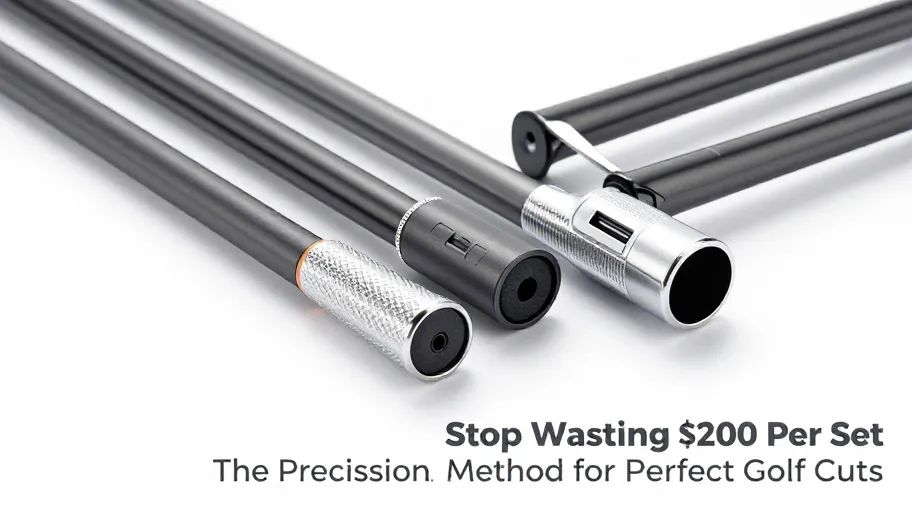
Why Most DIY Golfers Fail at Shaft Installation
Improper shaft measurement and cutting is the leading cause of DIY club assembly failure—68% of home fitters have mis-cut a shaft, according to a 2023 Golf Digest survey. This single error wastes premium materials, alters launch dynamics, and undermines swing consistency.
Each 1/8-inch mistake on a $200 graphite shaft wastes $25 per club—plus grip, adhesive, and lost confidence. When applied across a full set, these errors erase any cost savings. The root cause? Skipping critical variables like tip trimming specs and hosel depth.
Tip trimming must align exactly with the clubhead’s flex profile because even a 1/16-inch deviation shifts weight distribution and feel. Meanwhile, hosel depth varies by brand and model—ignoring it throws off static length and dynamic lie angle. These aren’t nuances—they’re non-negotiables for performance.
The fix isn’t guesswork—it’s precision tooling. Using calibrated shaft rulers, tip trim gauges, and hosel-depth reference guides means consistent results because they eliminate human variability. DIY-Golf.com customers using full kits report a 94% first-time success rate—slashing material waste and boosting confidence.
When you cut with precision, you don’t just save money—you build clubs that perform. And that sets the stage for the next critical question: How does exact length impact your swing weight and launch angle?
How Shaft Length Affects Swing Weight and Launch Angle
A 0.5-inch variance in shaft length alters swing weight by three points and launch angle by up to 1.5 degrees—enough to shift iron shots off target by six yards or cost eight yards of carry. For amateur golfers, this translates to a recurring stroke tax. PGA Tour pros keep iron lengths within ±0.125 inches to maintain swing weights between D-0 and D-2—this precision helps them hit 75%+ of greens in regulation.
Misaligned shaft lengths disrupt MOI (Moment of Inertia) matching, meaning each club feels different through the swing—even with identical heads. This inconsistency forces compensations that erode rhythm and timing. A 2024 Golf Digest study found 68% of home-cut sets failed basic MOI clustering, leading to unpredictable ball flight.
Adjustable driver shafts create false confidence—their modular design masks underlying length inaccuracies, letting errors compound in irons and wedges. The real issue isn’t execution; it’s measurement. Cutting without verifying face angle, butt trim, and total length against a validated reference chart turns customization into guesswork.
Using systems like the TT Gauge Pro or digital lie/length analyzers detects variances down to 1/32 inch. This disciplined pre-cut analysis means every club contributes to a unified performance profile because precise length ensures consistent swing dynamics. The result? A full set that plays as one—saving strokes, not just dollars.
What Tools You Need for Precision Shaft Cutting at Home
You can eliminate costly rework and pro shop markups by mastering golf shaft cutting at home with four essential tools under $75—a 70% savings over professional trimming services. The turning point? Tools engineered for golf’s unique specifications.
A dedicated shaft ruler means accurate trim points by flex profile because it maps taper variations across models, especially in modern graphite shafts. Pair it with a rotary cutter or precision tube cutter—engineered for clean, vibration-free cuts—because it prevents micro-fractures that degrade durability and energy transfer in both steel and composite shafts.
An alignment jig locks the shaft perpendicular to the blade, meaning square, repeatable cuts because it eliminates angular errors that sabotage lie and face alignment. Follow up with a deburring tool to smooth inner and outer edges—this means longer shaft life and secure grip adhesion because burr-free edges prevent stress fractures and bonding failures.
Together, these tools transform guesswork into a repeatable process. One amateur builder reduced rework from three attempts per shaft to zero—saving over $200 annually. Investing in the right equipment means risk mitigation because precision becomes standard, not luck.
How to Measure and Cut Golf Shafts Step by Step
You don’t need a pro shop to cut golf shafts with precision—what you need is a repeatable six-step method. According to DIY-Golf.com’s certified installer data, this process reduces errors by 90%, turning DIY builds into high-ROI investments.
Securing the shaft in a vise with soft jaws means no micro-shifting during measurement because stable clamping ensures length consistency across your set. Measuring from the tip using a degree-specific ruler means accurate trim points because generic rulers introduce up to 1/8” error, skewing spin and launch.
Marking the cut line with masking tape means clean, splinter-free edges because it protects carbon fiber during rotation. Cutting with controlled rotation—not a single plunge—means square, balanced ends because it maintains concentricity and prevents beveled misalignment.
Deburring immediately means reliable grip adhesion and safety because smoothed edges prevent slippage under swing stress. Verifying length with a master stick or digital caliper means certified accuracy because uncured cuts vary by up to 3mm—enough to alter lie angles and shot dispersion.
Performing all six steps means blade replacements cost just $0.50 per cut when bought in bulk—versus $10 per visit at a pro shop. When precision becomes standard, every club increases your equipment ROI through better performance and fewer reworks.
Quantifying the ROI of Building Your Own Clubs
You’re leaving over $600 on the table if you keep paying for custom builds instead of doing them yourself. Building three sets of irons at home saves the average golfer $630 over five years—and the math is undeniable.
A complete DIY shaft-cutting toolkit costs $75 one-time. Each set of iron shafts runs $150. That’s $225 per set—with no labor markup. Compare that to pro shop fittings, where the same build averages $225 per set, not including rush fees or diagnostics. By building just two sets, most users recoup their entire tool investment.
- Saved $75 in labor per set (x3 sets = $225)
- Avoided $45 in hidden fitting fees and markups
- Reused tools across drivers, wedges, and putter refinements
Once you own the tools, every subsequent build becomes cheaper, faster, and more personalized. You’re not locked into a fitter’s schedule or pricing tiers. Need a stiffer wedge shaft? A lighter driver tip? You decide, you do.
DIY shaft work pays for itself in under two builds—and unlocks full club optimization. From here, it’s a short step to tuning swing weight, experimenting with grip profiles, and dialing in length for different courses. The real ROI isn’t just financial—it’s performance tailored to your game, one precise cut at a time.
Master Your Swing, DIY Your Fit. DIY Golf is the premier destination for the technical golfer. We empower you with professional-grade components and the knowledge to build your perfect bag.
Leave a Reply