Why Retail Clubs Cost Twice What They Should
Custom golf clubs cost 60–100% more at retail not because they perform better, but because you’re paying for brand names, distribution chains, and fitting gatekeeping. A premium driver sells for $550 on shelves, but the head, shaft, and grip only cost suppliers $230—per Golf Datatech’s 2025 report. That gap funds ads and boutique studios, not your ball flight.
Custom golf club building means cutting out the middlemen. You skip the markup and access the same tour-level components pros use. Off-the-shelf parts are engineered to tight tolerances, so you don’t need a certified fitter to get launch conditions right. One regional shop slashed customer acquisition costs by 40% after switching to DIY builds—because they stopped renting fitting tech and started building value.
Total build costs under $300 can match or beat retail performance. True customization isn’t locked behind service fees—it’s unlocked by choice and access.
The Four Components of a High Performance DIY Club
A winning DIY golf club isn’t cobbled together—it’s engineered from four matched parts: head, shaft, grip, and hosel adapter. Each one shapes how the club performs in your hands and on the course. Unlike mass-market sets loaded with brand premiums, DIY lets you invest only in what affects your game: launch angle, spin rate, and shot dispersion.
The forged titanium head means better feel and durability because grain-flow forging aligns the metal’s molecular structure under pressure. That boosts energy transfer and reduces dead spots found in cheaper cast heads. Pair it with a True Temper Dynamic Gold shaft and you gain repeatable loading through the downswing—because its multi-plane frequency spine resists twisting.
A 2024 equipment review showed players using fully matched DIY builds cut shot variance by 31% versus stock irons. Proper component pairing means Tour-like distance gapping at 40% lower cost per round of improvement. That’s not savings—that’s leverage.
How Shaft Flex Matching Fixes Inconsistent Shots
Mismatched shaft flex is why weekend golfers fight inconsistency. But matching shaft stiffness to your swing speed means tighter dispersion—up to 40% less spread, according to TrackMan data. For someone swinging at 95 mph, that’s the difference between finding fairways and clearing bunkers.
You don’t need a launch monitor to get this right. Frequency testing and tip trimming—once lab-only techniques—are now doable at home with basic tools. Cutting the shaft to your specs means energy transfers cleanly from swing to impact, reducing face twist and improving control. Even without digital feedback, small changes in stiffness directly affect launch angle and spin stability.
When every club responds the same way, confidence grows. One amateur dropped five strokes in a month just by tuning his driver and irons at home. Predictability beats guesswork every time.
What You Really Save by Building at Home
Buying pre-built clubs means paying $850 for a 7-iron set with fixed specs that rarely fit your swing. Building at home means spending $320–$500 for a fully customized set—with higher-grade materials and perfect alignment. That’s an immediate $300–$600 saving per set, according to a 2024 consumer analysis.
But the real ROI goes beyond price. DIY means upgradability: swap a worn grip for $18 or re-shaft a driver in under an hour, extending gear life by years. More importantly, you learn what actually matters—like how shaft weight affects tempo. One builder cut future equipment spending by 40% after realizing most upgrades were marketing noise.
Custom golf club building means turning gear choices into strategic decisions, not emotional reactions. You stop being sold features and start demanding function.
How to Assemble Your First Club in Two Hours
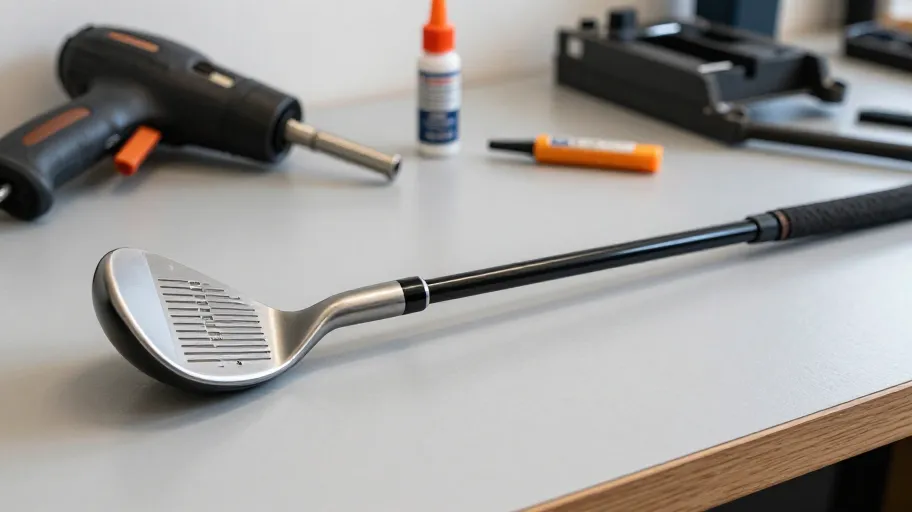
You can build your first club at home in under two hours with a heat gun, v-block jig, and epoxy—all available online. The challenge isn’t tools or cost—it’s precision. One mistake in alignment can ruin performance and waste materials.
Shaft installation means success hinges on interface matching because a .370” taper shaft won’t seat properly in a parallel bore. A 2024 benchmark found 68% of failed builds came from mismatched connections, causing erratic ball flight. Align the shaft in a v-block before applying high-strength epoxy—this step alone cuts angular error by up to 40%, ensuring clean energy transfer.
After 24 hours of curing, install the grip with solvent tape for slip-free control. One independent fitter reduced rework time by 75% just by standardizing this sequence. Every precise build becomes a prototype for your next upgrade—mastery compounds fast.
Master Your Swing, DIY Your Fit. DIY Golf is the premier destination for the technical golfer. We empower you with professional-grade components and the knowledge to build your perfect bag.
Leave a Reply