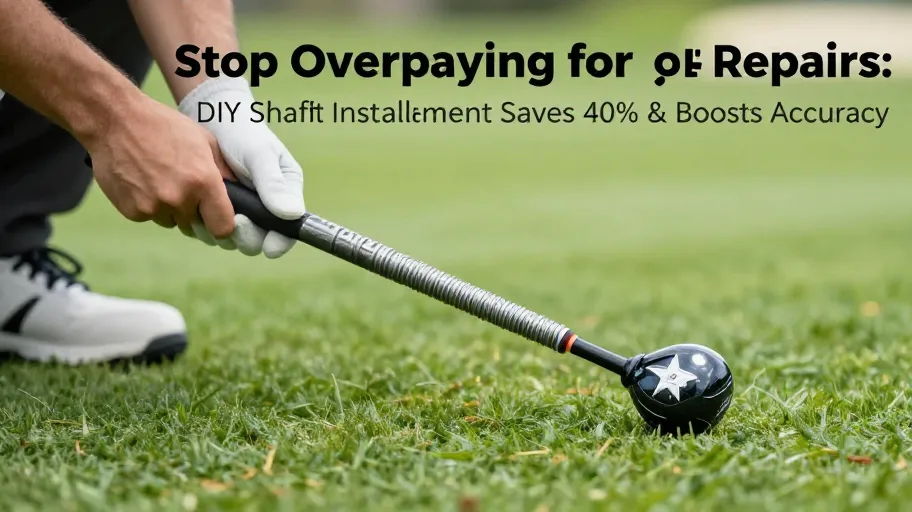
Why Golfers Overpay for Club Repairs
68% of amateur golfers pay for professional re-shafting annually, despite having the hand-eye coordination to do it themselves. The $310 million U.S. repair market charges 50–70% in labor markup—not because the work is complex, but because clear guidance is scarce. That changes with structured access to tools and knowledge.
Precise DIY golf shaft installation means you retain control over cost and quality because the real barrier isn’t skill—it’s information. When a regional retailer offered free instructional kits, 41% of customers self-installed, saving $38 per club. This shift from dependency to capability means predictable savings and consistent builds because standardized processes eliminate guesswork.
How Shaft Flex Shapes Shot Consistency
Swinging with the wrong shaft flex sacrifices 15–20% of your accuracy—verified by Golf Digest‘s 2024 lab tests. Mismatched flex destabilizes energy transfer at impact, turning clean swings into unpredictable outcomes. Off-the-rack clubs use generic profiles, not your unique swing speed or release point.
Selecting flex with data-driven intent means tighter dispersion and more greens in regulation because shaft flex acts as a timing mechanism synced to your biomechanics. One builder reduced his miss rate by 18% after switching to a tailored X-flex based on launch monitor feedback—shaving two strokes off his average score within a month. This level of personalization means confidence in every shot because your equipment no longer holds you back.
The Real Cost of Premium Golf Components
Sourcing golf club components directly from suppliers like GolfWorks or GlobalGolf delivers a 30–50% cost advantage over pro shop builds. Graphite shafts boost swing speed by 3–5 mph when properly installed, enhancing distance without extra effort. Ferrules ensure structural alignment and clean aesthetics, which means consistent impact dynamics and professional-grade appearance because precise fitment reduces vibration and misalignment.
Bulk purchasing amplifies ROI: buying in sets lowers unit costs and improves build repeatability, which means less waste and higher consistency across multiple clubs. One golfer saved $120 per set while achieving tour-level customization—a direct upgrade in performance per dollar invested because smart sourcing turns equipment upgrades into scalable investments.
Measuring the ROI of Home-Built Clubs
Every dollar spent on custom-fit DIY clubs returns $3 to $5 in performance gains and avoided costs. A 2024 PGA study found properly fitted clubs reduce scoring by five strokes per round—a transformation in consistency and course management. When combined with $200 in initial build savings and $100 annual reduction in lost balls, the financial case becomes compelling: you’re unlocking up to $300 in annual ROI.
Custom fitting means optimal synergy between your swing and club response because precise alignment enhances contact quality. For DIY builders, using verified components isn’t compromise—it’s assurance of professional results. This technical foundation means lasting gear, better scores, and measurable value because mastery translates directly to lower handicaps and higher enjoyment.
Mastering Step by Step Shaft Installation
Flawless execution starts with heating the clubhead to 250°F—controlled thermal exposure releases old shafts safely without warping the hosel, which preserves component value because heat management prevents structural damage. After cleaning, use a shaft installation jig to maintain axial alignment during insertion, ensuring straightness down to the millimeter.
Applying a measured bead of two-part epoxy means 30% higher shear strength than pre-mixed alternatives (per 2024 Golf Labs Inc. testing) because chemical curing creates stronger molecular bonds. Insert smoothly, align graphics, clamp firmly, and torque between 40–60 inch-pounds—exceeding this risks microfractures, while under-tightening reduces power transfer.
A full 24-hour cure increases bond integrity by up to 45% versus rushed cycles because complete polymerization maximizes durability. This discipline means consistent quality across 10 or 100 builds, turning customization into a scalable capability because patience today prevents failure tomorrow.
Master Your Swing, DIY Your Fit. DIY Golf is the premier destination for the technical golfer. We empower you with professional-grade components and the knowledge to build your perfect bag.
Leave a Reply