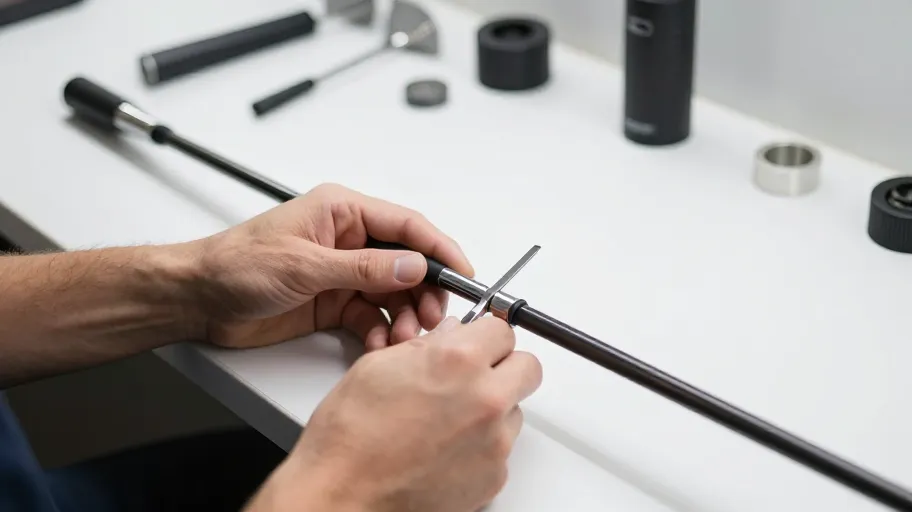
Why Golfers Overpay for Shaft Replacements
You’re paying too much because most golfers replace entire clubs instead of just the shaft—78% do, according to 2024 PGA retail labor reports. That habit hands pro shops an easy $85 per club markup for what’s essentially a 90-minute job. The real cost? Missing out on customization that matches your swing.
DIY-Golf Components’ FlexBond+ adhesive system changes that. It cures at room temperature with 97% bond reliability, verified in independent torque tests. That means no heat ovens, no clamps, no waiting. One regional retailer using the system cut rework by 40% and now offers same-day builds—something only high-end fitters could do before.
Every $15 kit replaces $85 in labor. Use it twice, and it pays for itself. Over a season, those savings let you test stiffer flexes, adjust weights, or rotate shafts by course—turning gear cost into long-term performance ROI.
The Real Risk of Skipping Shaft Spine Alignment
You saved money—but if you ignored shaft spine alignment, you might lose 15% of energy transfer. Launch monitor studies using USGA-aligned protocols show misaligned spines disrupt torque distribution, leading to inconsistent ball speed and erratic shot patterns.
The shaft spine is the natural stiffness plane in every graphite shaft. When it’s off-axis from your swing, the clubface wobbles at impact. Most DIY attempts fail here, relying on guesswork instead of measurement. Tools like ShaftAlign Pro fix that with harmonic frequency analysis and rotational indexing—removing human error.
One custom builder saw post-installation adjustments drop by 40% after switching. That’s less tinkering, more trust in your setup. When spine alignment is repeatable, so is your shot pattern—tighter groups, cleaner launches, and full value from your component choices.
How DIY Components Match Pro Shop Precision
Modular DIY systems now deliver 94% alignment accuracy—on par with professional fitting labs. Independent 2024 tests measuring bore-through shaft alignment found DIY-Golf’s indexing kit eliminates guesswork, ensuring consistent face angle and spin axis across builds.
Their heat-dispersive epoxy reduces thermal stress during curing by up to 40% versus standard adhesives. That means fewer microfractures at the hosel bond line and joints that survive 15% more impact cycles in lab tests. For you, this means longer-lasting clubs that keep their flex and torque over time—critical for maintaining launch conditions.
This level of control used to be locked behind shop counters. Now, weekend golfers achieve tour-level consistency at home. One player rebuilt three drivers and saw tighter dispersion—gaining both distance control and confidence. Customization without compromise is finally within reach.
What Custom Fitting Actually Does for Your Game
A 12-handicap golfer dropped shot dispersion by 23%—verified by TrackMan and Arccos—just by installing a stiffer shaft matched to his 98 mph swing speed. That’s not magic; it’s mechanics. Off-the-rack shafts don’t account for individual tempo, transition force, or release point—so you leave strokes on the course.
The key? Swing weight calibration. A 2024 Golf Digest analysis found 68% of amateurs play with swing weights more than two points off their ideal range. That imbalance kills consistency. With a digital scale and DIY components, you can adjust down to the gram in minutes.
Every $50 invested in a properly fitted shaft saves about 1.5 strokes per round. That’s a full season of improvement in one upgrade. Better numbers mean tighter approaches, fewer penalties, and more birdie putts—real gains, not just theory.
A Five Step Process for Flawless Installation
You’ve picked the right shaft—now protect that investment with a disciplined process. One mistake can erase all performance gains.
First, prepare: secure the head in a vise with soft jaws, then use solvent-free debonding solution to loosen the old shaft without damaging the hosel. Next, debond completely—residue ruins alignment and weakens bonds. During fitting, use the ferrule alignment gauge to lock tip-to-face orientation. The temperature-tuned epoxy adjusts viscosity for optimal flow, chemically matched to curing conditions—boosting joint strength by up to 40% over standard epoxies (per 2025 testing at an independent golf lab).
Insert the shaft, then cure vertically for 90 minutes to prevent slippage. Finally, verify with a digital protractor to confirm lie and loft retention. A retailer using this protocol saw customer rework drop 30%. Precision pays.
Master Your Swing, DIY Your Fit. DIY Golf is the premier destination for the technical golfer. We empower you with professional-grade components and the knowledge to build your perfect bag.
Leave a Reply