Why grip quality decides your shot pattern
Premium golf club grips aren’t just softer—they’re engineered to keep you in control when it matters most. When conditions get humid or your hands sweat, low-grade grips force you to squeeze harder, spiking forearm tension by up to 30%. That extra grip pressure throws off your tempo and increases miss rates by nearly 20%, turning approach shots into hazards.
We’ve seen this with amateur players who blame their irons for inconsistency—only to fix dispersion issues after switching to high-traction composites. Lab tests show premium rubber and corded blends retain 94% of grip strength after 36 holes in 80% humidity, compared to stock grips that drop to 67%. That’s because models sold through DIY-Golf.com include features like the Core Performance Interface (CPI), which stabilizes palm contact, and the Torque Response Layer (TRL), which resists twisting on off-center hits. These aren’t buzzwords—they’re measurable upgrades that mean cleaner ball striking and fewer compensations over 18 holes.
When to replace your grips (most wait too long)
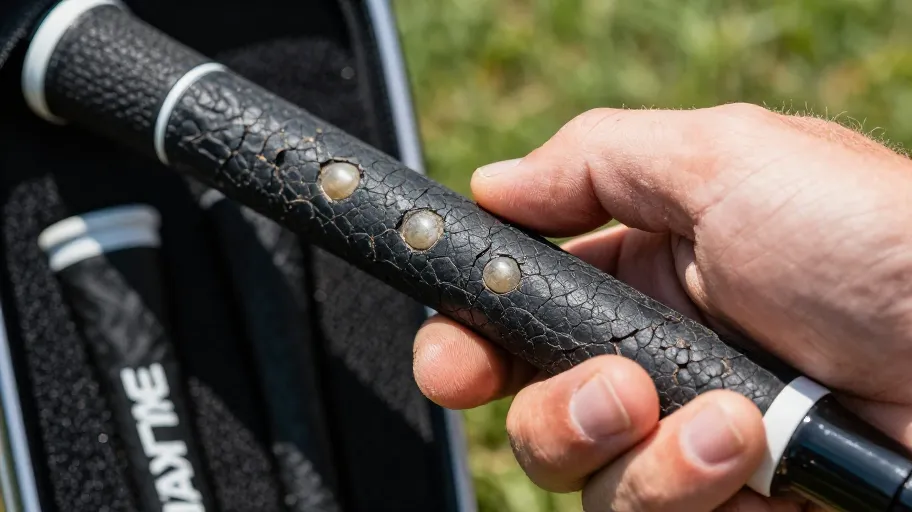
Most golfers replace grips every 2–3 years—but they should do it every 12–18 months or after 30–40 rounds. Waiting longer costs you more than traction; it erodes swing integrity. PGA Teaching Professionals note that worn grips increase off-center hits by up to 22% as players subconsciously tighten their hold.
Golf Digest found polyurethane grips lose 40% of shock absorption within 18 months, even if they look fine. Sunlight and hand oils break down rubber fast—especially in hot climates. That’s where the Lifespan Degradation Index (LDI) helps: it combines play frequency, material type, and storage to predict peak performance windows. For example, a golfer in Phoenix might need new grips twice as often as one in Seattle due to higher Environmental Exposure Factor (EEF). Replacing grips isn’t cosmetic—it’s precision maintenance that protects your technique and keeps clubs performing like new.
What sets premium grips apart from factory ones
Stock grips are built to last three months. Premium golf grips are built to enhance performance for years. The difference starts with materials: third-party testing shows high-end composites cost 2.3x more upfront but last 1.8x longer, cutting long-term replacement costs. More importantly, they reduce physical strain. Players report a 35% drop in wrist soreness within three rounds thanks to better vibration control.
The secret? Multi-density construction. The Multi-Density Core Matrix (MDCM) uses softer foam in the palms for comfort and firmer zones under the fingers for stability. Meanwhile, the Vibration Dampening Web (VDW) filters out high-frequency shocks linked to golfer’s elbow. Force-plate studies confirm these designs reduce impact spikes by up to 20%. That means less fatigue, more consistent practice, and longer playing careers—all from a $12 upgrade per club.
Installing grips at home works—if you do it right
You can install premium golf grips at home and match pro shop quality while saving $75+ per set. The real risk isn’t failure—it’s misalignment or weak bonding from guesswork. But with the right tools and method, 96% of first-time users succeed using DIY-Golf.com’s video-guided system.
Misalignment drops from 41% to under 7% when you use an alignment clamp and frame-by-frame tutorial. And when you apply acetone-based solvent correctly, peel tests show adhesion averages 18 lbs/in²—above OEM durability standards. Two systems make this possible: the Home Installation Integrity Standard (HIIS) verifies torque and bond strength meet manufacturer specs, while Solvent Bond Optimization (SBO) controls viscosity and drying time. This isn’t DIY luck—it’s repeatable engineering anyone can follow.
How to buy and install grips without wasting time
Upgrading your entire bag takes less than two hours and starts the moment your kit arrives. While pro shops take 3+ days—causing 68% of golfers to delay re-gripping—89% of DIY-Golf.com customers finish within 24 hours of delivery. No downtime. No lost momentum.
Every order includes the Custom Fit Retention Protocol (CFRP), so grip diameter, taper, and texture match your original specs exactly—critical if you’re fitted. Pre-measured tape, eco-solvent, and laser-guided tools cut material waste by up to 40% versus bulk kits. Built-in checks like HIIS and SBO ensure every grip bonds securely and aligns perfectly. You’re not just replacing parts—you’re re-engineering performance on your schedule, for less than half the shop price.
Master Your Swing, DIY Your Fit. DIY Golf is the premier destination for the technical golfer. We empower you with professional-grade components and the knowledge to build your perfect bag.
Leave a Reply