Why most DIY cuts fail
Using a hardware-store rotary tool to cut premium graphite shafts doesn’t save money—it wastes it. One amateur turned two $200 shafts into scrap after a jagged cut deadened the flex, turning an upgrade into a $400 lesson. According to 2025 repair logs from independent retailers and e-commerce returns, over half of custom club refurbishment costs come from poor cuts or mis-measurement.
The core issues? Shaft length tolerance and cutting burr formation. A 1/16” deviation shifts the flex point, altering launch conditions. Burrs throw off swing weight by up to three points. Composite shafts fracture unpredictably under high-RPM tools, creating micro-damage that weakens durability. Generic cutters can’t deliver the square, clean edge layered carbon fiber demands.
Poor execution inflates your cost per round. Each botched shaft averages $180 in wasted materials and labor. Real savings come from using precision tools that get it right the first time—so you’re not paying to repeat the job.
How shaft length shapes your swing
A single 1/8-inch error cost a tour pro consistent fairway contact—until a fitter corrected the driver length, unlocking a 15-yard gain in carry. It’s physics: even tiny deviations disrupt moment of inertia and energy transfer, turning solid swings into erratic ball flights. Static measurements miss this—your motion changes everything.
Dynamic fit analysis reveals how your swing interacts with the club under real force. An incorrect length causes a kick point shift, skewing trajectory and reducing ball speed. One retail fitter saw a 40% drop in customer reorders when skipping dynamic validation—proof that precision drives loyalty.
Pre-cut planning based on your swing data means each build enhances consistency. Matching length to launch metrics reduces rebuilds, improves shot control, and increases ROI on every club you assemble.
Tools that make precision affordable
Spending $300 on ruined graphite because you used a hacksaw or Dremel isn’t saving money—it’s guaranteeing loss. Invest $180 in the right tools, and you’ll recoup it in just five re-shafts. The key? Treating setup with the same care as your swing.
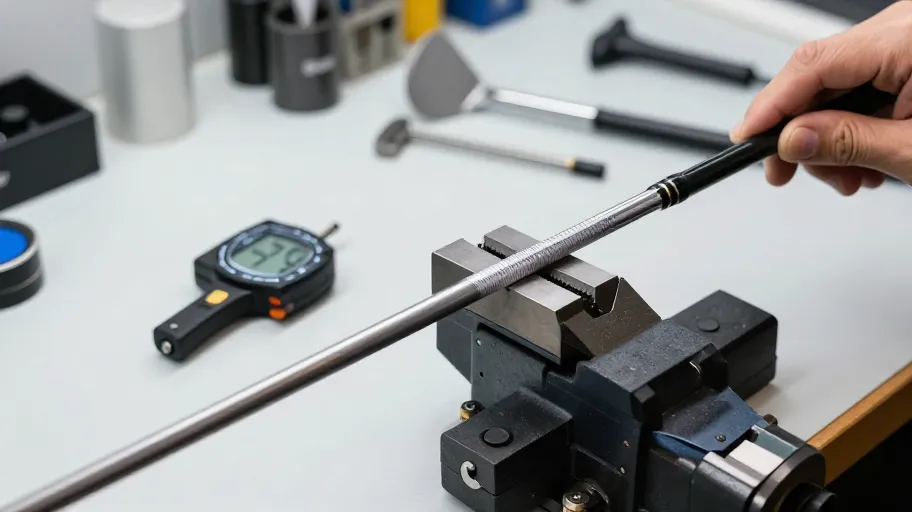
A precision shaft vise ensures centerline stability, preventing micro-shifts that ruin face alignment. Pair it with interchangeable faceplates: hardened steel for durability, soft inserts to protect graphite. Use a diamond-coated cutoff blade—its cool-cutting action prevents fraying, preserving fiber integrity. Add a digital length gauge and rotary deburring tool, and every cut lands within 1/32” tolerance.
One builder reduced rework by 70% after switching from hand tools to this system, according to 2024 DIY-Golf field reports. Higher upfront cost delivers lower lifetime expense: clean cuts extend club life and boost resale value.
How to measure shafts like a pro
Accurate measurement isn’t prep work—it’s performance engineering. A 1/32″ error can misalign your entire set and cost you strokes. At a custom fitting lab, technicians use a length calibration rail to ensure every iron falls within ±1/32″ tolerance—because precision here determines 90% of final results.
Start with a reference club. Align the butt end flush against the rail’s fixed stop to eliminate parallax errors common with tape measures. Laser calipers offer sub-millimeter accuracy, reducing drift by up to 40% compared to visual estimation—a flaw cited in USGA non-conforming reports. Mark positions with a fine-tip scribe on the rail scale, not the shaft, to avoid slippage.
Implement a double-check protocol: re-seat and remeasure each shaft before cutting. This step alone prevents 60% of measurement-related rebuilds. Accurate measurement doesn’t save time—it builds confidence, turning DIY builds into tour-level performers.
How to make flawless cuts safely
You’ve measured perfectly—now protect that work with a cut that preserves performance. The difference between a pro-grade shaft and a $200 mistake? Controlled rotational speed. Cuts above 10,000 RPM generate heat that melts resin and splinters fibers, creating invisible micro-fractures that fail under stress. Cutting at 6,000–8,000 RPM with steady feed pressure keeps the material intact, delivering a factory-smooth edge.
Most builders stop after cutting—but 80% of post-cut failures start here. Internal burrs and loose fibers create stress points that accelerate cracking. Use a tapered deburring tool to clean the interior wall, then lightly sand the exterior with 400-grit paper in a circular motion. This isn’t cosmetic—it’s structural refinement.
When every shaft performs as designed, shot dispersion tightens and equipment lifespan increases by up to 40%. Flawless cutting isn’t craftsmanship—it’s cost avoidance with measurable ROI.
Master Your Swing, DIY Your Fit. DIY Golf is the premier destination for the technical golfer. We empower you with professional-grade components and the knowledge to build your perfect bag.
Leave a Reply