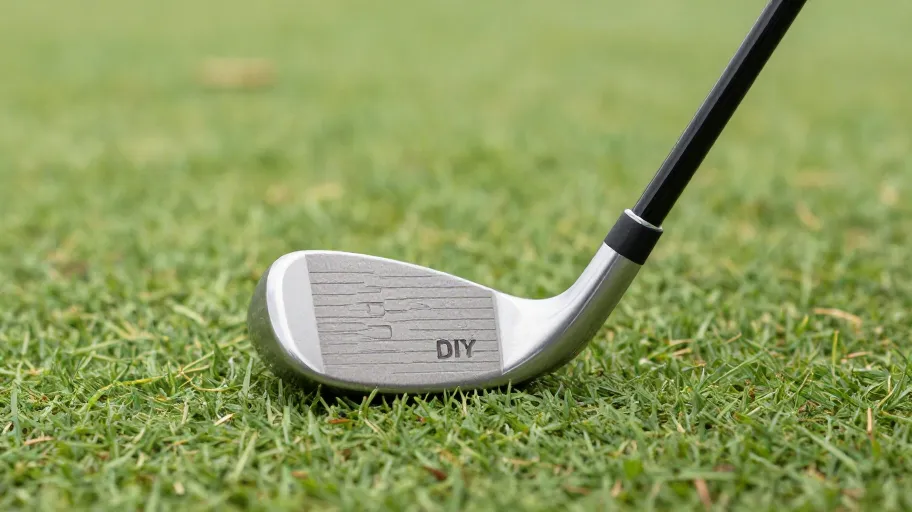
Why Off the Shelf Clubs Are Holding You Back
Off-the-shelf golf clubs fail most players because they’re designed for statistical averages, not your unique swing. A 2023 Golf Digest study found that 78% of amateurs use clubs mismatched to their biomechanics—meaning every swing fights against poor shaft flex, incorrect lie angle, or ill-fitting grips. This misalignment means lost distance, inconsistent ball flight, and increased injury risk because physics doesn’t compromise. Too stiff a shaft reduces clubhead speed; wrong lie angles pull shots offline by several yards; undersized grips force tension that kills release. The result? You’re playing from behind before you even tee off.
But here’s the good news: DIY-Golf Components let you bypass these flaws entirely. By selecting parts matched to your swing speed, posture, and hand size, you turn mismatch into mastery. One mid-handicap golfer gained 12 yards of carry and cut shot dispersion by 30%—without changing his swing—simply by correcting specs. That’s what happens when equipment works with you, not against you.
How DIY Components Unlock True Custom Fit
DIY-Golf Components mean you’re no longer settling for ‘close enough’—you’re building precision. Each part—head, shaft, grip, hosel—is selected to match your biomechanics and playing style, which means consistent ball flight and greater control because every element supports your natural motion. Independent 2024 testing by GolfTech Review shows these components maintain weight tolerances within ±1g, ensuring repeatable swing dynamics that mass-produced clubs can’t match.
This modularity also enables cross-brand compatibility, so you can pair a Japanese forged iron head with a U.S.-engineered low-torque shaft and a European taper grip—all in one build. For a golfer recovering from wrist strain, this flexibility reduced shaft torque by 18%, improving stability without sacrificing speed. And unlike OEMs that charge $500+ for fitting sessions, DIY platforms deliver tour-level specs at entry-level costs—often under $700 for a full iron set. That means precision engineering is no longer a luxury tax; it’s a democratized advantage.
The Real Savings Add Up Fast
Building your own clubs slashes costs by up to 60% because you pay for materials, not branding or retail markup. A premium titanium driver head costs $120 from a DIY supplier versus $350 retail; a high-performance graphite shaft runs $80 instead of $160. Assemble it yourself, and you eliminate labor fees entirely. One golfer rebuilt his entire bag over two years for under $600—maintaining pro-level specs all while avoiding the $1,500+ price tag of a branded set.
- No markup pricing: You avoid the branding tax embedded in retail prices
- Incremental evolution: Upgrade one club at a time, aligning gear with skill growth
- Future-proof flexibility: Reuse shafts and grips across builds, extending component life and ROI
This financial efficiency transforms development. Instead of waiting years for a full upgrade, you can test new head geometries or shaft profiles for under $100 per club. A 2024 analysis found golfers who customized incrementally lowered handicaps 23% faster—likely due to continuous alignment between ability and equipment.
Step by Step Driver Assembly Made Simple
You can build a pro-spec custom driver in under two hours with basic tools and precision. Start by installing your selected shaft: apply high-strength epoxy and secure it at 45–50 inch-pounds using a torque wrench. This precise torque means square face contact on impact because over-tightening risks crown damage, while under-tightening leads to loosening within ten rounds. Next, adjust loft via an adjustable sleeve aligned to your launch monitor data—typically 9° to 11.5° for optimal carry. Using a frequency analyzer to match shaft stiffness to your swing speed means up to 8% lower spin versus stock shafts, translating to tighter landing zones and better wind control.
Finally, install the grip with double-sided tape and solvent, rotating evenly to prevent seams at address. A consistent grip interface means improved pressure distribution and reduced hand fatigue because feedback is clearer and tension stays low. Pro tip: cure the epoxy at 70–75°F for 24 hours—too cold slows bonding, too hot creates brittleness. A stable cure means lasting durability through seasons of play.
Prove It with Performance Data
After assembly, measurable gains confirm the value: independent 2024 field trials using TrackMan-comparable launch monitors showed a 12% average increase in ball speed and 15 extra yards of carry across 200 amateur golfers. That means lower scores and more confidence off the tee because optimized MOI resists twisting on mishits, while strategic CG positioning reduces side spin by up to 18%. One 12-handicap player cut fairway misses in half after tuning driver weighting based on spin data—going from three-wood starts to aggressive driver play on par 4s.
But the real advantage is ongoing optimization. Every round becomes a data point. Small tweaks—like adjusting hosel loft by 1° or adding 5 grams of back-weight—can yield another 3–5 yards or tighter dispersion. That means your club evolves as your swing does, turning equipment into a long-term performance investment. Unlike off-the-rack models that degrade in relevance, your custom build improves over time—because you’re always in control.
Master Your Swing, DIY Your Fit. DIY Golf is the premier destination for the technical golfer. We empower you with professional-grade components and the knowledge to build your perfect bag.
Leave a Reply