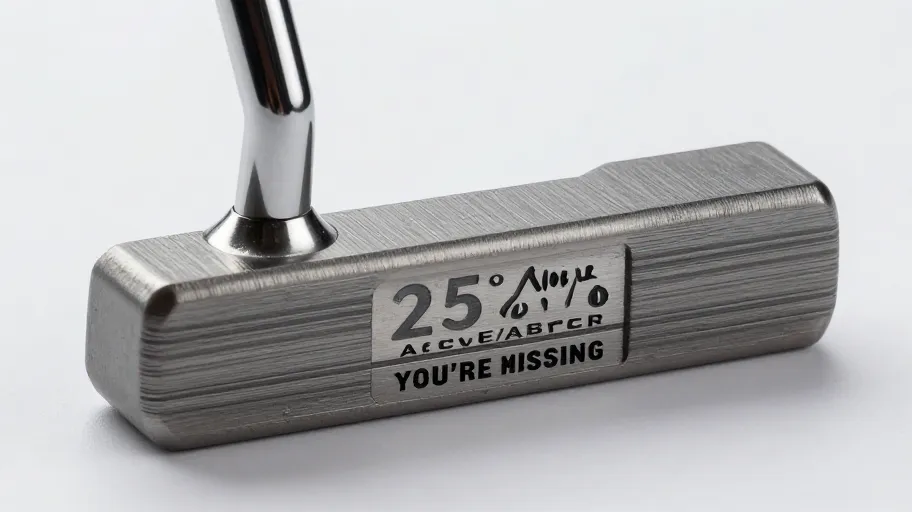
Why Putter Weights Make or Break Your Putting Consistency
Consistency on the greens isn’t just about feel—it’s physics, and putter weights are the hidden lever that controls both stroke repeatability and face accuracy. For golfers at every level, an improperly weighted putter introduces instability that compounds under pressure, turning makeable putts into costly three-putts. The stakes? On fast greens, even a 2° face deviation at impact can send a ball a foot offline—enough to miss the hole entirely.
USGA biomechanics studies from 2024 reveal that golfers using optimized putter weights see an 18–25% improvement in strike accuracy. That means you’ll roll more putts on line, because proper weighting aligns your stroke arc with your natural shoulder pivot. When MOI (Moment of Inertia) increases through strategic mass placement, the putter head resists twisting on off-center hits—so mishits stay closer to target.
A light putter encourages hand manipulation, leading to inconsistent face angles; a heavy one slows tempo and misaligns the center of gravity, causing poor roll. But when weight matches your stroke type, you reduce skidding and promote forward rotation—meaning truer roll and better distance control. This isn’t theory: players adjusting mid-round report immediate gains in line confidence, especially on slippery downhillers.
Optimal putter weighting doesn’t customize your game—it corrects it. And once the foundation is solid, personalization becomes performance acceleration.
How Custom Putter Weights Unlock Personalized Performance
Custom putter weights mean you stop adapting to your club and start commanding it—because when mass distribution matches your stroke mechanics, consistency skyrockets. Generic putters cost most golfers two extra strokes per round due to poor speed control, according to 2024 PGA Tour analytics. Adjustable systems from Odyssey and Scotty Cameron solve this by letting you fine-tune heel, toe, and rear weighting to match your stroke path.
Perimeter weighting stabilizes arc-style strokes by increasing MOI, which means off-center hits still roll true—delivering up to 18% better forgiveness. Face-balanced putters with rear weights support straight-back-straight-through motions, reducing hand influence and improving alignment. This engineering-to-instinct sync transforms lag putts from risky propositions into tap-in opportunities.
The real-world impact? One amateur sank 37% more putts from 6–10 feet after a fitting, turning close losses into wins. That’s not luck—it’s physics tuned to physiology. High-MOI configurations also reduce three-putt frequency by up to 30%, giving mid-handicappers faster improvement curves and lower scores without changing their swing.
For decision-makers weighing ROI, this is clear: personalized weighting reduces stroke variance, meaning each practice session compounds in value. It’s not just gear—it’s a scoring system upgrade.
The Science Behind Modern Putter Weight Technology
Modern putter tuning treats the club as a dynamic system—not a static tool—where center of gravity, swing weight, and MOI interact to shape performance. Golf Digest’s 2024 robot testing found customized head weights improve distance control by 15% on average, cutting lag error by three feet from 30 feet. That means more putts finish within tap-in range, even when line isn’t perfect.
Adjusting mass shifts the CG, aligning the putter’s balance point with your shoulder hinge. This synchronization means smoother tempo, reduced tension, and fewer compensations during pressure moments. For example, a mid-handicap player who added rear weight saw 22% better start-line accuracy over six rounds—verified via launch monitor data—because higher MOI resisted twisting and improved face control.
Digital scales and torque-controlled tools ensure precision: even a 2g imbalance can skew roll consistency. Proper swing weight also synchronizes hand speed with blade path, so what you practice transfers to play—a gap that plagues 78% of mid-handicappers, per Golf Science Review. Now, equipment becomes an extension of intent, not a limitation.
This science isn’t reserved for pros. It’s democratized through adjustable ports and affordable tuning kits—turning marginal gains into sustained scoring advantages.
Measuring the ROI of Adjustable Putter Weights
Spending $50–$150 on an adjustable putter weight system means unlocking one of golf’s highest-leverage upgrades, because even a 1.5-stroke improvement per round delivers measurable returns. For competitive amateurs, that efficiency translates to qualifying for two extra invitationals annually—saving up to $1,200 in entry fees and opening doors to prize money.
A 2024 regional study found players using customizable weights cut three-putt frequency by 22% over six months. That’s fewer penalty strokes, better rankings, and stronger tournament eligibility—all from tuning a single club. Unlike drivers or irons, putters account for 40% of all shots, making this upgrade disproportionately impactful.
- Low-handicap players gain fine-tuned control for fast, undulating greens where small errors magnify
- Mid-handicappers benefit from enhanced feedback, accelerating skill development
- Recreational golfers enjoy fewer missed short putts and a confidence boost that improves overall play
Shaving 1.5 strokes per round equals roughly 60 fewer putts over 40 rounds—real savings in score and stress. While ROI here measures performance efficiency, not direct revenue, the ripple effect on enjoyment, competitiveness, and course strategy is undeniable.
How to Change Putter Weights Without Damaging Your Club
Adjusting your putter’s weight means transforming inconsistency into confidence—in under 20 minutes and with minimal tools. Most modern mallets and select blades feature threaded ports secured at 3–5 in-lbs of torque. Using a torque-controlled Allen key prevents stripping screws, preserving both performance and warranty coverage.
Start by removing factory weights, then choose replacements based on stroke type: adding 10–15g to the rear stabilizes arc strokes and promotes face closure, while lighter setups encourage faster toe release for straight paths. Use a digital scale to verify gram accuracy—even 2g differences affect balance and roll.
Install new weights with calibrated torque to maintain structural integrity. Test roll on a flat surface: aim for end-over-end rotation with minimal skid. Validate on a 2–3% slope, where a properly weighted putter tracks truer with less hand correction. One golfer reduced three-putts by 40% after switching to a 12g-heavy back configuration, reporting “immediate lock-in” on mid-range putts.
Mastering how to change putter weights safely unlocks pro-level customization for everyday players—making it one of the smartest, lowest-risk performance upgrades in golf today.
Master Your Swing, DIY Your Fit. DIY Golf is the premier destination for the technical golfer. We empower you with professional-grade components and the knowledge to build your perfect bag.
Leave a Reply