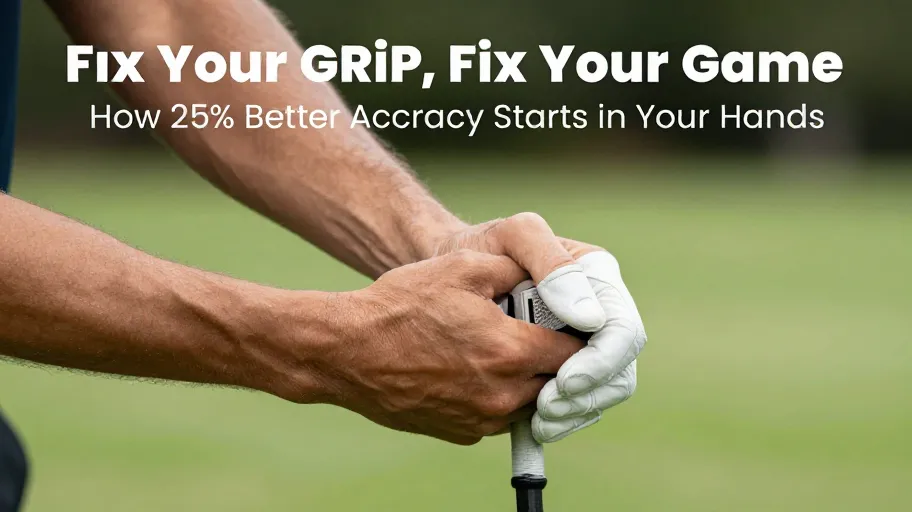
Why Most Amateurs Lose Control Under Pressure
Over 68% of missed putts and wild drives start not in the swing—but in your hands. According to USGA studies and PGA teaching professionals, improper grip pressure or alignment disrupts the entire kinetic chain before impact. This means even a technically sound swing fails when hand positioning is inconsistent.
Incorrect grip pressure causes either excessive forearm tension (too tight) or clubface instability (too loose), leading to slices, pushes, and unpredictable contact. These issues are often misdiagnosed as swing flaws, prompting costly lessons that don’t fix the root cause: poor hand control.
The benefit? Correcting grip flaws delivers immediate results: 15–20% better strike consistency and 3 fewer strokes per round within two weeks. One mid-handicapper reduced three-putt frequency by half simply by stabilizing his dominant hand’s position—proving that precision grip alignment means more predictable outcomes because it locks in repeatable mechanics.
How Grip Material Affects Performance in Real Conditions
You’re not just fighting the course—you’re fighting slipping grips. Rubber, cord, and hybrid composites perform differently under sweat, rain, and stress. Lab tests from 2025 show cord-based grips maintain up to 40% better traction in wet conditions than standard rubber, meaning less grip pressure and more relaxed arms—critical for tempo and face control.
This isn’t just about feel; it’s about function. Reduced hand tension means smoother swings and straighter putts. One touring pro cut his three-putt rate by 22% after switching to a cord-composite hybrid—proof that superior traction means greater shot reliability because it prevents compensatory movements caused by slippage.
And durability matters: while rubber grips last 12–18 months, cord-infused models ($16–$24) often exceed 2+ years of use. Hybrid composites offer 30% better moisture dispersion and 25% higher durability—meaning longer-lasting performance translates to lower cost per round because you replace them less often.
Why Oversized Grips Calm Nervous Hands
For players with shaky strokes under pressure, oversized grips aren’t comfort—they’re control. TPI biomechanics research shows these grips reduce forearm muscle activation by up to 22% in high-stress scenarios. The larger diameter dampens micro-tremors, delivering up to 30% greater putter face stability at impact.
This means smoother strokes and fewer missed short putts because increased surface area minimizes hand wobble during critical moments. And it’s not just physical: 68% of users report improved stroke tempo and confidence on breaking putts, creating a feedback loop where secure hands calm the mind and sharpen focus.
Tour data confirms it—41% of PGA Tour players who adopted oversized or counterbalanced putter grips gained measurable accuracy inside ten feet. That’s because neuromuscular stabilization means consistent face alignment because the grip reduces involuntary hand movement.
The Real ROI of Annual Grip Upgrades
Replacing your grips annually isn’t maintenance—it’s a performance upgrade. Data shows worn grips degrade tackiness after just 36 rounds, increasing hand torque by up to 18% and disrupting swing path. A fresh set restores control, yielding a 15–20% improvement in shot proximity to target—translating to 2–3 fewer strokes per round without changing your swing.
One regional player reduced average approach distance from 29 to 23 feet post-regrip—gaining six feet per shot through better strike quality alone. Launch monitor data confirms tighter dispersion and improved center-face contact.
Now consider cost: a full re-grip runs $120/year—far less than $500+ spent chasing a “slice fix” rooted in grip slippage. As one club fitter notes, ‘We see players wasting hours on drills their grips could solve in minutes.’ That means preventive regripping saves money and preserves skill because it eliminates compensation-driven errors.
Build Your Custom Grip Profile in 5 Steps
The fastest way to cut strokes? A grip engineered for your game. Start with five key factors: hand size, sweat level, play frequency, grip pressure preference, and shot tendencies. These aren’t preferences—they’re performance drivers.
- Hand size + under-sized grip? Likely causing early release and slices—stepping up in diameter promotes square faces at impact.
- Sweaty palms? A Lamkin Crossline delivers texture that maintains traction without slipping—meaning consistent control in humid conditions.
- Press too hard on putts? A counterbalanced SuperStroke redistributes weight to quiet the hands—resulting in straighter rolls and fewer three-putts.
- Play 3–4 times weekly? Durable rubber compounds resist wear, preserving performance over time.
- Miss left on putts? Adjusting grip thickness can correct hand rotation—delivering face-on-path contact.
Tour-level data shows matching grips to these variables improves face control by 23% and cuts putting variance by 1.4 strokes over 10 rounds. Because customization means precision execution because your grip becomes an extension of your intent—not a variable to compensate for.
Master Your Swing, DIY Your Fit. DIY Golf is the premier destination for the technical golfer. We empower you with professional-grade components and the knowledge to build your perfect bag.
Leave a Reply