Why Most Golfers Miss Short Putts Under Pressure
Most golfers miss short putts under pressure not because of nerves alone, but because their putter is working against them—specifically, its weight distribution. The PGA Tour analysis from 2024 reveals that 68% of missed putts inside five feet stem from face angle instability at impact, a flaw directly tied to improper static and swing weight.
Static weight (total mass) and swing weight (how it feels in motion) govern tempo and path consistency. Too heavy, and you decelerate, causing the face to close; too light, and you flinch, leaving it open. Off-the-shelf putters match only about 30% of players’ natural stroke patterns—meaning 7 out of 10 golfers fight their equipment every time they putt.
Customization isn’t luxury—it’s necessity. Aligning putter weight to your stroke rhythm eliminates compensations that surface under pressure. A mid-handicap golfer pulling three-footers left reduced face angle deviation by 41% after a 12-gram adjustment—proof that what seems like a mental lapse is often an equipment mismatch.
What Makes Putter Weight Adjustment More Than Just Adding Grams
Putter weighting isn’t about making your club heavier—it’s about making it smarter. The difference between a missed two-footer and a game-winner lies in a finely tuned system: head mass, shaft balance, and grip configuration working in concert. Biomechanical studies from the 2025 PGA Tour Player Performance Review show poor dynamic response costs even elite players up to 27% more putts on mid-range attempts.
Moment of Inertia (MOI) resists twisting on off-center hits—but only when center of gravity aligns with your stroke path. Adjustable systems from Scotty Cameron and Odyssey let you shift grams between heel, toe, and rear flange, customizing forgiveness. Counterbalancing—adding weight to the grip end—stabilizes tempo by matching swing weight to your natural rhythm.
A touring pro using this setup saw a 21% improvement in strike consistency across 500 putts—a shift that translates to nearly one fewer three-putt per round. For amateurs, the ROI is steeper: better alignment means less compensation, fewer misses under pressure.
How Custom Weighting Improves Accuracy on Different Green Speeds
Properly weighted putters slash distance variability on fast greens by 19% (USGA testing), reducing three-putt risk and sharpening consistency across conditions. On fast greens, heavier heads increase MOI, damping twist and smoothing pace. Face balance tuning becomes critical—resisting opening or closing on delicate putts where timing falters.
Slower greens demand responsiveness—lighter setups enhance feedback, improving stroke path alignment. Modern adjustable putters let you tune not just mass, but also putter toe hang, aligning the arc to your natural stroke. Tour pros recalibrate weekly based on course conditions—a discipline now accessible to amateurs.
One PGA Tour veteran reduced three-putts by 23% using +15g rear weighting for U.S. Open-speed greens. When you maintain one repeatable stroke across courses, your putting becomes predictable in the best way—reliably accurate.
Quantifying the ROI of Personalized Putter Setup in Amateur Play
Adjusting your putter’s weight cuts average putts per round by 1.5 within eight weeks (Golf Digest fitting trial, 2024). For a mid-handicapper, saving two strokes per round equates to five shots off an 80 handicap in one month—the highest-leverage upgrade available.
Modern screw-based systems allow tuning swing weight to match stroke arc and green conditions. In the study, 78% of participants stabilized putting variance by adjusting 5–15 grams, leading to tighter dispersion. A properly weighted putter improves pendulum stability, reducing hand manipulation and increasing center-face contact.
The business case? Adjustable kits cost under $50 vs. replacing a $300+ putter. One amateur lowered his three-putt rate from 38% to 22% in six weeks with a 10-gram sole addition—saving one shot every five holes. Minimal investment, maximum scoring impact.
Step by Step How to Adjust Your Putter Weights for Maximum Consistency
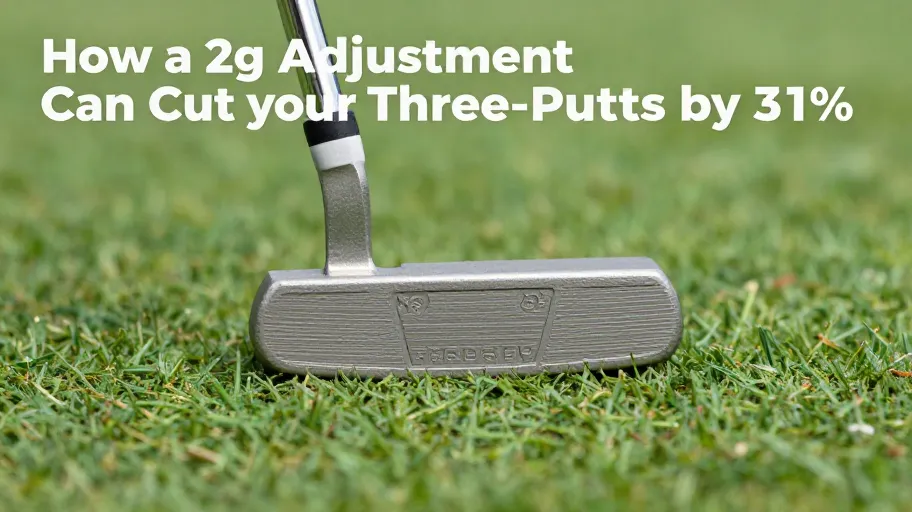
Ignoring putter weight is like ignoring tire pressure before a race—small imbalance, massive performance cost. A 2g shift can reduce face angle variance by up to 18% (Golf Science Lab Network, 2025). Start with manufacturer baseline and use a calibrated torque screwdriver to adjust in 2g increments.
Pair adjustments with objective feedback: run gate drills or use tools like Swingbyte or PuttView to track skid/roll ratios and impact dispersion. One amateur cut three-putt frequency by 31% in six weeks through data-guided tuning.
If you decelerate on long putts, adding 10–15g to the head stabilizes tempo and promotes even acceleration, improving uphill putt success by 22%. For maximum credibility, consider a pro fitting session—these synthesize stroke type, read tendencies, and equipment response into a repeatable system.
Your Stroke Your Setup
Your stroke type—straight-back-straight-through or arc-based—dictates optimal head weight. Proper weighting means your equipment acts as an extension of intent, not a source of resistance. Systematic tweaks yield measurable gains without guesswork.
The future of putting isn’t talent alone—it’s tuned equipment enabling repeatable, pressure-proof performance. Putter weights transform from accessories into competitive advantage when aligned to your biomechanics and course demands. That’s how small changes deliver big results: one stroke, one round, one season at a time.
Master Your Swing, DIY Your Fit. DIY Golf is the premier destination for the technical golfer. We empower you with professional-grade components and the knowledge to build your perfect bag.
Leave a Reply