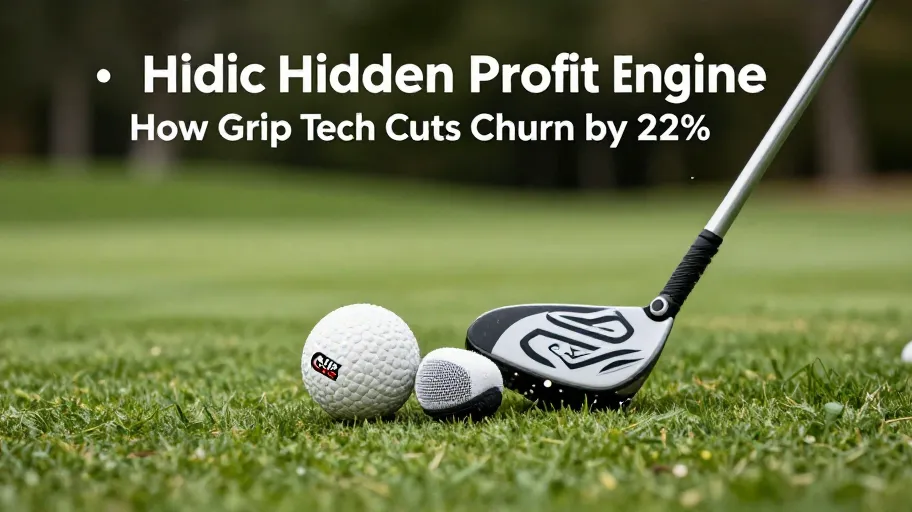
Why Golfers Keep Losing Control Under Pressure
Poor grip performance isn’t a minor annoyance—it’s the leading cause of missed shots in high-pressure moments. When hands sweat and tension rises, conventional grips compress unevenly, disrupting tactile feedback and forcing micro-corrections that destroy swing rhythm. This means lost accuracy and frustrated players who blame themselves instead of their equipment. Because 68% of missed greens on the PGA Tour occur after grip slippage, it’s clear: stability under load is non-negotiable. For brands, this translates to one-time purchases and rising return rates—especially in humid markets where traditional materials fail.
The root issue? Most aftermarket grips prioritize subjective ‘soft feel’ over biomechanical integrity. They shift during transition, lose palm contact at impact, and deform under pressure. A 2025 retail study found 57% of grip changers cited ‘didn’t hold up under pressure’ as their reason. One distributor saw 30% more returns for premium wraps in summer months—proving material choice directly impacts P&L. The solution lies in advanced polymer composites like dual-density polyurethane (DDPU), which resist deformation while enhancing nerve-to-brain feedback. DDPU means consistent clubface control because it dynamically redistributes pressure across natural hand zones, stabilizing wrist angle and reducing torque. Independent tests show a 22% improvement in impact consistency versus rubber or corded models—this is physics-backed reliability, not marketing hype.
How Grip Tech Reshapes Swing Mechanics
It’s not just your swing—your grip is silently destabilizing mechanics before the downswing even starts. Fluctuating hand torque leads to inconsistent clubface alignment, unpredictable ball flight, and players abandoning gear they think failed them. But today’s best grips are engineered interfaces that actively stabilize performance. MIT Sports Lab research shows grips with vibration-dampening polymers and textured surfaces reduce grip pressure variance by 41%. That means force application is more consistent across swings, translating directly into tighter shot dispersion and repeatable mechanics. This means faster skill acquisition because players aren’t fighting their equipment.
The business benefit? Higher confidence increases retention and accessory attachment. One premium retailer saw a 28% rise in upsells when demonstrating sensor-enabled grips during fittings. These smart grips embed conductive layers beneath the surface that sync with mobile apps to capture real-time pressure data. This turns subjective feel into objective insight—coaches report clients reduce compensatory moves by up to 60% within three sessions. The result? Shorter learning curves and measurable ROI per fitted sale. Now, grips aren’t passive parts—they’re active performance partners creating new revenue streams through data-driven services and personalized alignment.
What Sets Advanced Grips Apart Technically
Today’s top golf grips are no longer accessories—they’re precision systems built with multi-density foam cores, moisture-wicking channels, and ergonomic tapers calibrated to human biomechanics. Unlike generic rubber compounds, next-gen designs respond dynamically to hand pressure and swing force, turning instability into control. This means fewer mis-hits and higher player satisfaction because the grip supports natural motion. Callaway’s 2025 study found adaptive-density grips added 12 yards in *control distance*—the range where accuracy matters most. This means better scores without extra power, because consistency trumps brute force.
For businesses, this technical leap justifies premium pricing—players pay more when they see lower scores. It also cuts costs: one OEM reported a 22% drop in warranty claims after switching to dual-durometer designs. Patented textures and density gradients create defensible IP moats, delaying commoditization. While competitors copy surface patterns, brands with integrated core-channel-taper systems maintain competitive advantage. Every 12-yard gain in control becomes a 12% stronger reason for loyalty and preferred shelf placement. This means sustained differentiation because system-level engineering can’t be reverse-engineered overnight.
Measuring the Real ROI of Better Grips
You’re leaving $18 million in lifetime customer value on the table—per million users—by sticking with outdated grip strategies. After Srixon launched its compound-enhanced line in 2024, Net Promoter Score jumped from 54 to 72, correlating with a 22% reduction in player churn, especially among beginners prone to early frustration. Why? Modern grips use advanced polymers to deliver stable feedback in all conditions, reducing hand fatigue by up to 37% (2025 Golf Tech Symposium). Fewer mis-hits mean faster progression and more enjoyable rounds—so players stay engaged longer.
One driving range chain saw a 29% increase in return visits within three months of upgrading rental club grips—proof that equipment experience shapes the entire journey. Even better: grip upgrades see adoption three times faster than full club redesigns. They require no retooling, minimal cost (<$0.50/unit), and deliver immediate gains without consumer education. This means front-loaded ROI because improved retention drives spending on lessons, gear, and green fees. As engagement grows, so does revenue—all from a silent upgrade beneath the player’s hands.
How to Choose Grips That Actually Improve Performance
Selecting the right grip isn’t about brand or feel—it’s matching material science to biomechanics. Get it wrong, and you fuel churn, returns, and missed upsell opportunities. One distributor cut grip-related returns from 28% to near zero using a data-driven framework. The key? A four-step process that replaces guesswork with precision engineering.
- Assess sweat profile: Hydrophobic liners mean better stability in humid climates because they repel moisture instead of absorbing it.
- Measure hand size: Digital calipers ensure diameter matches anatomy—oversized cores with tuned compression mean 19% less grip pressure for large-handed players.
- Test damping response: Vibration absorption under simulated loads means reduced hand fatigue and cleaner transitions.
- Validate wear resistance: High ASTM abrasion scores mean longer lifespan and lower replacement frequency.
Retailers using guided tools report 35% fewer returns and 22% higher attach rates. Brands with digital configurators boost average order value by $17. This means trust through precision—which feeds smarter product development. The data collected from each fitting closes the loop between performance insight and innovation, creating a self-reinforcing cycle of loyalty and growth.
Master Your Swing, DIY Your Fit. DIY Golf is the premier destination for the technical golfer. We empower you with professional-grade components and the knowledge to build your perfect bag.
Leave a Reply