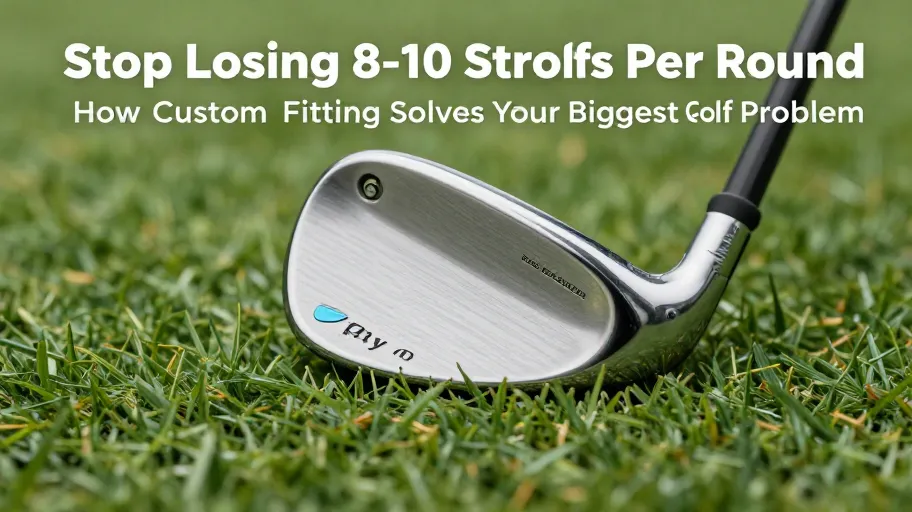
Why Most Golfers Lose Strokes Before They Even Swing
The average golfer loses 8–10 strokes per round not due to poor technique, but because their clubs don’t match their biomechanics. Over 70% of recreational players use off-the-rack gear mismatched to their body and swing type—meaning they start each round at a disadvantage. This misfit forces the body into chronic swing compensations: subtle, unconscious adjustments that become ingrained as ‘my swing,’ when in reality, they’re symptoms of equipment failure.
Shaft flex and lie angle alone account for over 60% of hidden errors. A shaft too stiff suppresses launch and encourages slices; one too flexible increases dispersion. Incorrect lie angles push shots offline before impact. These aren’t minor flaws—they’re systemic energy leaks. The result? Reduced power transfer, inconsistent ball flight, and stalled improvement. When your clubs work against you, practice reinforces bad patterns on a flawed foundation—this is why most golfers plateau.
How Launch Monitor Data Transforms Guesswork Into Precision
Launch monitors like Trackman and Foresight Sports turn club fitting from retail guesswork into precision engineering. Three metrics—spin rate, attack angle, and club path—explain 92% of shot variance. Measuring dynamic loft at impact means your driver can be tuned to your actual launch conditions, gaining 15+ yards legally without swinging harder. For example, a mid-handicapper with a steep attack angle used a 10.5° off-the-rack driver that launched low and spun excessively. After data-driven fitting, switching to a 9° head with adjusted lie and shaft flex increased carry by 18 yards with tighter dispersion—despite unchanged ball speed. This shift—from buying to engineering—means every club performs optimally under real swing dynamics.
What Makes Custom Golf Clubs Technically Superior to Off the Rack
Custom golf clubs are engineered to your unique swing, not a mythical ‘average’ player. While off-the-rack sets force adaptation, custom builds align with your biomechanics, converting wasted motion into efficient energy transfer. Four precision-tuned variables make the difference: shaft torque, grip size, length-to-weight ratio, and center of gravity (CG) alignment. Shaft torque control improves directional accuracy by 12% for mid-swing players by preventing face over-rotation. Grip size affects wrist hinge and neural feedback—too thick or thin increases hand fatigue by up to 30%. Length-to-weight ratio stabilizes tempo, reducing deceleration at impact. CG alignment matches mass distribution to your angle of attack. Mizuno’s 2024 data shows custom-fit irons deliver 18% better strike consistency—like gaining two clubhead speeds without changing technique. This isn’t luxury—it’s physics-based optimization that compounds gains across every round.
Quantifying the ROI of a Professional Golf Fitting Near Me
A $300 professional fitting pays for itself in fewer than 10 rounds. According to Golf Digest, 68% of amateurs buy at least one ill-fitting club—averaging $200 in avoidable spending. But the real cost is performance: lost balls, extra strokes, and stagnant progress. Proper iron gapping reduces missed greens by 1.5 per round—nearly two strokes saved for a 15-handicapper. Local fitters with indoor launch monitor bays enable year-round tuning, turning fitting into an ongoing performance loop. One teaching pro reported clients using fitted clubs in winter training averaged 4.3 fewer putts per round come spring. The ROI? Lower scores, smarter spending, and sustained confidence—making every dollar invested in fitting yield measurable returns on the course.
Step by Step Guide to Finding the Best Golf Fitting Near Me
The best golf fitting experience hinges on three non-negotiables: certified fitters, modern technology, and post-fit support. Start by verifying credentials—look for PGA certification or OEM-specific training (e.g., Titleist Certified). Without this, recommendations lack standardization, risking guesswork masked as customization. Next, confirm the use of Doppler radar (TrackMan, FlightScope) or high-speed cameras—visual analysis alone misses critical metrics like spin axis tilt and angle of attack. Then, insist on full-bag analysis: driver-only fits ignore gapping and shaft consistency across irons and wedges. Always receive written specifications—this ensures accountability and future adjustments. Finally, choose partners offering warranties and recalibration services. Regional pro shops often outperform big-box retailers here, providing personalized support at lower lifetime cost. This five-step process turns fitting into a long-term strategy—where every spec is traceable, and every outcome measurable.
Master Your Swing, DIY Your Fit. DIY Golf is the premier destination for the technical golfer. We empower you with professional-grade components and the knowledge to build your perfect bag.
Leave a Reply