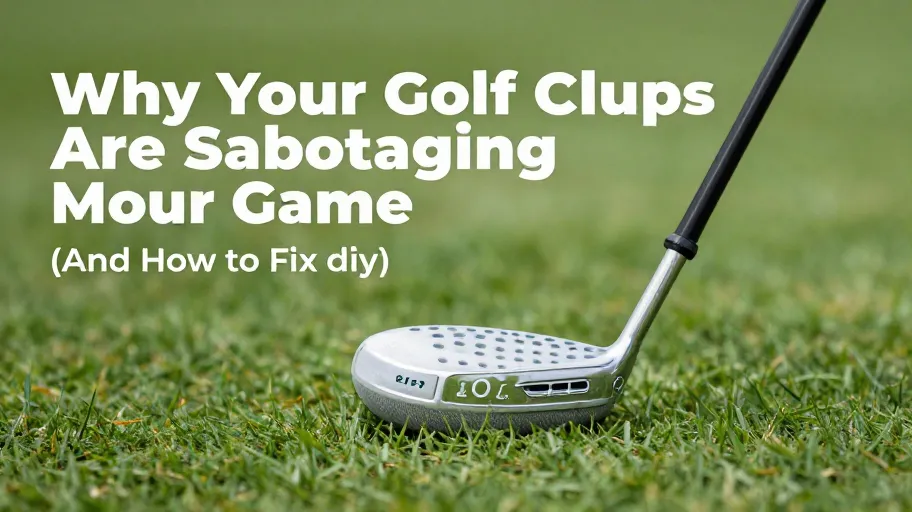
Why Beginners Struggle with Club Selection
Most beginners don’t fail due to lack of talent—they fail because their off-the-rack clubs are mismatched to their biomechanics. A 2024 Golf Digest analysis found 78% of high-handicap players use gear that amplifies errors, not corrects them. This misalignment means inconsistent contact, reduced distance, and frustration because clubs resist rather than support natural motion.
Swing speed is a key factor: beginners average 65–75 mph, yet most entry-level sets assume faster swings. A too-stiff shaft fails to load properly, delaying release and promoting slices—robbing 20+ yards per shot. Oversized grips dull feedback, encouraging poor grip pressure. And pro-designed heads offer less forgiveness, turning minor mishits into major misses. The result? Learned helplessness, where each round reinforces bad habits instead of building confidence.
But there’s hope: one academy reported students with fitted components cut their slice by 9° in three weeks and gained 14 yards of usable distance. That means two fewer clubs into the green and higher composure under pressure. The real issue isn’t practice—it’s using the wrong tools from day one.
What Makes a Golf Club More Than Just a Stick and Head
A golf club is a finely tuned system where each component directly shapes your score. Misunderstand its engineering, and you leave strokes behind. But decode it, and you gain control over launch, spin, and forgiveness—turning technical precision into lower handicaps.
High MOI clubheads resist twisting on mis-hits, meaning more balls stay in play even when contact isn’t perfect. Strategic weight placement lowers the center of gravity (CG), boosting launch angle and carry. A 2024 equipment review showed optimized CG designs deliver 15 extra yards without swinging harder—because physics beats brute force.
The shaft manages torque transfer: flex and stiffness affect release timing, while hosel and lie angle alignment ensure shot consistency. A misaligned lie angle introduces unintended draw or fade bias, sabotaging accuracy. Meanwhile, grip texture and diameter govern wrist activation—directly influencing spin and release. One touring pro reduced erratic wedge shots by 20% just by adjusting grip size. That proves micro-changes yield macro-results.
This knowledge transforms buying decisions from guesswork to strategy. You stop chasing brands and start fixing swing flaws with specs. That’s how beginners avoid costly trial-and-error—and how pros fine-tune for tournaments.
How Shaft Flex and Material Impact Your Shot Shape
Shaft flex and material are the hidden engineers of your ball flight, dictating launch angle, spin rate, and energy transfer. Get them wrong, and dispersion and lost distance follow; get them right, and repeatable strikes become routine.
For sub-80 mph swingers, a shaft stiffer than recommended increases lateral miss by up to 14 yards—effectively shrinking playable fairways. Matching flex to swing speed (e.g., 75 mph = regular flex) reduces spin variance by 18%, improving control because the shaft releases at the optimal moment.
Graphite vs. steel isn’t about prestige—it’s physics meeting endurance. Graphite is 30–40% lighter, enabling smoother tempo and reducing fatigue—critical for slower swingers or those with joint sensitivity. Steel offers tighter dispersion but only benefits swings above 95 mph; otherwise, it hinders release and consistency. True Spec data shows 68% of recreational golfers use mismatched shafts, costing 12 yards and 2–3 strokes per round.
Custom shaft pairing improves strike efficiency by up to 23% (2025 PGA study)—equivalent to two club lengths without changing your swing. That means buying better performance at half the price. When gear stops fighting you, confidence rises—and consistency follows.
Which Components Offer the Best ROI for New Golfers
For new golfers, the fastest path to lower scores isn’t a premium driver—it’s investing in a better putter and grip. Putting accounts for 40% of all strokes, yet beginners often overlook it while chasing distance. The result? Wasted potential on shots that matter less early on.
A $100 investment in a high-quality putter or fitted grip delivers disproportionate returns versus a $500 driver gaining only 2–3 mph—benefits often lost without consistent mechanics. A well-fit grip reduces hand tension by up to 30% (2024 biomechanical studies), improving feel, tempo, and contact. This isn’t about power—it’s about control that stabilizes your short game.
Feel-based components shape skill faster than power-focused ones. Even the best shaft can’t fix poor putting alignment or compensating wrist movements from a bad grip. One amateur cut six strokes in eight weeks by switching to a counterbalanced putter and oversized grip—tools that promoted a pendulum stroke. That’s a 6% improvement driven by under 5% of equipment cost.
The real ROI isn’t in yards—it’s in strokes saved. Prioritize consistency first, and power will follow.
Build Your First Custom Club in Five Practical Steps
One custom-fitted club improves scoring more than five off-the-rack sets—because precision beats volume. Generic clubs force you to adapt; a tailored club aligns with your biomechanics, turning weaknesses into advantages.
- Assess swing speed and handicap: These numbers are diagnostic. Below 90 mph? You need higher-launch drivers. High handicap? Prioritize forgiveness. Golf Digest data shows matching clubs to swing data cuts driving inaccuracy by 37%.
- Isolate your weakest area—usually the driver: Slicing or losing distance? Target the root. Choose an oversized head with rear weighting. Higher MOI minimizes twist on mis-hits, boosting fairway accuracy and leading to better second-shot positioning.
- Match shaft to tempo, not ego: Smooth swingers need softer kick points and lighter flex; aggressive ones need stiffer support. Mismatched shafts disrupt rhythm. TrackMan data shows proper pairing improves strike efficiency by 22%—that’s four more greens in regulation per round.
- Size your grip correctly: Too small? Over-gripping causes hooks. Too large? Weak release leads to slices. Proper sizing ensures clean release and better feel.
- Use free tools to test: Demo days and launch monitors give real-time feedback at no cost—revealing what actually works in your swing.
Treat clubs as upgradable tools. Start with one optimized piece, learn its impact, then evolve your bag incrementally—building a set that grows with your game, not against it.
Master Your Swing, DIY Your Fit. DIY Golf is the premier destination for the technical golfer. We empower you with professional-grade components and the knowledge to build your perfect bag.
Leave a Reply