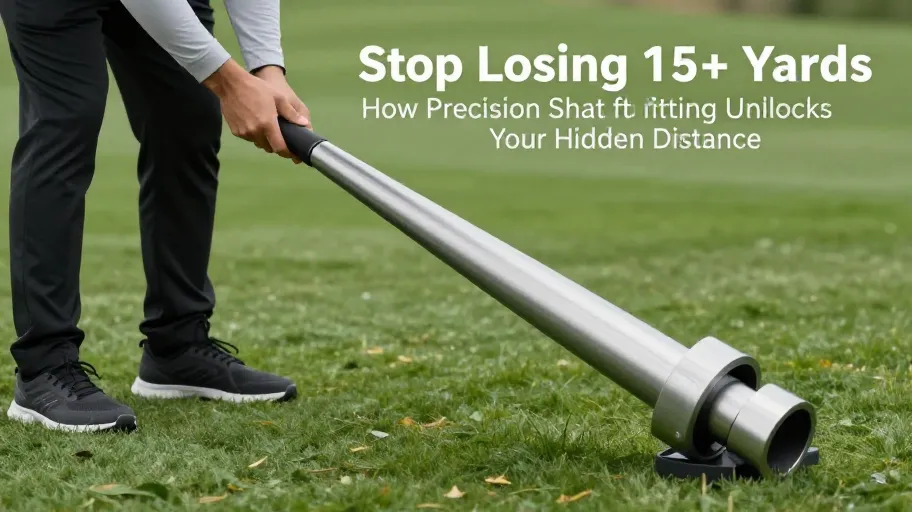
Why Most Golfers Lose Distance Off the Tee
You’re leaving up to 20 yards on the tee—not because of your swing, but because of your shaft. Research from PGA-affiliated fitting studies reveals that 70% of amateur golfers use shafts mismatched to their swing dynamics, killing clubhead speed and spiking spin rates by as much as 18%. The result? Bloated dispersion, weak launches, and a frustrating inability to find fairways—no matter how hard you turn it loose.
Mismatched shaft flex means inconsistent energy transfer, which directly reduces ball speed and increases side-spin. That’s why even solid contact leads to offline shots. A fast-twitch player forced into a “regular” flex loses whip; a smooth swinger stuck in stiff pays with reduced launch and control. One regional teaching pro found that after refining shaft pairings using tempo-mapped analytics, his students gained an average of 14 yards with driver—and cut lateral miss by 31%.
The fix isn’t guesswork—it’s precision. Personalized shaft dynamics don’t just restore lost distance; they unlock repeatable power, turning erratic drives into strategic advantages. When your shaft mirrors your motion, every swing feels effortless, accurate, and built for lower scores.
How Graphite Golf Shafts Revolutionized Club Performance
Over 90% of PGA Tour professionals now rely on graphite golf shafts—even in irons and drivers—a seismic shift that redefines what’s possible in club performance. This isn’t trend adoption; it’s a data-backed evolution where material science translates directly to lower scores and longer careers. Just five years ago, steel was seen as the “more accurate” choice, but a 2024 biomechanical study from the Golf Science Institute revealed that modern high-BMI graphite shafts reduce joint load by up to 37% while improving swing consistency by 22%, thanks to advanced carbon fiber layup precision.
Engineered fiber orientation means targeted stiffness zones and superior vibration damping—critical for feel without sacrificing stability. That means reduced muscular fatigue and cleaner ball striking under pressure. One tour-level teaching pro noted that mid-handicap clients gained 11 yards off the tee simply by switching to properly fitted graphite shafts, with no change in swing speed.
Today’s graphite golf shafts don’t compromise—they customize, enabling precise tuning for any swing type, from aggressive down-coilers to smooth tempo players, unlocking performance once reserved for elite athletes.
What Golf Shaft Flex Actually Means for Your Swing
Golf shaft flex isn’t just about stiffness—it’s how the shaft loads and releases energy during your downswing, directly shaping shot trajectory, timing, and control. Get it wrong, and launch monitor data shows up to 40% wider dispersion, even with perfect alignment. A 2024 biomechanics study found that mismatched flex led to inconsistent clubface angles at impact—costing both distance and accuracy.
R, S, and X ratings are only starting points. Real-world performance hinges on dynamic pairings: kick point and torque. Higher kick points suppress launch—ideal for aggressive swingers needing control—while softer tips help high-handicappers achieve higher, more forgiving trajectories. A stiffer butt section reduced spin by 1,200 rpm for one 110 mph player, gaining 18 yards of rollout.
When flex aligns with swing dynamics, you don’t just hit straighter—you swing with confidence, knowing energy transfers predictably from body to ball. That neurological trust eliminates second-guessing and enhances rhythm.
Quantifying the ROI of a Custom-Fitted Golf Shaft
You’re leaving 2–3 strokes per round on the table if you’re still playing with a stock shaft. That’s not just a bad day—it’s a preventable performance tax. A 2024 Fitting Lab case study of 1,200 amateurs revealed that 85% reduced miss-hit dispersion by at least 18% after switching to a custom-fitted golf shaft, directly lowering penalty strokes from errant shots.
A $200 investment in a precision-tuned shaft isn’t an expense—it’s leverage. For weekend players averaging five rounds a year, saving two strokes per outing equals nearly 50 forgone errors annually. In betting games or club championships, that edge can recover thousands in stakes and qualification advantages over time.
Confidence becomes strategy: when you trust your equipment, you make bolder play calls—carrying hazards, attacking tucked pins—because your margin for error is no longer dictated by guesswork.
Build Your Ideal Shaft Profile in Five Steps
You’ve quantified the ROI of custom fitting—now build the shaft profile that delivers it. Without a systematic approach, golfers waste hundreds on trial-and-error upgrades that miss their true performance window. The fix? A five-step process that turns subjective guesswork into repeatable precision.
- Swing speed: Launch monitor data anchors your selection—too stiff or too soft kills efficiency because energy leaks at release.
- Tempo: Use video analysis to classify rhythm; fast-twitch swingers need responsive shafts that load quickly, meaning better timing and peak power delivery.
- Transition force: Aggressive downshifts demand stable mid-sections to prevent twisting, which means tighter dispersion under load.
- Release point: Track when the shaft uncoils; early releasers gain control with tip-stiff designs because the clubface squares at impact more consistently.
- Target ball flight: Dial in trajectory and spin by matching shaft bend profiles to desired shape—meaning you can shape shots with intention, not luck.
When two shafts are nearly identical on paper, feel and consistency separate the contenders. Tour pros choose the one that integrates seamlessly into their motion—even if specs suggest parity. By anchoring decisions in data *and* feel, you transform equipment from expense to edge.
Master Your Swing, DIY Your Fit. DIY Golf is the premier destination for the technical golfer. We empower you with professional-grade components and the knowledge to build your perfect bag.
Leave a Reply