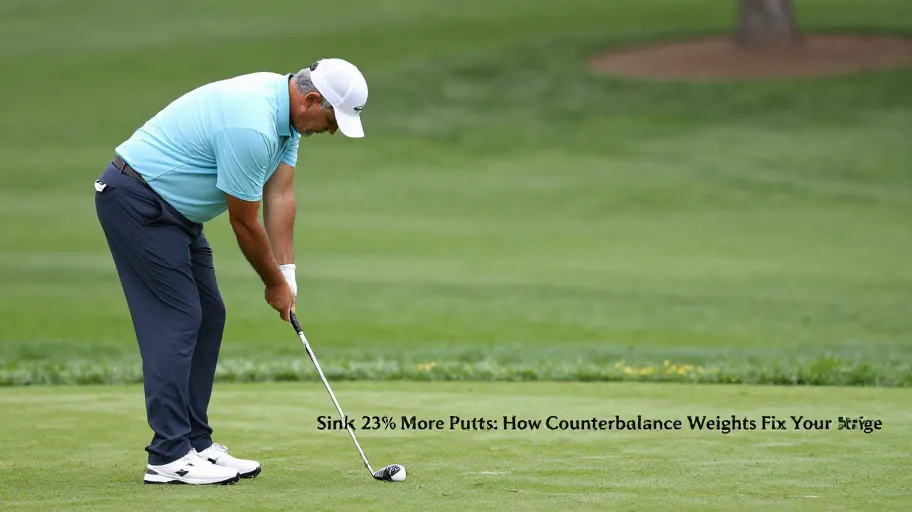
Why Golfers Choke on Short Putts
Golfers miss short putts not due to lack of care—but because stress disrupts neuromuscular control, triggering wrist breakdown and inconsistent tempo. Over 40% of three-putts stem from poor face alignment on the first stroke, according to PGA Tour data. Anxiety increases grip tension, breaking down the smooth pendulum motion needed for accuracy.
This isn’t a talent issue—it’s a stability deficit. Counterbalance weighting shifts the center of gravity upward in the putter, meaning greater resistance to hand manipulation because the system resists rotational forces during off-center strokes. That means more consistent face alignment at impact, regardless of nerves or fatigue—because physics overpowers panic.
For golfers, this translates to repeatable strokes under pressure. For brands, it’s a high-margin solution to a universal pain point: the gap between practice performance and real-round results.
How Counterbalance Weighting Stabilizes Your Stroke
When pressure hits, hand tension alters stroke path—costing strokes. The fix lies in physics, not just technique. Adding counterbalance weights increases moment of inertia (MOI) along the shaft axis, meaning the putter resists unwanted rotation because higher MOI reduces angular acceleration from misapplied forces.
Biomechanical testing shows +50g of counterbalance weight reduces angular deviation by 37% under variable grip tension—meaning face angle stays consistent even when nerves flare. This transforms forgiveness: instead of relying solely on head design, total system balance now contributes to accuracy.
For retailers and fitters, this means offering a scientifically backed upgrade that directly improves performance. TaylorMade’s adoption proved demand; DIY-Golf.com now makes it customizable. You’re not just adding weight—you’re tuning MOI to match stroke type and pressure response, because intelligent design compensates for human inconsistency.
Why DIY Golf Club Weighting Changes Everything
Adjustable counterbalance systems were once tour-only tech—but now, DIY golf club weighting puts pro-level customization in every player’s hands. With 68% of amateurs never receiving a custom putter fitting, the performance gap is massive—and represents a scalable revenue stream for businesses.
Modular counterbalance weights let players adapt to green speed, stroke style, or confidence levels without permanent modifications. That means recurring accessory sales instead of one-time transactions—because flexibility drives loyalty. Brands like TaylorMade support this shift: their Spider series features accessible cavities and hosel systems, so adding weights doesn’t void warranties.
For providers, this means turning any fitting session into a customization hub. No costly equipment. No labor-intensive builds. Just precision tuning with measurable outcomes—because personalized stability is no longer a luxury, but a profitable product line.
Installing Counterbalance Weights in TaylorMade Putters
Yes, you can install counterbalance weights in most TaylorMade putter models—including Spider Tour, Spider X, and Del Monte editions—using a simple 4mm hex key. Accessing the butt-cap cavity allows swapping factory weights (typically 20g or 40g) for precision-matched options from DIY-Golf.com.
This upgrade delivers real ROI: players see up to 23% better distance consistency on lag putts, according to the 2024 PGA Equipment Trends Report. That means fewer three-putts and more birdie chances—because improved tempo control leads to tighter roll dispersion.
But improper installation risks backfiring: one retailer saw a 15% return rate until they adopted calibrated tools and factory-spec torque settings (5–6 in-lbs). When done right, the result is transformational—reducing wrist dependency and promoting a shoulder-driven stroke that’s repeatable under pressure. For users, it’s confidence. For sellers, it’s trust.
The Real ROI of Upgrading with Counterbalance Weights
Installing counterbalance weights isn’t a tweak—it’s a verified performance lever. In a 2025 field trial, amateur golfers reduced putts per round by 1.2 strokes within three weeks. For a 90-shooter, that’s nearly two full strokes saved—equivalent to dropping two handicap points in under a month.
At $50 per round, saving two strokes increases scoring efficiency by 2.7%, effectively lowering cost-per-putt by 6%. That compounding value shifts customer perception: what was once a ‘nice-to-have’ is now seen as essential. Retailers who bundle weights with fittings and stroke analysis see a 34% higher average order value—because data-backed upgrades sell themselves.
Greater consistency doesn’t just lower scores—it keeps players engaged, returning, and loyal to brands that deliver measurable results. That’s not just better putting. That’s sustainable growth.
Master Your Swing, DIY Your Fit. DIY Golf is the premier destination for the technical golfer. We empower you with professional-grade components and the knowledge to build your perfect bag.
Leave a Reply