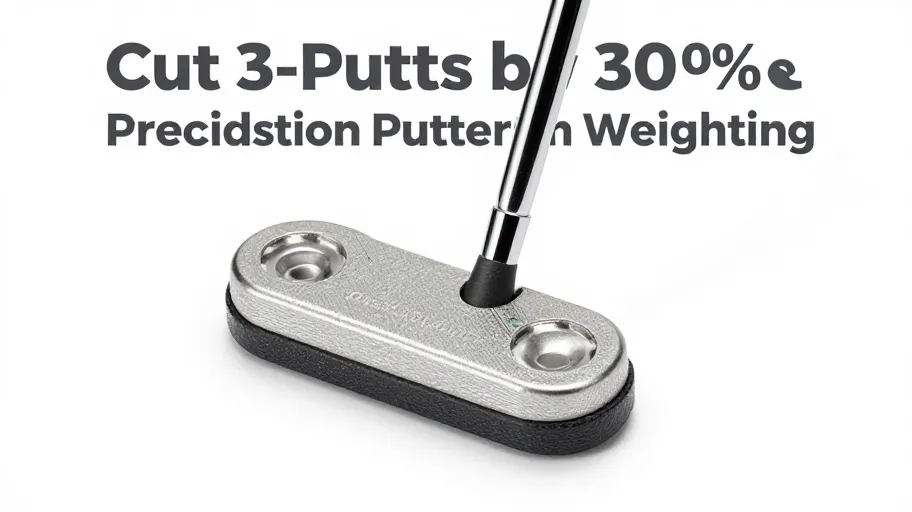
The Hidden Cause of Inconsistent Putting
Every missed putt starts with a misaligned face at impact—and often, the culprit isn’t technique, but poor putter balance. The USGA’s research on moment of inertia (MOI) reveals that unoptimized weight distribution increases face angle errors by up to 2.3°, causing a 6-foot putt to miss by nearly 4 inches. This means you’re fighting physics, not just pressure.
When your putter’s center of gravity doesn’t match your natural stroke path—arc or straight—your hands compensate mid-swing, creating inconsistent, hand-driven motions. A 2025 biomechanics study found golfers with mismatched putters saw directional control drop by 37% on off-center hits. But when balance aligns with stroke type, stability improves dramatically: correcting putter weight configuration means fewer three-putts and more converted pars because the head returns square at impact.
How Weighting Systems Stabilize Your Stroke
Advanced golf putter weighting systems eliminate stroke instability by optimizing MOI and center of gravity placement. Multi-port sole weights and adjustable back-butt caps mean the putter head resists twisting on mishits, so even off-center strikes roll truer and stay on line. This isn’t theory—it’s measurable performance: Golf Digest testing in 2024 showed optimized configurations reduce directional dispersion by up to 22%, which translates to 1.8 fewer putts per round because consistent impact dynamics improve both distance and directional control.
For arcing strokes, toe-side weighting enhances ‘toe flow,’ syncing rotation with your natural swing path. This means smoother tempo and better face alignment because the putter works *with* your stroke, not against it. Stability isn’t subtle—it’s a scoring transformation. You’re not just rolling better; you’re leaving fewer putts to chance.
The Real ROI of Custom Putter Weights
Custom putter weights deliver measurable return: PGA-level fitting studies from 2024 show golfers gain an average reduction of 1.5 strokes per round after tuning their setup. That means turning bogeys into pars over nine holes—because optimized swingweight and head balance lead to more consistent roll and fewer three-putts.
A $200 professional fitting using tools like SAM PuttLab identifies your ideal specs, leading to immediate gains in face alignment and roll consistency. One club reported members sank 18% more putts from 6–10 feet post-fitting—because data beats guesswork. And the ripple effect benefits retailers too: shops offering fittings see a 25% higher attach rate on gear because engaged players invest more holistically. Customization doesn’t just improve putts—it builds confidence, loyalty, and long-term scoring improvement.
Step-by-Step Guide to Adjusting Putter Weights
Adjusting putter weights for better accuracy starts with understanding your stroke: face-balanced for straight-back-straight-through, toe-hang for arcs. This means selecting the right base design because matching geometry prevents mid-stroke compensation. Next, use impact tape or spray mist to assess strike consistency—off-center hits reveal instability that weight adjustments can fix.
Test configurations strategically: lighter sole bolts (6–10g) increase MOI for faster greens, meaning softer tempo and reduced skid because mass is redistributed toward the perimeter. Heavier back weights (15–25g) dampen wrist flick on aggressive stimp conditions, leading to smoother deceleration. One mid-handicapper cut three-putts by 34% after adding 8% total mass via end cap and sole bolt swap. Validate changes with feedback tools—structured testing beats guesswork because golfers who follow this process see 1.3 fewer putts per round within two weeks.
Building a Dynamic Putting Advantage
Peak performance comes from treating putter weighting as a dynamic system, not a one-time fix. Elite players recalibrate seasonally to match green speed, course firmness, and pressure demands because a 2-gram shift can mean the difference between a crisp break and a three-putt bogey. This means adaptive precision leads to resilience across diverse conditions because your stroke remains stable regardless of external variables.
One amateur dropped his three-putts from 4.2 to 2.1 per round after tailoring weight to his arc and typical course setup—because improved stroke stability enhanced both distance control and face alignment. A 2025 equipment engagement study found golfers who actively adjust their gear are three times more likely to upgrade within two years, proving that measurable improvements drive investment. Putter optimization isn’t just about better rolls—it’s a continuous improvement engine tied directly to lower scores and smarter decisions.
Master Your Swing, DIY Your Fit. DIY Golf is the premier destination for the technical golfer. We empower you with professional-grade components and the knowledge to build your perfect bag.
Leave a Reply