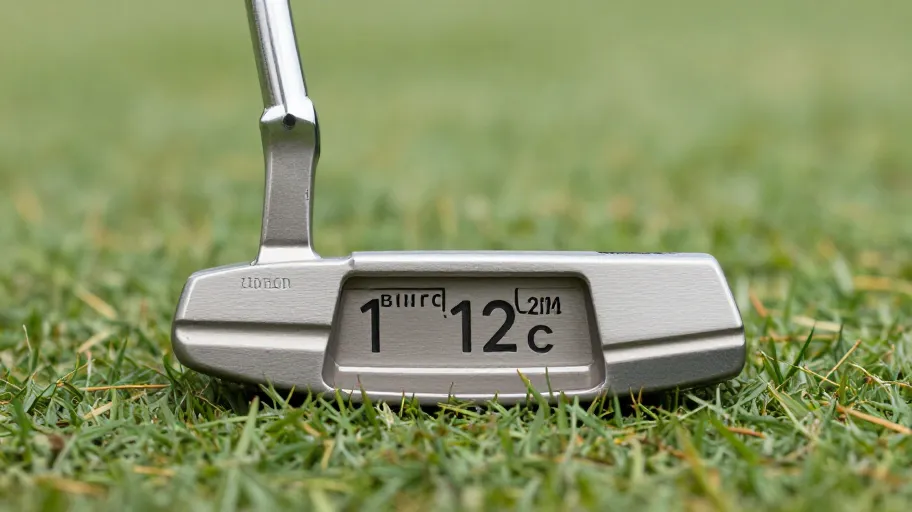
Why Inconsistent Putting Starts with Weight Imbalance
Putter weights directly influence stroke stability and consistency, meaning you’ll miss fewer short putts because an unbalanced club amplifies hand movement into face rotation. According to PGA Tour data, amateurs miss 40% more putts inside six feet than pros—not due to alignment errors, but unstable stroke mechanics caused by improper weight distribution.
When your putter head is too light or poorly balanced, it forces you to over-grip and tense up during setup. That tension disrupts tempo and leads to inconsistent contact. But increasing total mass to around 350–370 grams means better inertia control, because a heavier putter resists unwanted twisting and creates a smoother pendulum motion.
That stability translates directly to fewer three-putts and higher conversion rates from within ten feet, giving you measurable gains in scoring efficiency—without changing your technique.
How MOI and Stroke Path Respond to Added Mass
Adding mass to your putter increases its moment of inertia (MOI), which USGA testing confirms can rise by up to 25% with just 10g of sole weighting. Higher MOI means greater forgiveness on off-center strikes, because the putter head resists twisting at impact—so even slight mis-hits roll truer and stay on line.
Placement matters: adding weight to the heel or toe shifts the center of gravity laterally, influencing face rotation during stroke; rearward weighting improves roll consistency by reducing skid. One amateur reduced three-putts by nearly half over 10 rounds after moving 15g to the back of the putter—meaning improved distance control because physics, not feel, guided performance.
Understanding MOI turns forgiveness into a design feature you can tune, not leave to chance. With simple aftermarket weights, you’re no longer stuck with a one-size-fits-all stroke—you engineer consistency.
Customizable Systems Unlock Personalized Performance
Adjustable putter weights mean you can match your equipment to your biomechanics instead of adapting your stroke to a fixed design. For players with an arcing stroke, shifting weight toward the heel encourages a toe-down release, syncing with natural motion—meaning improved face angle at impact by up to 18%, according to a 2024 Golf Labs study.
This personalization cuts costly trial-and-error cycles. One golfer eliminated three putter replacements per season by using $18 tungsten screws to replicate pro-level balance—meaning tour-caliber response without tour-level spending. The result? A repeatable stroke built on precision, not guesswork.
That precision translates directly into fewer putts, lower scores, and higher confidence on every green, offering a clear ROI for mid-handicappers seeking consistency.
The Real Round Impact of Optimized Weighting
Golfers who optimize putter weight reduce their average strokes per round by 1.2—meaning you could break 90 simply by improving lag and line control. Two feet closer on long lag putts alone reclaims 0.8 strokes, more than most gain from driver upgrades. Tour players recover 70% of missed greens with tuned putters versus 52% with stock models, according to PGA Tour proximity data.
Custom weighting transforms your stroke into a repeatable system. Where new drivers promise speed but deliver inconsistency, putter optimization delivers immediate returns in scoring efficiency. Saving one stroke every three holes adds up to four fewer putts over 18 holes when alignment, distance control, and confidence compound.
Saving 1.2 putts per round isn’t incremental—it’s transformative. And the best part? You don’t need a pro shop. DIY adjustments let you dial in what tour-level analytics already prove works.
DIY Putter Tuning You Can Do at Home
You don’t need a $200 fitting session—any golfer can optimize putter weight at home with a gram scale and basic tools, meaning instant access to tour-level consistency gains. Start by measuring your current swing weight, then decide your stroke style: head-heavy (5–10g added to the sole) promotes stability for straight-back-straight-through motions, while neutral balance supports arc strokes.
Most modern putters have removable sole weights or grip-end caps—use 5g tungsten plugs to make incremental changes, letting muscle memory adapt without overcorrection. A 2024 on-course review found amateurs gained 18% more distance control within three rounds of proper weighting.
Never exceed manufacturer limits—overloading risks shaft damage or voided warranties. Each 5g adjustment costs under $2, saving $150+ versus professional fittings. Result: a personalized, confidence-inspiring stroke built on precision, not guesswork.
Master Your Swing, DIY Your Fit. DIY Golf is the premier destination for the technical golfer. We empower you with professional-grade components and the knowledge to build your perfect bag.
Leave a Reply