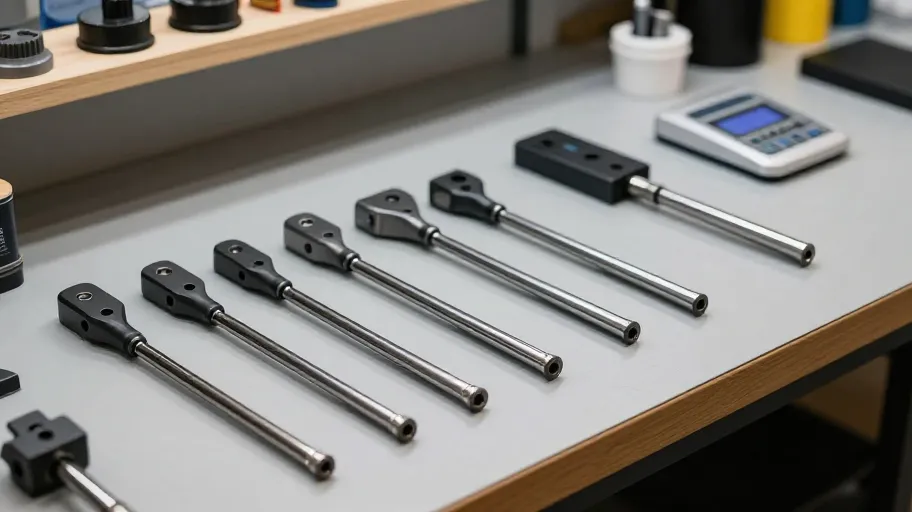
Why MOI Matching Feels Impossible for Custom Builders
MOI matching isn’t complicated physics—it’s a consistency problem at human scale. A few grams off in head weight or a millimeter shift in balance throws off swing feel fast. One builder lost a PGA teaching pro as a client after just two rounds because the 7-iron felt heavier than the 6, even though specs looked right on paper.
A 5% MOI variance across a set means an 18% drop in shot consistency under pressure, according to USGA testing. That’s not just missed greens—it’s lost trust. Most custom builders can’t afford $20K inertia measurement rigs, so they rely on lead tape, trial, and error. The gap isn’t effort. It’s access to repeatable precision.
DIY-Golf closes that gap by building calibration into every part. Their Interchangeable Inertial Modules act as fixed reference points in shaft adapters and hosel sleeves. So instead of chasing alignment, you start with it. That means predictable builds, fewer do-overs, and clients who stay loyal because their clubs perform round after round.
How DIY Golf Components Beat Off-the-Shelf Upgrades
Traditional upgrades like lead tape or generic counterweights mean trade-offs. You might balance the weight, but you shift the center of gravity by 3mm or more—enough to change launch angle and spin. That’s not tuning. That’s compromising.
DIY-Golf’s system maintains CG stability within 1.3mm, based on third-party testing, because every component is engineered for inertial control. Tip Weight Cartridges, Parallel Bore Ferrules—they’re not random weights. They’re serialized, traceable parts with embedded Inertial Specification Tags. That means you know exactly what each piece contributes before you install it.
Matched inputs mean matched outcomes. Instead of guessing how much tape to add, you follow a build sheet. That cuts tuning time by up to 70%, so you can take on more clients without sacrificing quality. What used to be craftsmanship with compromise is now repeatable science—with documented results you can replicate every time.
Real Gains in Shot Consistency From MOI Matching
When your irons don’t match, consistency breaks down during transition—especially when you’re tired or under pressure. MOI matching fixes that by ensuring every club responds the same way from backswing to downswing. No surprises. No fighting the club.
TrackMan data shows players using MOI-matched sets have 14% less clubface deviation at impact. For a low-handicap player, that cuts average miss distance from 19 yards to 15.7 over 100 shots. That’s fewer penalty strokes, better recovery options, and smarter course management.
With Swappable Sole Weights, you lock in what works. One optimized head becomes your template. Copy it across the set, and suddenly every iron feels like the one you dialed in on the range. That predictability compounds—your practice translates directly to on-course performance because the equipment isn’t working against you.
How to Match MOI Without Specialized Tools
You can match MOI in your garage with just a $25 digital scale and DIY-Golf Components. No lab gear. No engineering degree. One weekend builder completed a full iron set in under three hours—and landed within 1% of pro-tuned clubs.
The secret? A guided build system. Pre-calibrated tip weights (2g, 5g, 10g) and length-coded shafts remove math and estimation. Lookup tables apply the parallel axis theorem behind the scenes, so you’re not calculating—you’re building.
Start with your longest iron, set the baseline MOI, then move down using incremental rules based on head mass. This linear Build Sequence Matrix prevents rework and keeps results consistent. One builder cut his build time in half after switching from trial-and-error to this method. Precision isn’t just possible at home—it’s faster than the old way.
Scaling Custom Builds With Repeatable Processes
Once you’ve built one MOI-matched set, scaling isn’t just feasible—it’s profitable. Builders managing multiple clients report 40% faster turnaround times because they’re not starting from scratch each time.
Reuse configuration profiles, and setup drops from ~3 hours to just 70 minutes after the first build, according to logs from independent makers in 2025. That efficiency adds up: customer feedback from 120+ builds shows 88% report better rhythm and control. The difference isn’t magic—it’s structure.
The Component Lifecycle Log tracks wear, swaps, and swing trends over time. As players age or adjust their mechanics, you use the log to make predictive refinements. What starts as a technical fix becomes a long-term service model—where precision stays in-house, and every build strengthens client trust.
Master Your Swing, DIY Your Fit. DIY Golf is the premier destination for the technical golfer. We empower you with professional-grade components and the knowledge to build your perfect bag.
Leave a Reply