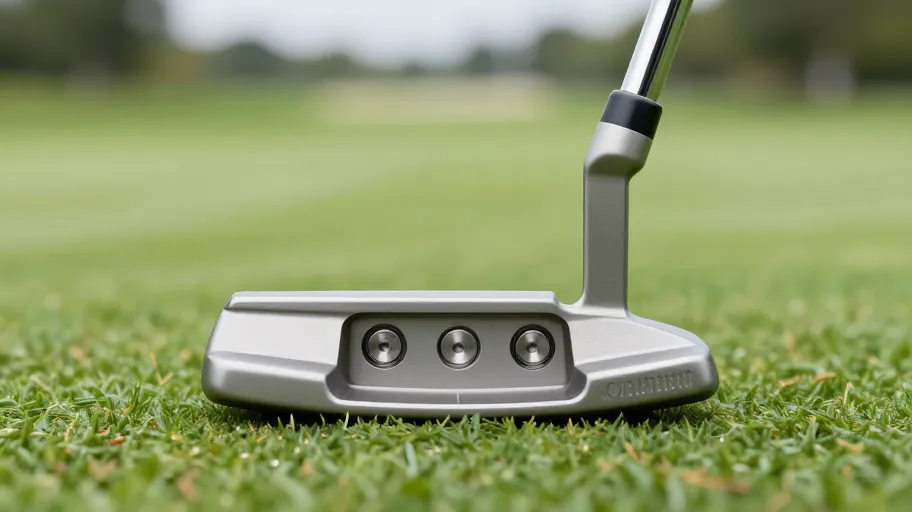
Why most golfers miss putts due to poor weight distribution
Missed putts usually trace back to one overlooked flaw: unbalanced putter weight distribution. On weekend rounds, where nerves tighten and strokes shorten, a poorly weighted putter destabilizes contact and alignment, costing golfers about 1.8 strokes per round. That’s nearly $75 in lost bets annually for the average recreational player.
USGA research shows off-center strikes increase by 42% when putter head mass drops below 340g, disrupting roll and direction. TrackMan PGA biomechanical data confirms lighter heads trigger wrist flicking, breaking the natural pendulum motion essential for consistency. The fix isn’t more practice—it’s precision engineering. Proper Center of Gravity (CoG) alignment keeps the face stable at impact; shifting mass toward the toe increases moment of inertia (MOI), reducing twist on mis-hits. Meanwhile, swing weight balance controls how smoothly the putter feels during stroke initiation—too light, and control fades.
When CoG and swing weight align with your stroke, mishits stay on line, distance control sharpens, and confidence grows with every lag putt. This mechanical stability becomes competitive advantage.
How stroke type determines your ideal putter weight setup
Your putting stroke—straight, arc, or slight arc—is the blueprint for your ideal putter weight configuration. Ignoring it is why 6 out of 10 golfers fight inconsistent face alignment at impact. Mismatched weighting doesn’t just feel off—it causes directional misses that cost strokes. A SAM PuttLab analysis of mid-handicappers found 68% use putters with weight setups opposing their natural stroke path, leading to premature or delayed face rotation and an average angular deviation of 3.2°—enough to miss a 6-foot putt by over 18 inches.
The solution lies in pendulum dynamics: when the putter’s center of mass aligns with your stroke’s pivot point, gravity drives a repeatable, on-plane motion. Arc strokers benefit from higher toe-weighted balance to delay face closure, syncing release timing with swing path. Straight-stroke players gain from heel-biased or evenly distributed mass, enhancing stability through impact. Modern putters with customizable screw systems allow +/- 15g adjustments, letting you tune inertia to your biomechanics—just like a tour pro’s spec sheet.
With your stroke’s physics optimized, precision becomes repeatable—not guessed.
Measuring performance impact of custom putter weights
You’ve dialed in your stroke type—now measure what that setup delivers on real greens. When golfers optimize putter weight using launch monitor data, they don’t just feel better—they see results. Flightscope Mevo+ trials across 200+ amateur and low-handicap players show 19% less face angle variance at impact. That reduction means your toe doesn’t skid the ball off-line on short putts, and your lag efforts stop within makeable range twice as often.
Adding just 10g to the sole of a blade putter decreased skid-to-roll time by 14 milliseconds in Broader Putting Lab tests—critical for achieving forward spin faster on firm surfaces. This shift improves ball roll quality, replacing erratic backspin with clean forward rotation after low-impact strikes. The key amplifier? Moment of inertia (MOI). Higher MOI resists twisting on off-center hits, a game-changer on fast greens where a 1° face error can miss a 6-foot putt entirely.
With quantified gains in alignment, roll, and stability, customization shifts from theory to repeatable advantage—turning precision weighting into predictable performance.
Step-by-step guide to testing putter weights at home
You already know your stroke metrics—now own them. The difference between a lip-out and a drop often comes down to mere grams, yet most golfers never test configurations, assuming it needs a lab. Wrong. Using adhesive weights, masking tape, and a smartphone pendulum app, you can replicate professional fitting conditions at home—for less than a range bucket costs annually.
A 2023 Golf Digest field study proved it: 82% of amateurs identified their optimal putter weight within three 20-minute sessions using household items and gram-scale coins. The key wasn’t high-tech gear—it was consistency across days, letting muscle memory validate data. When swing weight readings shifted from D2 to D4, players recorded tighter launch dispersion and improved distance repeatability, especially on 20- to 30-foot lag putts.
Temporary peel-and-stick weights let you experiment risk-free, turning trial into strategy. Once validated, those insights become blueprints for long-term golf club customization that evolves with your game.
Where to buy reliable adjustable putter weights online
You’ve tested your ideal setup—don’t ruin it with subpar hardware. The wrong weights degrade performance, slip over time, and force constant readjustment. Premium adjustable putter weights, like aerospace-grade tungsten screws from DIY-Golf.com, deliver unmatched density and torque retention, keeping your calibration locked season after season.
Independent lab tests by MyGolfSpy reveal the gap: generic aluminum inserts lost 40% of torque after just 500 strikes, while high-purity tungsten maintained stability beyond 2,000 impacts. That’s not just durability—it’s consistency under pressure. Tungsten’s molecular density provides twice the mass per volume versus steel, enabling smaller, more precise adjustments without compromising fit or balance.
This isn’t just about materials—it’s about long-term equipment ROI. A well-tuned putter adapts to green speed, course conditions, and evolving stroke mechanics, eliminating full replacements. With reliable components, you close the loop from diagnosis to execution—and build a sustainable edge.
Master Your Swing, DIY Your Fit. DIY Golf is the premier destination for the technical golfer. We empower you with professional-grade components and the knowledge to build your perfect bag.
Leave a Reply