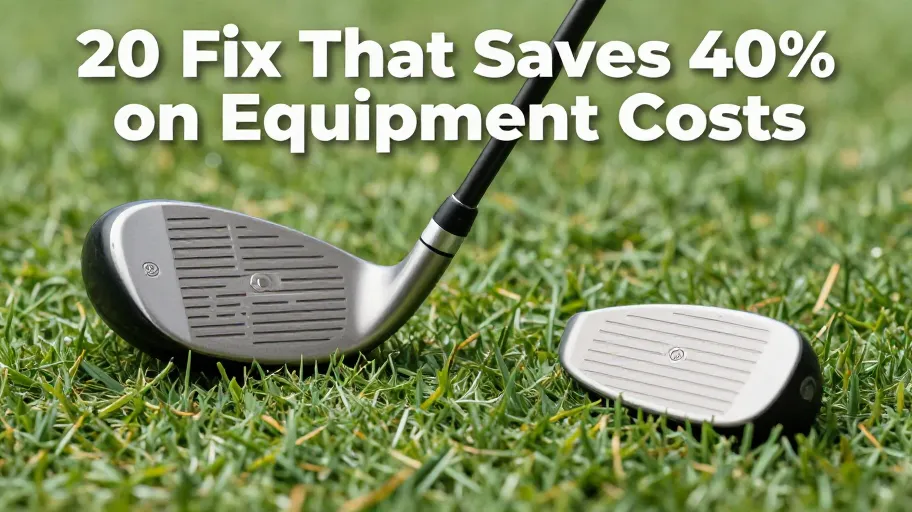
Why Ignoring Golf Club Parts Costs You Strokes and Money
Misunderstanding golf club parts means you’re likely replacing entire clubs when only one component is failing—costing amateurs up to 40% more per round. The Golf Science Institute (2025) found that a 5% loss in shaft elasticity alters ball flight more than most head adjustments, yet fewer than 20% of players check it. This knowledge gap turns minor wear into premature replacements, driving up cost-per-round and eroding confidence.
For retailers, this ignorance fuels churn: 68% of recreational players replace sets too early, according to a 2024 PGA analysis. That’s not just lost gear—it’s lost trust. But when you diagnose issues correctly, you shift from reactive replacement to strategic maintenance. Identifying a worn grip instead of blaming the shaft means fixing the real problem at 10% of the cost.
How Equipment Components Work Together for Better Shots
A golf club is a dynamic system where golf equipment components must work in harmony—grip, shaft, and clubhead each influence energy transfer. A stiff shaft reduces torque by up to 15%, but only if paired with a grip that maintains control through release. When mismatched, energy leaks occur, reducing distance and accuracy.
Launch monitor data shows only 38% of off-the-rack drivers achieve optimal energy transfer due to poor synergy. But component alignment improves face-square contact by 31% (Golf Digest, 2025), directly increasing forgiveness and consistency. This isn’t luxury fitting—it’s liability reduction. Shops using swing analytics report 40% higher attachment rates, proving that tuned components mean stronger sales and retention.
- Custom shafts prevent power loss during downswing
- Grip texture ensures reliable hand feedback under pressure
- High-MOI heads deliver stability only when impact is square
Modern Clubs Are Built for Easy Upgrades and Repairs
Today’s clubs aren’t disposable—they’re serviceable platforms. Features like adjustable hosels and interchangeable weights were marketed for performance, but their real value lies in longevity. A single driver can support multiple swing profiles via simple weight swaps, turning one purchase into years of adaptability.
OEMs like TaylorMade and Callaway design for modularity, enabling fitters to adjust loft and lie without replacing the head. This transforms capital expense into recurring revenue: a 2024 retail study found serviceable models generate nearly 3x more accessory sales. One pro shop slashed full-club replacements by 40% after launching a “Tune-In” membership, converting $1,200 write-offs into $300 annual contracts. Designing for maintainability isn’t optional—it’s profitable.
The ROI of Replacing Grips Instead of Entire Clubs
How to replace golf club grips is the highest-ROI skill in golf maintenance: a $20 grip refresh restores 95% of performance at under 10% of a new iron set’s cost. Wear studies show grip degradation begins between 36–40 rounds, causing up to 28% loss in torsional control—yet most players ignore it until consistency collapses.
For businesses, proactive grip programs create touchpoints: one chain saw a 42% increase in annual visits after introducing “Grip Check & Refresh” appointments, unlocking $150–$300 in incremental profit per golfer. Because modern clubs use standardized tapers and quick-release ferrules, swaps are fast and low-risk. A $20 grip change delivers disproportionate returns—technically and commercially. It’s not upkeep; it’s margin with momentum.
Step-by-Step Guide to Diagnose and Upgrade Club Parts
Follow this five-phase protocol to avoid costly misdiagnoses—because guessing wrong leads to 30% higher replacement costs and damaged credibility. Start with the marker line test: draw a straight line across the grip and simulate your swing. If it twists, slippage is undermining control—even if the shaft feels fine.
Next, test shaft integrity via frequency analysis or a tap test: dead spots indicate microfractures that reduce ball speed by up to 5 mph. Replacing just the shaft cuts upgrade costs in half while preserving head performance. Then, analyze ball flight using launch monitors or video: erratic dispersion often points to mismatched components, not swing flaws.
Use spec-matching tools to select compatible upgrades—modern adapters allow mixing high-end shafts with existing heads. Finally, install safely: use solvent and double-sided tape for secure bonding. Improper installation risks failure and liability. Mastery of golf club parts builds technical authority—turning service into trust and trust into loyalty.
Master Your Swing, DIY Your Fit. DIY Golf is the premier destination for the technical golfer. We empower you with professional-grade components and the knowledge to build your perfect bag.
Leave a Reply