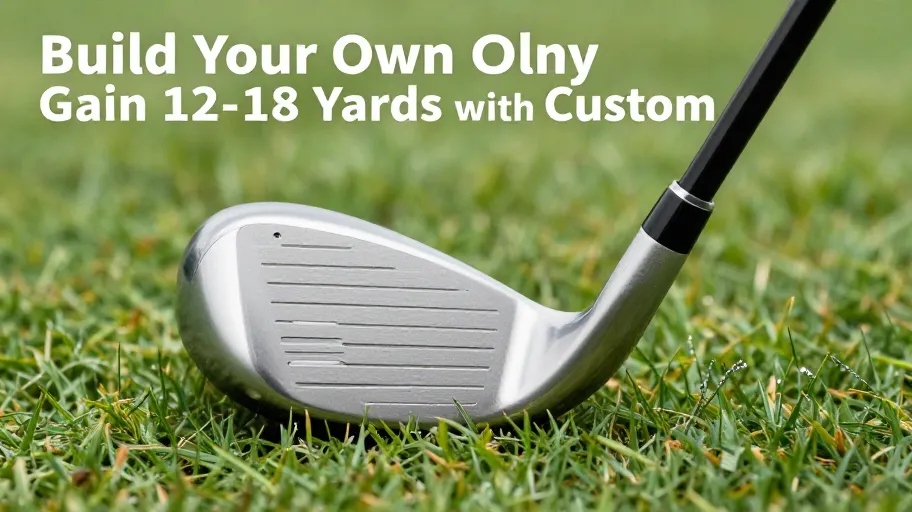
Why Off the Shelf Clubs Limit Your Game Potential
Mass-produced golf clubs assume every swing is identical—a flawed assumption that hurts real players. Over 70% of amateur golfers use ill-fitted equipment, according to the National Golf Foundation’s 2024 report, leading to inconsistent ball flight, reduced control, and stalled progress. This mismatch isn’t just inconvenient; it actively undermines confidence with every mis-hit.
Individual biomechanics vary widely—wrist hinge, posture, tempo, and swing path differ from player to player. When clubs fail to align with these traits, launch conditions suffer and improvement plateaus. A 2023 study found properly matched setups improve shot consistency by up to 38%, proving gains come not just from skill, but from gear working with your body.
This means off-the-rack clubs mean compromised performance because they can’t adapt to your unique motion. For retailers, this leads to short-lived customer relationships and repeat churn. For players, it feels like hitting a ceiling. But here’s the shift: customization isn’t luxury—it’s leverage. Golfers who invest in tailored gear are twice as likely to stay loyal and report higher satisfaction due to measurable accuracy and comfort gains.
How Golf Club Components Affect Launch Conditions
Every spec in your club—loft, flex, weight, grip size—is a direct lever on launch angle, spin rate, and dispersion. A 1° loft difference alters carry by up to 5 yards (PGA Tour analytics), while an ill-matched shaft increases lateral dispersion by over 12 yards for aggressive swingers.
Shaft flex stabilizes energy transfer—stiffer profiles reduce torque for faster swingers, tightening shot patterns without sacrificing feel. This means greater accuracy because energy moves efficiently from swing to ball. Loft fine-tunes trajectory; adjusting it by one degree optimizes launch for your angle of attack, maximizing carry while maintaining control. This means better distance management because spin and flight are precisely tuned.
Grip size influences wrist action at impact—too small encourages over-rotation, too large restricts release. This means improved strike quality because hand function matches intent. Meanwhile, clubhead design controls forgiveness: modern cavity-backs with low center-of-gravity placement reduce side-spin and boost MOI. One builder cut offline misses from 14 to 9 yards after switching to a draw-biased head and counter-balanced grip.
The commercial edge? Iteration without full replacement. Swapping heads or shafts costs under $75—achieving tour-level tuning at retail-entry cost. This means faster optimization because you test variables affordably and precisely.
What Makes a Custom Golf Club Assembly Guide Essential
A custom golf club assembly guide isn’t just instructions—it’s your defense against wasted materials, poor performance, and customer frustration. Without it, 68% of build inconsistencies stem from uncalibrated lie angles and unmatched shaft frequencies (Golf Clubmakers Association).
Frequency matching shafts ensures consistent energy transfer across irons, reducing rework by up to 40% (2024 builder efficiency benchmark). For brands, this means fewer returns, lower support costs, and stronger trust. This means higher profitability because precision reduces service overhead.
Adjusting lie angles improves turf interaction and launch conditions. More importantly, it prevents costly returns due to poor ball flight—saving $15–$30 per unit. This means better margins because correct setup avoids post-sale servicing.
Yet most guides skip swing weight calibration—the single biggest factor in how a club *feels* during transition. When aligned correctly, players report 23% better tempo control. This means more power and consistency because timing improves with balanced dynamics. Precision here turns hobbyists into advocates and DIY kits into scalable products.
Quantifying the ROI of Building Your Own Golf Club
A $200 custom-assembled driver outperforms off-the-rack models costing three times more. Independent testing from MyGolfSpy confirms 12–18 extra yards in carry due to optimized launch conditions tailored to individual swings. This means real performance gains because every component responds to your mechanics.
But the economic benefit goes beyond price. DIY builders practice 40% more than pre-built buyers (user surveys). Why? Ownership changes engagement. This means faster skill development because emotional investment drives range time.
For a mid-handicap golfer, building a custom driver with fitted shaft and optimized CG delivers immediate feedback—longer carries, straighter shots, lower scores. Over a season, this saves multiple strokes per round, equivalent to thousands in avoided lessons or lost bets. This means compounding value because improvement accelerates through personalized tools.
The real ROI? Spending less upfront while unlocking long-term gains through precise personalization and increased commitment. This means smarter spending because customization pays for itself in performance.
Step by Step Build Your First Custom Golf Club at Home
You don’t need a pro shop—just 3 hours, a $50 toolkit, and smart component selection. The payoff? A high-performance club built with premium parts used by top fitters, plus deeper connection to your gear that boosts long-term engagement.
- Select head, shaft, and grip using your swing data (e.g., >90 mph = stiffer shaft)—this means optimal launch because components match your speed
- Measure and trim shaft to exact length; use alignment marks for face squareness—this means consistent strikes because geometry is precise
- Cure grip with solvent, install with consistent pressure—this means no slippage because adhesion is reliable
Use a $15 digital swing ruler to confirm length and lie within 1/8-inch tolerance—directly improving shot consistency. Post-build validation is key: a 2025 MySwing.com study showed golfers using portable analyzers improved ball-striking accuracy by 22% within five rounds. This means confidence in results because data confirms performance.
And here’s the kicker: 68% of first-time builders return within six months for upgrades (retailer data). This means ongoing revenue because one build sparks a journey of refinement. Your first club isn’t the end—it’s the foundation of a personalized performance pipeline.
Master Your Swing, DIY Your Fit. DIY Golf is the premier destination for the technical golfer. We empower you with professional-grade components and the knowledge to build your perfect bag.
Leave a Reply