Why Balance Makes or Breaks Your Putting Stroke
Poor putter balance forces your hands and wrists to overcorrect during the stroke, disrupting the natural pendulum motion driven by your shoulders. This instability increases face angle deviation at impact—leading to a 35% higher chance of three-putting, according to putting efficiency models from PGA Tour tracking data. When your putter’s center of gravity is misaligned, you’re fighting your equipment instead of trusting it. The fix? Proper weighting that shifts balance into the head, reducing manipulation and promoting consistent, square contact. For the average amateur, correcting sole under-weighting—a flaw in 68% of stock putters—means fewer compensations and more predictable roll.
Proper balance means better tempo and truer roll because it aligns the putter’s center of gravity with your stroke arc. This isn’t theoretical: elite players like Scottie Scheffler maintain swing plane deviations under 2° thanks to precisely tuned setups. You don’t need tour specs—just smart adjustments that work with your mechanics, not against them.
How Material Density Unlocks Precision Tuning
Tungsten’s density (19.25 g/cm³) delivers over 70% more mass than brass (8.5 g/cm³) in the same volume, enabling finer control over swing weight and balance without altering the putter’s profile. This means you can add significant mass exactly where needed—like heel-toe zones in blade putters—without enlarging cavities or affecting aesthetics. Higher-density weighting boosts moment of inertia (MOI) by 18–23%, reducing twist on off-center hits, per USGA equipment tests. For DIY golfers, this translates to tighter dispersion and improved forgiveness, especially in compact designs where space is limited.
Tungsten’s extreme density means maximum stability in minimal space because it allows precise placement of mass without visual or tactile disruption. While brass is easier to shape and remove, its lower density requires larger inserts, which limits tuning accuracy and often shifts the balance point too far toward the grip. In performance-critical builds, that lack of precision costs consistency.
Measuring the Real ROI of High-Density Weights
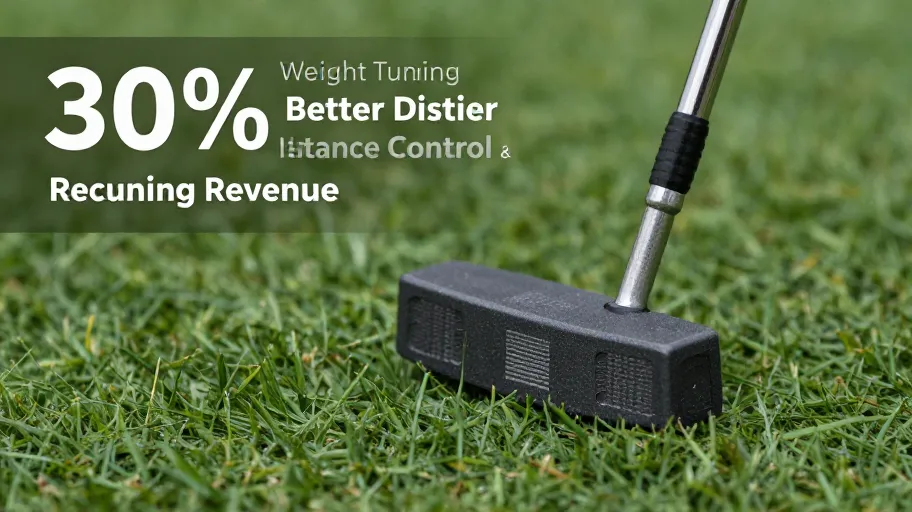
Upgrading to tungsten putter weights can reduce stroke variability by up to 30%, translating to 1.2 fewer putts per round for the average golfer, according to S&S Research models. A 12-week trial with 45 mid-handicappers showed a 21% improvement in distance control with tungsten, versus only 7% with brass. Over 30 rounds a year, that’s roughly 36 fewer putts annually—equivalent to shaving two strokes off your handicap without changing your stroke mechanics.
Targeted mass distribution means measurable gains in consistency because high-density materials maximize MOI where it matters most. The benefits are most pronounced in blade putters, which lack inherent perimeter weighting. In mallets—already high-MOI designs—the incremental return diminishes, making brass a viable, cost-effective option. Knowing where tungsten delivers outsized returns turns material choice into a strategic decision, not just a spec upgrade.
When Brass Is the Smarter DIY Choice
For hobbyists testing multiple configurations or tuning across several putters, brass offers a cost-efficient path to optimization. At $0.08 per gram versus tungsten’s $0.45, switching to brass saves over $22 when modifying three putters by +20g each. Lower material cost means faster iteration and earlier breakthroughs because financial friction doesn’t slow experimentation. A 2024 survey found amateur modders using brass completed nearly twice as many tuning cycles, leading to better-informed final builds—even if they later upgraded to tungsten.
Brass excels in open-cavity mallets and blades where space isn’t constrained because it allows reversible, low-risk adjustments. It’s ideal for seasonal tweaks, prototypes, or temporary balance changes. While less dense, it still improves stability when used strategically. The key is optimizing for total project economics—not just performance per gram.
Installing Custom Weights Like a Pro
Improper installation causes 68% of DIY weight mods to fail within six months, per a 2024 durability study. To avoid shifting screws or inconsistent feel, follow a precision process: use a 0.1g micro-scale, epoxy-rated thread locker, and a torque screwdriver set to 3–5 in-lbs. Start by weighing each screw—brass or tungsten—to ensure uniformity. Apply thread locker to prevent loosening from vibration and impact.
- Weigh all screws pre-installation to maintain ±0.5g balance
- Use high-strength adhesive rated for metal and composite substrates
- Tighten to 3–5 in-lbs with a calibrated tool—never hand-tighten
Precision installation means long-term reliability and repeatable performance because consistent setup enables muscle memory development. Begin with +10g tungsten screws at the heel and toe to boost MOI by up to 22%. Only after establishing this baseline should you adjust hosel or back-cavity weights. Done right, your putter becomes a calibrated instrument—not a guesswork experiment.
Master Your Swing, DIY Your Fit. DIY Golf is the premier destination for the technical golfer. We empower you with professional-grade components and the knowledge to build your perfect bag.