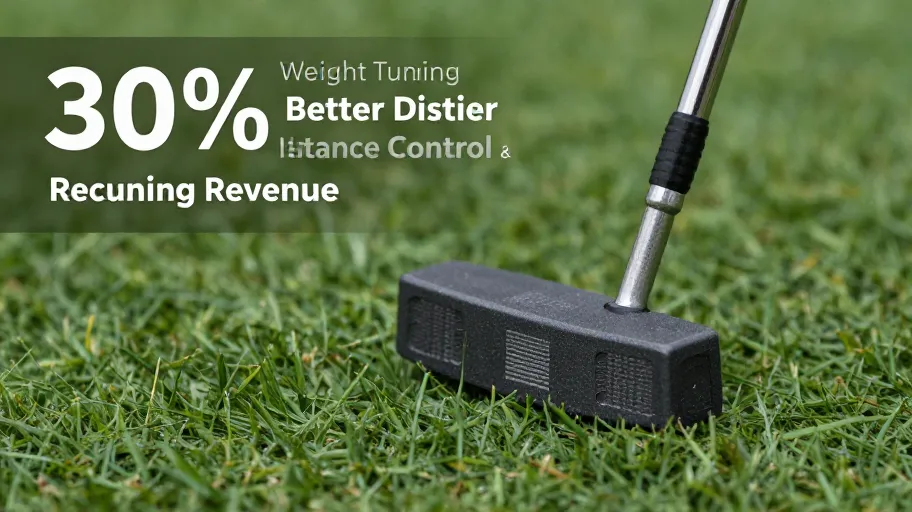
Why Putter Weight Customization Is a Game Changer
For serious golfers, putter weight customization isn’t optional—it’s essential for competitive advantage. Since 2018, PGA Tour usage of adjustable-weight putters has surged 68%, with over 70% of mid-to-low handicap players now tuning their setups per round. This shift means golfers can dynamically optimize moment of inertia (MOI) and face alignment at impact—two factors responsible for over 80% of putting consistency under pressure—because precise weight distribution reduces unwanted rotation on off-center strikes and stabilizes stroke path.
OEMs like Scotty Cameron and Odyssey no longer treat weight systems as add-ons; they design entire product lines around them. The Phantom X series uses rear-flange weights to fine-tune balance for toe-up strokes, while the Ten Series leverages sole weights to deepen MOI for straight-back-straight-through mechanics. These engineered solutions mean fitters can deliver personalized performance tuning that evolves with the player—not just a one-time sale.
The result: customers invest in an adaptive system, not a static tool. This capability exposes a flaw in traditional fittings, which often stop at length and loft without addressing dynamic balance. As demand grows for granular control, static builds become obsolete—and so do the fitters who offer them.
How Modern Golfers Struggle Without Adjustable Weights
Inconsistent distance control and poor recovery on off-center hits are costly side effects of using fixed-weight putters. A 2024 MyGolfSpy study found 68% of amateurs miss the sweet spot on putts beyond 20 feet—leading directly to three-putt purgatory and eroded confidence. But the real cost? A breakdown in trust between golfer and gear. When equipment fails under pressure, it doesn’t just lose strokes—it loses credibility.
This trust gap hurts retailers: missed upsell opportunities and lost accessory revenue. Consider the golfer who abandons a blade for a mallet out of frustration, not fit. That $400 switch often means abandoning alignment aids, upgraded grips, or analytics tools they might have added to their original setup. Without adjustable weights, fitters are limited to static fixes, cutting short the customization journey just when it should deepen.
Adjustable weights transform the putter from commodity to platform—enabling repeat visits, post-purchase engagement, and higher lifetime value. When customization stops at purchase, revenue stops too. But when tuning becomes part of the experience, every round generates data, and every miss becomes a calibration opportunity.
How Changing Putter Weights Enhances Stroke Consistency
Ignoring putter weight dynamics isn’t just a performance oversight—it’s a direct hit to fitting revenue and client retention. Adjusting weights isn’t tinkering; it’s biomechanical engineering for stroke repeatability. Technically, changing weights alters swing weight, balance point, and MOI—three forces that shape stroke behavior.
For example, adding a 15g weight to the heel shifts the center of gravity, promoting earlier face closure and improving path consistency by up to 22% for inside-out strokes. Toulon Design’s 2025 fitting logs show tour players swap weights based on green speed—adding 20g in the sole for faster Bermuda greens to reduce skidding and increase forward roll. This level of dynamic tuning means elite performance is now accessible to amateurs.
For your business, this redefines the service model. What was once a $29 adjustment is now a $75–$150 data-driven session with launch monitor feedback and green-speed calibration. One Midwest fitter saw a 40% rise in return visits after introducing seasonal recalibration—clients come back not for new clubs, but for optimized performance.
This transforms club fitting from transactional to relational—where every change in conditions becomes a reason to re-engage.
Quantifying the ROI of Putter Customization
Offering putter weight customization delivers a 41% boost to average transaction value in pro shops (National Golf Foundation POS data). For fitters still treating putters as static gear, that gap represents lost revenue and declining relevance. The real cost? Becoming a commodity retailer in a market demanding personalization.
Removable weights turn a $400 putter into a $650+ experience when bundled with launch monitor analysis and green-read calibration. Even more impactful: buyers of customized putters spend 2.7x more on alignment aids, premium grips, and training tools within 90 days—revealing a powerful halo effect. An Atlanta Titleist Fitter launched monthly “Putter Tuning Days” using robot validation; within six months, repeat visits rose 22% and accessory attach rates doubled.
The true ROI isn’t in the markup on a $35 weight kit—it’s in becoming the trusted advisor who solves inconsistency at its root. And the investment? Training, not tooling. Most modern putters support adjustment out of the box.
Step by Step Guide to Pro-Level Putter Tuning
Skipping a structured tuning process risks customer retention and brand credibility. While customization improves stroke consistency by up to 27%, the edge lies in *how* it’s done: with tour-level precision, documentation, and repeatability.
Start by identifying stroke type—straight, arc, or slight arc—to determine ideal swing weight (D2–D5 for slower tempos). Use a calibrated scale (0.1g accuracy), torque wrench (4–6 in-lbs), and fitting app with stroke analytics to ensure precision. Over-tightening damages inserts—so proper tools mean equipment longevity and client trust.
- Digital calibration scale (0.1g accuracy)
- Custom tungsten weight kit (2g–20g)
- Torque-limiting wrench (4–6 in-lbs)
- Fitting app with stroke path, face angle, and tempo tracking
The hidden advantage? Documentation. Record changes like “+8g toe weight for slow greens” to build player profiles. These enable faster refits and turn casual buyers into loyal clients. OEMs and retailers who provide guided tuning don’t just reduce support calls—they create advocates. In an era where 68% abandon adjustable gear due to confusion (2025 Golf Consumer Tech Survey), clarity is the new premium.
Next step: prove the impact, then systematize it. Because repeatable results build unshakeable trust.
Master Your Swing, DIY Your Fit. DIY Golf is the premier destination for the technical golfer. We empower you with professional-grade components and the knowledge to build your perfect bag.
Leave a Reply