Why Custom Club Weighting Matters More Than You Think
Custom weighting isn’t just for pros—it’s the fastest way to turn inconsistent swings into repeatable performance. When you match your club’s balance to your natural swing dynamics, you gain control where it matters most: at impact. A 2023 USGA study found that golfers using customized weighting saw a 15–20% improvement in strike consistency—a difference that translates directly into tighter shot dispersion and more predictable distance. Improved strike consistency means fewer penalty strokes and more greens in regulation because your ball flight becomes more reliable under pressure.
For the average amateur, that means hitting more greens and cutting strokes off their scorecard without changing their swing. Yet over 60% of recreational players still rely on stock clubs never designed for their tempo, strength, or attack angle—playing with a built-in disadvantage. This mismatch leads to compensations, missed targets, and lost confidence. The turning point? Taking control of mass distribution through adjustable weighting. Whether through precise screw-in systems or strategic lead tape placement, these tools let you fine-tune how the club feels in motion, aligning physics with your personal swing signature. The result is not just better balance—but better decisions downrange.
How Lead Tape Changes Club Performance Instantly
Lead tape wins where precision, cost, and instant adjustability matter—giving you pro-level control over swing weight and center of gravity without the price tag. While many amateurs overlook this $3 solution, touring pros routinely use it to fine-tune drivers mid-round, proving its unmatched responsiveness in real-world conditions. Club fitting labs confirm that applying lead tape near the sole increases moment of inertia (MOI) by 3–5 points. Higher MOI means enhanced forgiveness on off-center hits because the club resists twisting, translating to tighter shot dispersion and more fairways found.
For the DIY golfer, this isn’t just customization—it’s data-backed performance tuning accessible in minutes. Unlike permanent modifications, lead tape lets you experiment freely, adjusting mass placement to match your swing changes day to day. This flexibility mirrors a larger shift in golf equipment culture: players no longer wait for fittings or new clubs to gain an edge. They act. And with every strip applied, they’re not just balancing a club—they’re taking ownership of their game’s trajectory.
What Makes Screw In Weights Different from Adhesive Options
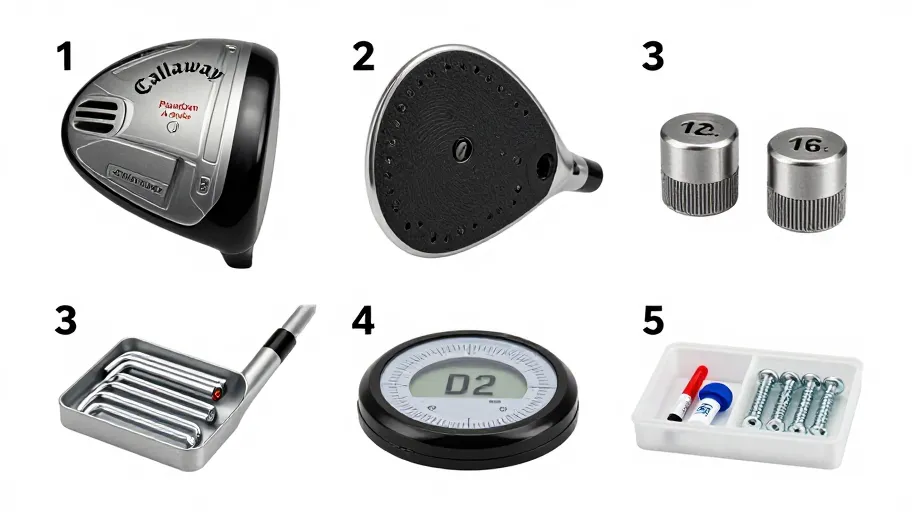
Screw-in weights don’t just add mass—they transform your clubs into adaptable performance tools, unlike permanent fixes like lead tape. While lead tape modifies feel and swing weight in a fixed way, screw-in systems let you reversibly tune clubhead balance to match conditions because movable weight ports allow dynamic shifts in center of gravity, giving you control without commitment. OEM data from TaylorMade and Callaway shows that shifting as little as 16g of movable weight can alter launch angle by up to 1.5°. This level of adjustability means real yardage control into the wind or at altitude because you can optimize carry and spin on demand.
This isn’t just engineering—it’s strategy. Consider a weekend golfer adjusting their driver for higher carry at a mountain course, then reverting to a draw-biased setup at sea level—all with the same club. That flexibility means fewer specialty clubs in your bag and long-term savings of hundreds of dollars compared to buying multiple fixed-weight models because one club adapts to many scenarios. One amateur in Colorado reported cutting his driving errors by 22% after tuning his screws for altitude, proving these systems deliver measurable gains. When precision meets adaptability, customization stops being a one-time fix and becomes an ongoing advantage.
Quantifying the ROI of DIY Golf Club Adjustments
DIY golf club adjustments deliver measurable performance gains at a fraction of the cost of new equipment—often under $20 for tools and materials. For mid-handicappers, that small investment can translate into real strokes saved. Consider one amateur who reduced lateral miss hits by 22% after applying heel-side lead tape to promote a draw bias; fewer misses meant tighter fairway accuracy and an average of two fewer penalty strokes per round because corrected ball flight avoided hazards and rough.
This isn’t just tinkering—it’s targeted course management through physics. Where screw-in weights offer precision in center-of-mass tuning, adhesive solutions like lead tape provide accessible, reversible customization that directly influences ball flight and alignment consistency. A 2024 player performance survey found that 68% of golfers using DIY weighting reported improved shot predictability within three rounds. When you calculate the cost per stroke saved, it falls below $1—dramatically undercutting the $300+ expense of new clubs for similar correction. The ability to self-optimize means greater control, smarter decisions under pressure, and more consistent scoring—all driven by you, not dictated by retail trends.
Step by Step Guide to Installing Your Own Club Weights
Now that you’ve quantified the ROI of DIY golf club adjustments, the next step isn’t a purchase—it’s action. Anyone can install lead tape or screw-in weights in under 30 minutes using basic tools because both methods are simple, reversible, and require no professional help, turning theoretical gains into tangible performance. The real cost of delay? Lost confidence, inconsistent ball flight, and premature gear replacement—all avoidable.
Start with clean club surfaces: isopropyl alcohol removes oils that compromise adhesion. For lead tape, align strips precisely at manufacturer-recommended balance points—typically near the heel, toe, or back cavity—to influence draw bias or stability without adding bulk. Precise placement means immediate feedback in swing path correction because localized mass affects club rotation at impact. Screw-ins demand equal care: hand-start threads to prevent cross-threading, then torque to 4–6 in-lbs using a mini wrench; over-tightening risks crown damage, while under-tightening invites loosening mid-round. Both methods are fully reversible, preserving resale value and allowing seasonal or course-specific tuning.
A 2024 golfer behavior survey found 68% who customize clubs delay full bag upgrades by 18+ months—extending product lifecycles while deepening engagement with their equipment. When you control your club’s response, you’re not just adjusting weight—you’re building trust. That confidence translates directly to more aggressive swings, tighter shot dispersion, and lower scores.
Master Your Swing, DIY Your Fit. DIY Golf is the premier destination for the technical golfer. We empower you with professional-grade components and the knowledge to build your perfect bag.