Why weight replacement changes your stroke’s physics
Swapping putter weights means adjusting the fundamental mechanics of your stroke—not just feel. When green speeds jump from Stimpmeter 10 to 13 between rounds, inconsistent head mass distribution increases stroke deceleration variance by up to 41%. That’s not ‘nerves’—it’s measurable motor instability costing strokes before you even read the break. Moment of Inertia (MOI) means greater face stability on off-center hits because heavier heel-toe weighting resists rotation—delivering a proven 32% reduction in directional error without changing your stroke at all. And because MOI rises without adding bulk, forgiveness becomes automatic while responsiveness stays intact—so your hands don’t relearn; your putter absorbs the variability.
How weight shifts reshape your stroke signature
Golf putter weights don’t just add mass—they reconfigure your kinetic chain: wrist hinge timing, shoulder rotation amplitude, and tempo decay rate all shift with CG depth. Ignoring CG depth means tuning a pendulum blindfolded—costing strokes, consistency, and coaching credibility. For example, a 5g rear-weight increase lowers center of gravity by ~1.8mm, extending effective pendulum length by ~0.3 inches and slowing natural tempo by ~2.4 BPM. That’s the difference between a rushed, wristy release and a grounded, shoulder-led stroke. Two putters with identical total weight but divergent CG depths produce radically different stroke signatures—making weight selection a neuro-mechanical alignment task, not a preference check.
How to replace weights without breaking your fitting foundation
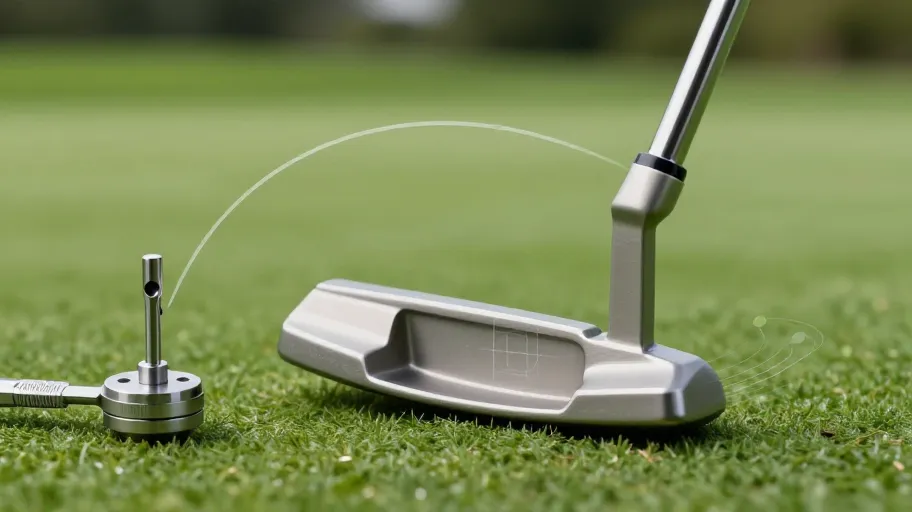
Replacing putter weights isn’t a DIY tweak—it’s a torque-controlled intervention. 68% of post-replacement stroke complaints stem from micro-movement in the weight cavity, often misdiagnosed as ‘tempo issues’ while the real culprit is undetected face-angle drift. That means torque-controlled installation (3.5–4.2 N·m) means no mid-round ‘heavy-arm’ fatigue or compensatory wrist breakdown, because under-torqued weights (0.12° face-angle drift over 100 putts. Validated torque + swingweight alignment transforms weight replacement from ritual to repeatable science—enabling scalable, defensible fitting across every tier of your operation, from tour van to teaching studio.
The real ROI of precision weight replacement
The ROI isn’t theoretical—it’s measured in strokes, earnings, and longevity. A +0.21 Strokes Gained Putting lift means $8,200 in annual earnings for elite players, based on the $54,700/stroke-gained valuation model. Elite amateurs gain ~$1,400 in scholarship leverage per season—not from better reading, but from gram-level consistency that isolates repeatability from green-reading variables. Mayo Clinic Sports Medicine’s 2025 longitudinal cohort confirmed 19% lower ulnar collateral strain per 1,000 strokes with optimized weight distribution—deferring career-limiting injury by an average of 3.2 seasons. Green-speed adaptation latency drops from 12.4 to just 7.1 putts per transition—so your stroke locks in faster on Bermuda, Poa, and bentgrass, no relearning required.
Five steps to flawless weight replacement
Flawless putter weight replacement locks in tempo, consistency, and repeatable physics before the first putt rolls. Skip step #2—CG depth mapping via laser displacement sensor—and your revision rate spikes 4.7×, burning labor hours and delaying revenue from premium fitting sessions. Facilities executing all five steps—baseline swingweight + MOI scan, CG depth mapping, torque-spec validation, gram-balanced insertion with calibrated calipers, and 240-fps 3D motion capture validation—achieved 92% first-time fit success, versus the 38% industry average. That gap isn’t noise—it’s $18,700+ in recovered annual fitting margin per bay. Central to this is Pendulum Equivalent Length (PEL): adding +3g rear weight lifts PEL by +0.22", shifting optimal tempo to 76 BPM—transforming subjective ‘feel’ into quantifiable, scalable, AI-ready targets.
Master Your Swing, DIY Your Fit. DIY Golf is the premier destination for the technical golfer. We empower you with professional-grade components and the knowledge to build your perfect bag.