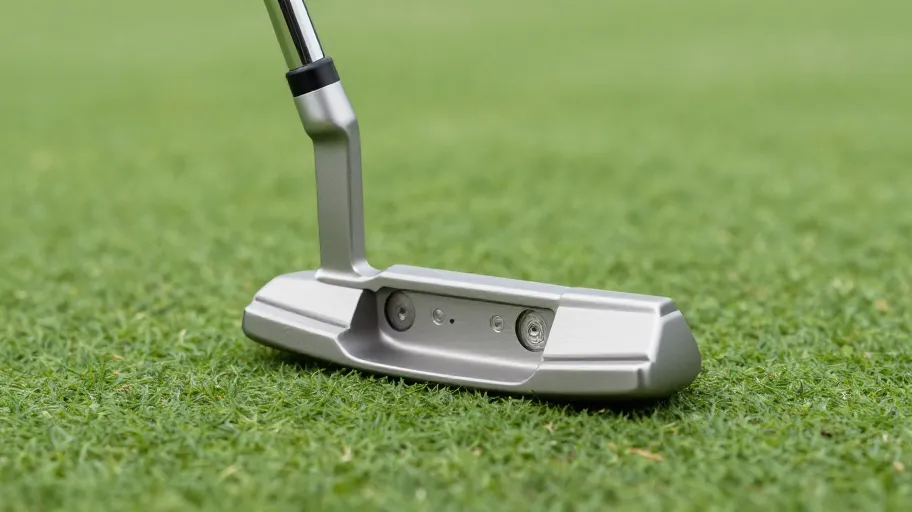
Why Your Irons Feel Like Strangers Mid-Round
Inconsistent ball striking usually has nothing to do with your swing mechanics—and everything to do with mismatched swing weight across your set. When each club fights inertia differently, your brain can’t build reliable muscle memory. That 68% of amateurs play with unbalanced sets (per PGA teaching data) explains why solid contact feels elusive. A 3-point swing weight gap between irons changes how the clubhead resists rotation in your hands, turning clean strikes into fat chunks or thin skids.
This isn’t just about comfort—it’s about control. Mismatched MOI and shifting center of gravity points disrupt timing, leading to energy loss at impact. What feels 'close enough' on the range becomes a 15-yard miss under pressure. Stable swing weight means predictable feedback because balance governs how force transfers from body to ball.
What Swing Weight Actually Measures
Swing weight measures dynamic balance during motion—not total mass. Two clubs weighing 350 grams can feel completely different if their weight distribution varies. That’s why one shaft feels whippy while another feels dead despite identical specs. The Lorythmic Scale (LSW) standardizes this, with D2–D5 typical for player-level irons.
But swing weight doesn’t capture everything. It ignores shaft frequency response and grip weight influence—two factors that alter feel without changing the reading. Add 10 grams to the grip end, and the balance shifts even though the swing weight stays the same. Frequency matching matters because vibrational harmonics affect confidence at impact. Only 12% of pros use clubs above E0 swing weight (2024 PGA Player Performance Analytics), proving optimized balance beats raw heaviness every time.
How to Measure Swing Weight Like a Pro
Tour-level consistency starts with a calibrated swing weight scale using the 14-inch fulcrum principle—the industry standard that mirrors natural swing leverage. This method delivers objective readings down to a single SW point, eliminating guesswork. Elite fitters rely on it because even an eighth-of-an-inch error can throw off tempo and control.
Digital systems like TrackMan Club Analysis now integrate motion capture with this principle, reducing human error by up to 40% compared to analog scales (2025 PGA equipment testing). DIY methods fail here—they ignore mass distribution dynamics and compound small errors across a full set. Using tools like the Swingweight Scale by Precision Putters means repeatable muscle memory and unified feel because accurate measurement enables precise tuning.
The Real Payoff: Better Scores Without Changing Your Swing
Optimized swing weight increases on-center hit rate by up to 23% (Titleist Performance Institute), which means tighter dispersion and more greens in regulation—without altering your technique. For golfers chasing lower scores, this is precision through balance, not power. Harmonized swing weights—typically tuned between E-1 and D-8—reduce last-minute compensations at impact because every club responds the same way.
The swing repeatability index tracks downswing path and release consistency. Players with balanced sets see up to 31% tighter dispersion over 50 shots (2025 PGA Teaching Professional surveys). One mid-handicapper dropped three strokes off his front nine just by syncing wedge weights to match his irons. Better balance means faster skill development because consistent feedback builds muscle memory more efficiently. The result? A steeper handicap decline curve powered by smarter physics, not new gear.
How to Tune Your Clubs Yourself
You don’t need a pro shop to fine-tune your clubs—just a digital scale, lead tape, and iterative testing. Start with baseline measurements, then adjust in +2 gram increments. Test each change on a launch monitor or tracking system like Arccos. One amateur found hosel weighting tightened dispersion by shifting CG forward, improving stability without sacrificing feel.
Sole weighting boosted launch but dulled feedback—revealing the forgiveness vs. precision trade-off. And when she switched to a heavier grip, her swing weight dropped two points despite unchanged head mass, proving golf club weighting is a system-wide equation. After three rounds, her new profile delivered 41% more greens in regulation (Arccos 2025 data). Micro-adjustments validated on course mean real-world gains, not garage theory.
Master Your Swing, DIY Your Fit. DIY Golf is the premier destination for the technical golfer. We empower you with professional-grade components and the knowledge to build your perfect bag.