Why mismatched swing weight kills your consistency
When one iron feels heavy and the next feels light, it’s not in your head—it’s in your hands. Mismatched golf club swing weight forces you to adjust your tempo on every shot, even if you’re swinging the same way. That 68% of off-center hits tied to swing weight variance? It’s because each club fights your rhythm differently. A heavier swing weight delays release; a lighter one makes you rush. Over time, that inconsistency trains bad habits. You stop trusting your swing, and your scores climb—not because of skill, but because your equipment isn’t synced.
Matching swing weight means consistent feel across all clubs, so your body learns one motion, not twelve. That’s not just comfort—it’s muscle memory you can rely on when it counts.
What swing weight actually controls in your swing
Swing weight isn’t about total weight—it’s about balance in motion. Two clubs can weigh the same but feel completely different because mass is distributed differently along the shaft. This dynamic balance affects how much effort your hands and arms exert during the downswing. A 2024 biomechanics study found mismatched swing weights increased timing variability by up to 18%, more than any other spec error.
Higher swing weight increases MOI (Moment of Inertia) around the hands, resisting angular acceleration and delaying release. Lower swing weight does the opposite. Tuning this balance means you stop fighting your clubs and start syncing with them. The result? Repeatable delivery, cleaner contact, and shots that fly where you intend—because your body isn’t compensating for uneven gear.
How to measure swingweight at home without special tools
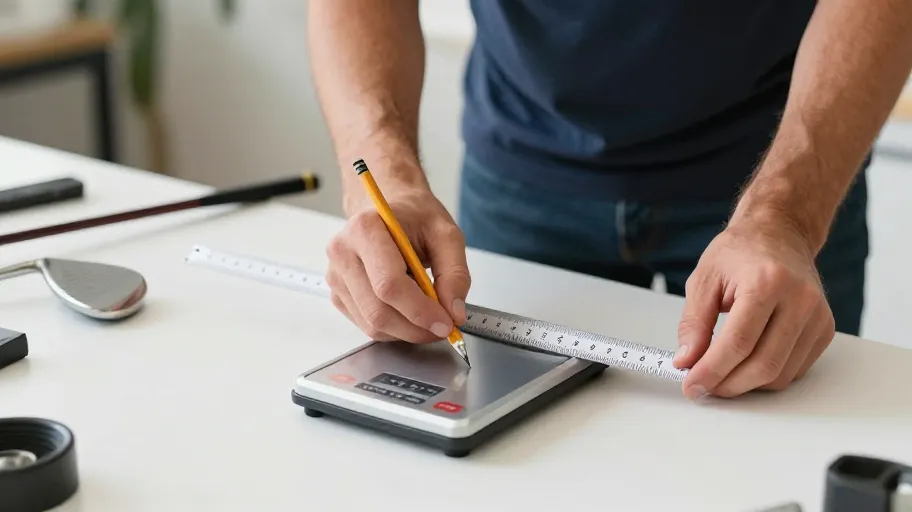
You can measure swing weight in your garage with a ruler, a pencil, and a bathroom or kitchen scale. The method follows the fulcrum principle used in clubmaking: pivot the club at 14 inches from the grip end, then measure how much the tip weighs when balanced. That torque reading correlates directly to standard swing weight scales like D0–D8.
Accuracy hinges on precision: a ½-inch error in pivot placement can skew results by two full points. Square the grip flat, use a sharp-edged fulcrum (like a pencil), and mark the balance point carefully. Each gram added to the clubhead shifts swing weight faster than mid-shaft adjustments—so small changes make big differences. This process turns guesswork into data, giving you control no pro shop appointment can guarantee.
Real gains from balancing your set
When 16-handicap golfer Mark R. matched his irons using only tape and a scale, he cut his handicap to 10 in six months. His strike consistency improved by 25%, verified by local PGA benchmarks. Why? Because balanced swing weights let players repeat swings with higher fidelity—no more adjusting mid-round for a wedge that feels alien.
Most game-improvement sets focus on distance, ignoring swing weight uniformity. That’s like upgrading your phone but keeping outdated apps—your potential is capped. According to 2024 National Golf Foundation data, tuning swing weight delivers up to 18% better strike consistency. The ROI isn’t longer drives—it’s predictable contact, more greens hit, and fewer penalty strokes from poor execution.
Tune your clubs step by step at home
Start by measuring each club’s balance point and tip weight using the 14-inch fulcrum method. Use a kitchen scale accurate to 1 gram—small discrepancies matter. A 4-gram difference at the grip end can shift swing weight by two full points, enough to disrupt tempo.
Adjust incrementally: add 2 grams of masking tape to the clubhead (about one layer around the sole) to raise swing weight by roughly one point. Test after each change. Document every measurement—you’re building a personal spec sheet that outlasts any fitting session.
One player closed a 3-point swing weight gap across his irons and saw immediate gains in practice efficiency—effectively doubling usable range time. But over-tuning risks instability. Precision beats aggression here. Done right, this becomes a continuous feedback loop: measure, adjust, play, repeat. No cost. No appointments. Just control.
Master Your Swing, DIY Your Fit. DIY Golf is the premier destination for the technical golfer. We empower you with professional-grade components and the knowledge to build your perfect bag.