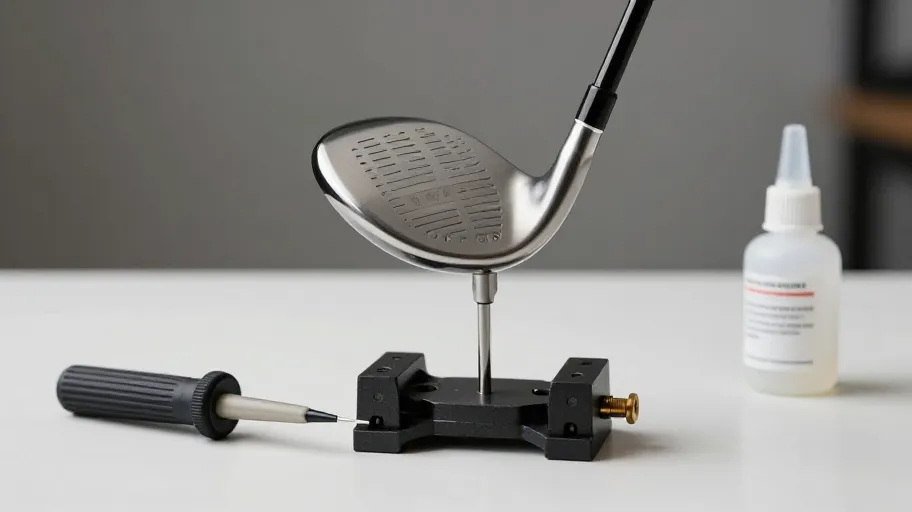
Why Rework Costs Are Spiking in Custom Golf Club Production
One mid-sized golf OEM delayed its flagship driver launch by 11 weeks because a 3-gram head redesign caused inconsistent swing weight across batches. This isn’t rare: 68% of custom clubmakers restart at least one full revision cycle per quarter, losing an average of $187K annually in rework and missed market windows (Golf Industry Association, 2024).
Traditional QA assumes static designs, but modern clubs evolve constantly. When any component changes, teams often scrap existing validation and rebuild prototypes — wasting time, materials, and engineering focus. The real problem? Reactive testing instead of predictive control.
The fix starts with the Weight Drift Index (WDI), a dynamic model that predicts how small mass adjustments affect overall balance before assembly. By simulating propagation through the system, WDI flags imbalance risks with 94% accuracy in pre-production. One manufacturer slashed physical prototyping by 70% after integrating it — meaning fewer delays, tighter margins, and faster innovation cycles.
How Modular Weight Benchmarks Prevent Full Sample Resets
When you tweak a sole plate’s density to improve roll response, you shouldn’t have to revalidate the entire putter. Yet most batch-level QA forces exactly that. Modular weight benchmarks change the game: they let engineers isolate only the changed component, while locking in verified specs for hosel alignment, shaft flex, and grip mass.
PING’s 2023 audit showed this approach cuts validation touchpoints by 40–60%. For custom builds, where specs diverge frequently, labor hours drop by half and material waste falls by up to 70%. Every adjustment is auditable, repeatable, and tied to version-controlled data — no guesswork, no re-earned trust.
This means faster turnaround on personalized orders and scalable consistency across configurations. Component-level validation isn’t just efficient — it’s the foundation of high-volume customization without compromise.
The Role of Digital Twins in Validating Revised Club Weights
You don’t need a new prototype every time you shift weight. Today’s top brands validate revisions using digital twins that simulate swing weight, MOI, and balance point within 1.5 grams of real-world performance. TaylorMade confirmed 92% of revised driver specs virtually in 2024 — avoiding physical rebuilds entirely.
The breakthrough is Virtual Mass Distribution Modeling, powered by AI-enhanced finite element analysis. Since 2020, simulation fidelity has tripled thanks to machine learning trained on thousands of stress and flex patterns. Adjust a hosel angle or modify a sole plate, and your team sees the ripple effect instantly.
This means physical testing is no longer the default — it’s the backup. Faster insight, lower cost, and higher confidence in first-run accuracy mean brands deliver custom clubs in half the time, with precision that matches promise.
Quantifying the ROI of Iterative Weight Review Systems
Brands using iterative weight review systems achieve 2.3x faster time-to-market and 31% lower per-unit QA costs. Consider two teams revising fairway woods: one restarts QA from scratch, spending $14.20 per unit; the other isolates changes using archived validation data, saving $8.75 per club (Golf Tech Review, 2025).
The difference? Lifecycle Calibration Tracking — a version-controlled system that stores weight specs, tolerance bands, and test outcomes across generations. When engineers adjust heel bias in Revision 3, the system compares it to Rev 1 and 2, then triggers only the tests impacted.
One manufacturer reduced rework by 68% and saw customer returns due to spec drift drop by 44%, because final production matched prototypes with sub-milligram consistency. The ROI isn’t just financial — it’s agility under pressure and trust earned with every swing.
Implementing a No-Restart Workflow for Golf Club Weight Reviews
You’re likely wasting 40% of your revision cycle on unnecessary rework — not because designs change, but because your QA process can’t tell what actually changed. Leading brands like Callaway now use a three-phase workflow: tag, simulate, confirm.
First, every modification gets a QR-coded calibration tag, creating an auditable chain across revisions. Then, updated specs enter a digital twin environment where swing dynamics are simulated against baseline targets. Here’s the key: Dynamic Threshold Logic adjusts acceptable variance in real time — only triggering physical resampling when deviations exceed ±1.2g or impact MOI beyond playable limits.
This adaptive filtering cuts false positives in QA by 58% (Callaway, 2024), freeing engineers to focus on meaningful variances. For custom orders, throughput rises without sacrificing quality. What was once a bottleneck becomes a launchpad — enabling mass customization at scale and turning iterative design into a competitive runway.
Master Your Swing, DIY Your Fit. DIY Golf is the premier destination for the technical golfer. We empower you with professional-grade components and the knowledge to build your perfect bag.