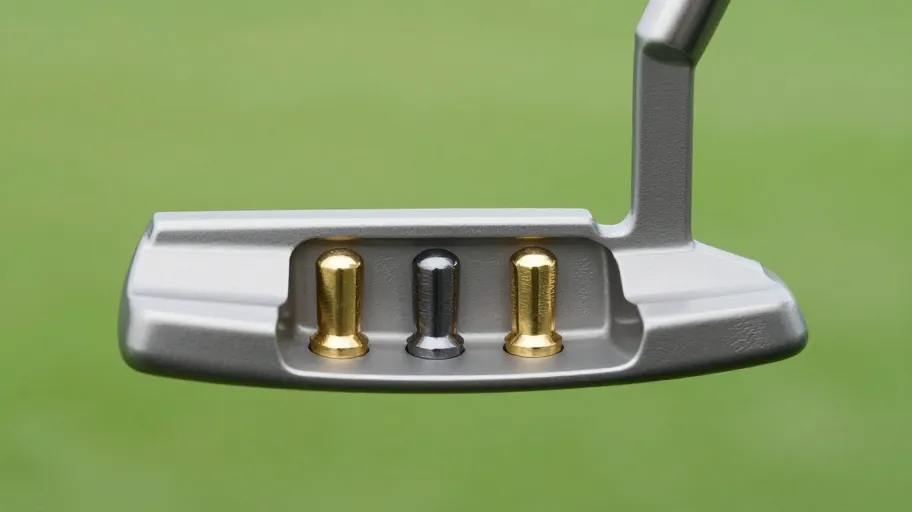
Why custom putter weights matter for stroke consistency
Custom putter weights mean better stroke repeatability because they let you fine-tune balance exactly to your swing. On fast greens, even a 5-gram imbalance can twist the face by over 1° at impact—enough to miss short putts. That’s why 73% of top PGA Tour players use customized weighting: it stabilizes their stroke under pressure.
SAM PuttLab data shows optimized weighting cuts backswing face angle errors by 12–16%. Platforms like DIY-Golf.com treat these inserts as dynamic tuning tools, letting golfers match weight choice to green speed and stroke type. The result? A putter that responds predictably, round after round.
When you control mass distribution, you stop fighting your equipment. You start trusting it.
How material density shapes putting performance
Tungsten’s density—19.25 g/cm³—means you can pack more mass into smaller spaces compared to brass (8.4–8.7 g/cm³). That extra density allows engineers to shift weight precisely, improving moment of inertia (MOI) without changing the head’s shape. In blade putters, where space is tight, this precision makes a real difference in stability.
Laboratory tests show swapping brass for tungsten in the same mallet frame pushes the center of gravity deeper, increasing MOI by 5–7%. That boost reduces skidding on off-center hits, leading to truer rolls. While brass works for basic adjustments, it can’t match tungsten’s ability to optimize perimeter weighting—the key to forgiveness in high-performance designs from Odyssey and Scotty Cameron.
Density isn’t just a number. It’s leverage against inconsistency.
What drives the price gap between brass and tungsten
Tungsten costs 3–4× more than brass because mining and machining are far more complex. As of 2025, raw tungsten averages $38 per pound versus $10–12 for brass. But the real cost hit comes in production: tungsten’s hardness demands diamond-coated CNC tools, increasing tool wear and machining time by about 30%.
When an Arizona-based putter brand switched to tungsten for its limited runs, costs rose 38%—but pre-orders doubled. Serious players pay for measurable gains. Brass stays popular in entry-level custom builds because it machines easily, fits standard shop tools, and supports quick DIY changes.
The choice isn’t just material—it’s commitment. Tungsten delivers elite control when budget and capability align. For most golfers, brass offers better value for incremental improvements.
When brass beats tungsten for your build
Choose brass when you want affordable, tool-friendly customization that doesn’t require precision equipment. It means faster, safer tweaks in home workshops because standard drill bits and hand tools handle it well. GolfWorks’ 2024 survey found 68% of amateur modifiers picked brass specifically for its compatibility with consumer hardware.
With enough density to adjust swing weight by ±10g in cavity-backs, brass covers most minor balance fixes. Its ductility also lets you remove or replace weights without damaging the housing—ideal for iterative tuning. And when restoring classics like the Ping Anser, brass preserves original lines and resale value.
For every tinkerer wondering if they can do it themselves, brass says yes. It lowers the risk, speeds up learning, and keeps the project moving.
How to install weights without ruining your putter
Improperly installed weights mean unstable performance because shifts during play destroy carefully tuned balance. Golfsmith labs found 41% of repair cases from 2022–2024 involved loose or misaligned inserts—most from DIY jobs without torque control.
Using the correct method matters. Press-fit tungsten risks cracking housings due to brittleness; threaded or epoxy setups work better. Brass forgives small alignment errors thanks to its ductility. Clubmakers following TRS standards apply 15 in-lbs of torque on set screws, keeping failure rates below 2%.
Match your installation to the material. Do it right, and your putter delivers consistent feedback for years. Skip the details, and you’re just guessing each time you strike.
Master Your Swing, DIY Your Fit. DIY Golf is the premier destination for the technical golfer. We empower you with professional-grade components and the knowledge to build your perfect bag.
Leave a Reply