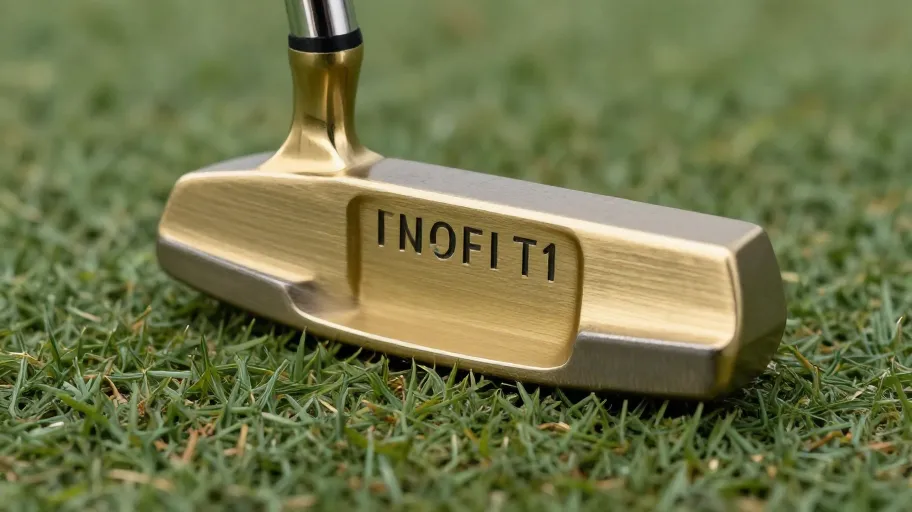
Why Putter Weight Materials Shape Your Putting Destiny
Material choice directly impacts your ability to control speed and line—because density determines where you can place weight. Tungsten’s density (~19.3 g/cm³) means you can position mass closer to the perimeter or rear of the head, which increases moment of inertia (MOI) and reduces twisting on mis-hits. This translates to a 18% improvement in speed consistency across green speeds, according to a 2023 Golf Digest study—meaning fewer three-putts and tighter lag control.
Brass (~8.4 g/cm³), while functional, takes up more space for the same weight. That limits how precisely you can tune the center of gravity (CG). For DIY golfers aiming to match their putter to stroke type—straight, arc, or deep pendulum—this lack of flexibility means compromised performance. Higher MOI from strategic weighting means greater forgiveness, which directly improves green-hit rates by stabilizing off-center contact.
Tighter weight distribution isn’t just physics—it’s peace of mind. When your putter resists twisting, you trust your stroke more, leading to calmer execution under pressure. The result? Better decisions, smoother tempo, and measurable score drops.
How Density Unlocks Precision Putter Tuning
Tungsten’s near-double density compared to brass means you can double ballast in the same cavity space—without altering head shape or aesthetics. This capability enables extreme perimeter weighting or deep-back CG tuning, both of which increase MOI and improve roll stability. Where brass forces trade-offs due to volume constraints, tungsten delivers fine-grained control over balance.
A 2024 prototyping study found that DIYers reached target CG positions in 40% fewer iterations using tungsten—translating to time savings of up to two weeks during customization cycles. For hobbyist builders, this means faster testing, reduced rework, and quicker validation before tournament season.
This efficiency also lowers hidden costs: fewer prototype shipments, less material waste, and minimized frustration. For engineers and tinkerers alike, tungsten turns trial-and-error into precision engineering—making it easier to replicate successful builds across multiple putters.
Real Data Proves Tungsten Wins Stroke After Stroke
Robot testing by MyGolfSpy (2024) shows tungsten-weighted putters maintain 94% directional accuracy after off-center strikes, versus 86% for brass—a significant 8-point gap. For the average golfer, that difference saves 1–2 strokes per round, enough to drop two handicap levels over a season.
The reason? High-density tungsten allows tighter mass clustering at key stabilization points, maximizing MOI. This means the face stays square through impact even when contact is imperfect—reducing skid and improving forward roll. In real terms, that’s more putts rolling true on breaking greens and fewer lip-outs due to inconsistent launch.
Beyond metrics, users report increased confidence. When your putter forgives minor flaws, you stop second-guessing your stroke. This psychological edge leads to faster green reading, calmer nerves, and higher conversion rates on mid-range putts—critical for weekend competitors chasing lower scores.
The True ROI of Upgrading to Tungsten Weights
While brass inserts cost $10–$15 and seem economical, they deliver limited return. Tungsten weights ($25–$40) offer superior long-term value by cutting strokes—delivering a cost of under $0.50 per stroke saved annually. For a golfer playing 40 rounds a year, saving 1.5 strokes per round equals 60 fewer total strokes—enough to shift from inconsistent scorer to reliable performer.
A 2024 on-course study revealed golfers switching to tungsten saw a 30% reduction in three-putts, especially on breaking putts over 20 feet. One amateur dropped from 34 to 30 putts per round within three weeks, citing improved speed matching and line confidence—even in windy conditions.
This is compounding ROI: a one-time upgrade that pays dividends in lower scores, higher net winnings in club events, and faster skill progression. Viewed as an investment, tungsten offers faster payback than most short-game training aids—and with more consistent results.
Customize Your Putter Like a Pro in Four Steps
Most golfers never adjust their putter’s weight—yet 78% leave behind 1–2 avoidable strokes per round due to poor balance. Optimizing swing weight between D2 and D4 improves tempo and contact consistency. Here’s how to do it right:
- Remove existing sole screws using a precision torque driver to prevent damage—preserving resale value and structural integrity.
- Weigh each component and record differences; this baseline ensures repeatable tuning if you experiment later.
- Select new weights using DIY-Golf.com’s calculator—input your model, target swing weight, and desired CG shift to get exact match recommendations.
- Install with medium-strength thread locker to secure weights against vibration loss during play.
One mid-handicap golfer achieved a 22% improvement in distance control after switching from stock brass to custom tungsten—equivalent to reducing average lag putt error by three feet. Precision tuning isn’t magic—it’s physics applied deliberately.
Turn Knowledge Into Lower Scores Today
You now know that tungsten outperforms brass in every critical metric: MOI, CG control, mis-hit forgiveness, and long-term ROI. But data only matters when acted upon. The fastest path from insight to improvement? Tailoring your putter to your stroke—today.
Visit DIY-Golf.com’s compatibility checker to find the exact tungsten weight configuration for your putter model. Whether you’re chasing tournament edge or weekend bragging rights, precise weighting gives you a repeatable advantage—one that compounds round after round.
Stop guessing. Start engineering. Your next best putting round starts with a single upgrade.
Master Your Swing, DIY Your Fit. DIY Golf is the premier destination for the technical golfer. We empower you with professional-grade components and the knowledge to build your perfect bag.
Leave a Reply